News
How to Tokenize Real Estate in the EU (2026 Guide)
How to tokenize real estate in the EU, step by step: choose the legal wrapper, structure the SPV, onboard investors and complete the register entry.

Lukas Wipf
CPO & Co-Founder
last updated on
Share
90% of Clients start with a free personal strategy
On this page
Contact Us
ONINO provides infrastructure for digital & tokenized financing to make your next financing a success.
Quick Takeaway
Real estate is worth $380T globally but remains one of the least accessible asset classes. Tokenization converts property ownership into fractional digital securities via an SPV structure, cutting minimum investments (e.g., €2,000 per token), reducing admin costs by 20-40% through smart contract automation, and enabling secondary market transfers in 1-3 days instead of 60-120. The market is projected to reach $1.5T by 2034. EU compliance runs through MiFID II, MiCA, and Germany's eWpG, with platforms required to hold proper authorization and implement full KYC/AML.
How to Tokenize Real Estate in the EU: Step by Step (2026 Guide)
Tokenizing real estate means issuing a stake in a property, or in the company that owns it, as a digital security instead of a paper certificate or a spreadsheet entry. In the EU this can take the form of a tokenized subordinated loan, a tokenized bond, or a security token, depending on how the offering is structured, and each form carries its own prospectus and disclosure rules. This guide walks through how the process works, step by step, from choosing the legal wrapper to going live. Tokenization changes how the stake is issued and recorded. It does not change what the investor actually owns.
Real estate is the largest asset class humans own, worth roughly $380 trillion worldwide according to Savills. Yet most people cannot invest in it directly, because a single property costs more than most people earn in a decade. Tokenization is the attempt to fix that mismatch: it splits a property, or a claim on its income, into digital security tokens small enough for anyone to buy.
The money is starting to follow the idea. Tokenized real estate was worth less than $300 billion in 2024, and Deloitte's Center for Financial Services expects it to grow more than tenfold by 2035, to around $4 trillion. For European property owners and developers, that raises one practical question, and it is the question this guide answers: how does real estate tokenization actually work in the EU, and what does it take to tokenize a property in 2026?
We will take it in order: what tokenization is, how it works under the hood, the deals that have already happened, a step-by-step path for issuers, the EU rulebook, and an honest look at what tokenization does and does not solve. One note before we start: this article reflects patterns we keep hearing in structuring conversations with issuers and counsel. It is general information, not legal advice, and ONINO is a software provider, not a law firm.
What is real estate tokenization?
Real estate tokenization means converting rights in a property, or in the income it produces, into digital tokens recorded on a blockchain. Instead of one investor buying an entire €2 million apartment building, 100 investors can each hold a €20,000 stake, and the token is the digital proof of who holds what. Each token can then be held, transferred, or sold, privately or on a secondary market.
That one change moves three groups at once. Investors get a lower entry price and a realistic way to spread money across several properties instead of betting everything on one. Owners and developers get access to a wider pool of capital, because the people who can afford €1,000 vastly outnumber the people who can afford €1 million. Regulators get a cleaner record, since every transfer is logged in one register instead of scattered across paperwork.
The part most explainers skip is that the token itself is a wrapper, not the product. Underneath every serious tokenized property sits a familiar legal instrument, such as a bond or a participation right, and the token is simply its digital form. Understanding that wrapper is what separates a compliant offering from an expensive mistake, which is why the mechanics deserve a closer look.
A real estate token is a security, or a regulated investment instrument, not a share of the land register entry. Depending on how the offering is structured, it is a tokenized subordinated loan, a tokenized participation right, or a tokenized bond, and each form is documented and regulated the same way its non-tokenized version already is. Owning a token means holding that instrument. It does not mean owning a fraction of the building's title deed, and no EU country currently lets a token replace the land register.
Why a token cannot carry the property title itself
The reason the token stays a wrapper is legal, not technical. In Germany and most EU countries, ownership of land changes hands only through a notarized deed and an entry in the state land register (the Grundbuch in Germany), and those registers do not read blockchains. A token can move between wallets in seconds, but the name in the land register stays exactly where it was, so buying the token does not make anyone the legal owner of the building.
Securities law and property law have also modernized at very different speeds. Lawmakers have opened securities to purely digital form, which is why a bond no longer needs a paper certificate, but transferring land ownership still runs through national formalities in every EU member state, and no land register today accepts a token transfer in their place. A related observation from structuring conversations: much of the confusion in this market is vocabulary, because "tokenized property" sounds as if the deed itself sits on chain, when in practice it never does.
The market's answer is indirection. The property goes into a dedicated company once, with notary and land register entry done the classic way, and what gets tokenized are claims against that company: a bond, a participation right, or shares in the vehicle. Tokens can then change hands daily while the land register entry never moves, and setting up that dedicated company is exactly where the mechanics begin.
How does real estate tokenization work?
The structure usually begins with a special purpose vehicle, or SPV: a separate legal entity created to hold the property. The property is transferred into the SPV through normal conveyancing, and investors buy into the SPV rather than into the building directly. This separation protects investors, because the asset sits in a clean entity that does nothing else, and it keeps token trading from ever touching the land register.
The SPV then decides what investors actually receive, and this choice matters more than the technology. The instrument can be a bond that pays fixed interest, a profit-participation right (Genussrecht) that passes through rental income, or in some setups a share in the vehicle itself. A recurring theme in structuring conversations is that the investor's cash-flow rights can be written almost identically across very different structures, while the setup and running costs differ by a factor, not a percentage. The rights live in the instrument; the token just carries them.
Once the instrument is defined, the tokens are issued and smart contracts take over the repetitive work. Income distributions to hundreds of holders, lock-up periods, and transfer restrictions run as code instead of as manual back-office tasks, which is what makes a 500-investor cap table administrable at all.
The final layer is compliance, and it is what separates a tokenized security from crypto speculation. Every investor passes KYC and anti-money-laundering checks before receiving tokens, and every later transfer is validated against that registry. Some offerings restrict which investor types or countries can participate, and the platform enforces those rules automatically. How well this layer holds up is easiest to judge by looking at the deals that have already run through it.
Real examples of tokenized real estate
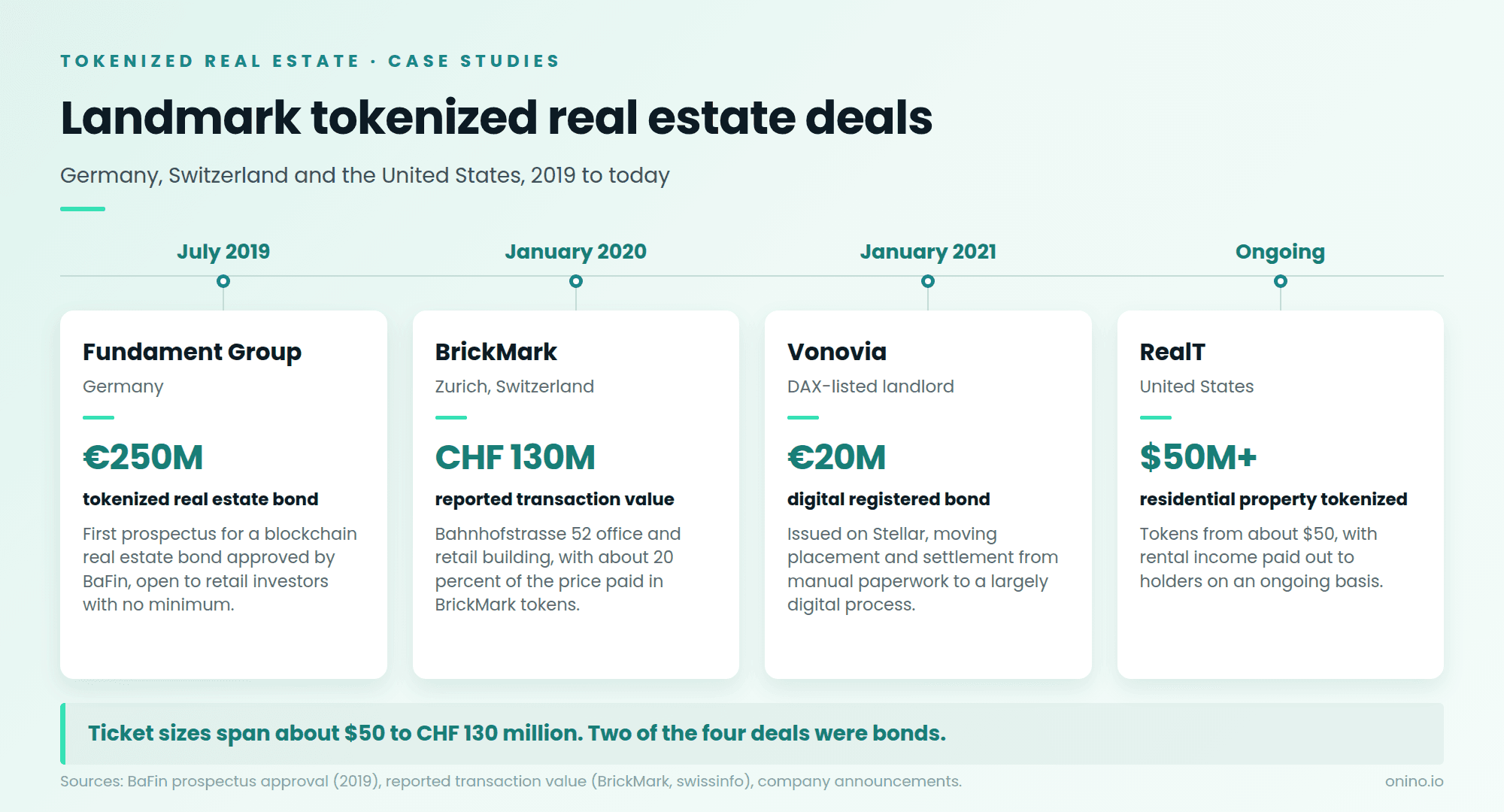
As shown in the graphic, €250 million in 2019, CHF 130 million in 2020 with 20 percent paid in tokens, €20 million in 2021, and over $50 million ongoing from $50 tickets. Two of the four were bonds. It already works in practice.
Germany produced one of the first regulator-approved cases. In July 2019, Germany's Fundament Group received BaFin approval for a €250 million tokenized real estate bond on Ethereum, the first blockchain-based real estate bond prospectus approved in Germany, open to retail investors. The approval mattered more than the volume, because it showed that a token offering could pass a full prospectus review rather than living in a legal grey zone.
Switzerland followed with scale. In January 2020, BrickMark bought the Bahnhofstrasse 52 office and retail building in Zurich in a transaction reported at around CHF 130 million, with roughly 20 percent of the price paid in BrickMark's own tokens, at the time the largest real estate transaction settled partly in tokens. This showed tokens working at the top end of the market, in a prime-street commercial deal between professional parties.
Listed players tested the rails next. In January 2021, Vonovia, Europe's largest residential landlord, issued a €20 million digital registered bond on the Stellar blockchain, moving placement and settlement from manual paperwork to a largely digital process. When a DAX-listed company uses tokenized debt for ordinary refinancing, the technology has stopped being an experiment.
The retail end of the model is easiest to see in the United States, where RealT has tokenized more than $50 million of residential property and sells tokens from about $50, paying out rental income to holders on an ongoing basis. Together the four cases answer part of our opening question: tokenization already works in practice, at ticket sizes from $50 to $130 million. What they do not show is how to run your own offering, which is where the step-by-step view comes in.
How to tokenize real estate: step by step
Step 1: Start with distribution, not structure.
The most consistent lesson from structuring conversations is that no advisor can pick the right setup before you know who you are selling to. Retail investors almost never probe the fine print of a structure; an institutional investor's lawyers will decide the entire deal on it. Selling to retail argues for a lean setup, selling to institutions argues for the heavier one, and issuers who choose the structure first routinely pay for a rebuild later.
Step 2: Evaluate the asset.
Tokenization suits assets with steady, explainable cash flow: multi-unit residential, commercial offices, hotels, or development projects with a defined revenue timeline. Size sets a floor here: structuring and compliance costs shrink with the building only so far, because a base of legal and setup work remains whatever the asset is worth. In practice that puts the economic floor for a single-asset offering at roughly €500,000.
Step 3: Choose the instrument.
A bond, a participation right, or a fund share can each carry the same economics to the investor, at very different cost levels. One test we keep hearing decides much of it: if you raise money for one named asset that investors choose, you stay outside collective-investment rules; if you collect money first and decide later where it goes, you are running a fund, with everything that brings.
Step 4: Decide your prospectus route.
EU offerings face a fork at €100,000. Set the minimum ticket above it and the prospectus requirement generally falls away, but you have limited yourself to large tickets. Go below it and you need a prospectus or an exemption, which is exactly what buys you retail investors and the EU passport. Issuers planning a pipeline rather than a single deal often use a base prospectus: one approval, then each new issuance is a short notification rather than a fresh review. Passporting itself is likewise a notification between regulators, where the real workload is translations, not months of new approvals.
Step 5: Choose the platform and the licensed partners.
The software itself does not need a license; the regulated functions around the offering do, such as maintaining a crypto-securities register, custody, or regulated distribution. ONINO specializes in EU-compliant real estate tokenization as the software layer, with those licensed functions running through pre-integrated partners, so the issuer does not have to source a registrar, custodian, or liability umbrella (Haftungsdach) one by one. In the Haftungsdach model, investors see your brand and your flow, while the licensed partner stands behind the regulated activity in the terms of service.
Step 6: Issue, onboard, and manage.
Investors register, pass KYC, and subscribe; the platform tracks every check for the audit trail. After closing, the ongoing work is distributions, reporting, and investor votes on major decisions such as refinancing or sale, most of which runs automatically. Speed is the quiet advantage here: instead of waiting for one buyer with €10 million, a developer can fundraise from 500 investors in weeks.
Every one of these steps leans on the EU rulebook, so it is worth knowing which regulation does what.
The EU rulebook in 2026
The most common misconception is that MiCA governs tokenized real estate. It generally does not: MiCA covers crypto-assets that are not financial instruments, and a token that carries ownership, income, or a claim on an asset is a financial instrument, which places it under securities law, including MiFID II (Markets in Financial Instruments Directive) for the firms that provide investment services around it. Counterintuitively, this is good news for issuers: issuing your own instrument does not require a license, because licenses attach to the services around the instrument, such as brokerage, custody, and register-keeping, not to the act of issuing.
Germany went furthest in making the digital form official. Germany's electronic securities law, the eWpG, in force since June 2021, lets bonds exist as purely electronic securities, including crypto securities issued on a blockchain, with no paper certificate. The crypto-securities register is maintained by a BaFin-authorised registrar; the permission sits with that partner, not with the software provider whose platform the issuer uses.
The Prospectus Regulation sets the disclosure rules for public offers across all 27 member states, which is what makes the base-prospectus and passporting mechanics from Step 4 possible: one approved document, reusable across issuances and borders. Alongside it, ECSPR, the EU crowdfunding regulation, offers a separate route for platforms that raise up to €5 million for third-party projects, a common frame for smaller property raises.
The genuinely hard wall sits after issuance. Primary issuance of your own instrument needs no license, but the moment anyone brokers tokens between investors or holds investor positions, that activity is licensed, and this holds across regimes, so switching token frameworks does not remove it. This is worth stating plainly because investors always ask about the exit before they enter, and honest answers about secondary market liquidity win more trust than promised 24/7 trading.
EU rules at a glance (2026)
Germany, prospectus exemption: EUR 12 million. Public offers up to EUR 12 million over 12 months need a three-page Wertpapier-Informationsblatt (WIB) filed with BaFin, not a full prospectus. The threshold rose from EUR 8 million on 5 June 2026. National only, so no EU passport.
Crowdfunding (ECSPR): EUR 5 million. Per project owner, over any 12 months, counting crowdfunding raises, loans and prospectus-exempt offers together. Unchanged in 2026. Between EUR 5 million and EUR 12 million you can still use a WIB, but not an ECSPR-licensed platform.
Above that: full prospectus under the Prospectus Regulation, which is also what buys the EU passport.
Register and permission: with the partner. A German tokenized security sits in a crypto-securities register under the eWpG, and keeping that register needs a BaFin permission. It sits with the registrar, not with the software provider whose platform the issuer uses.
Rules as at 22 September 2026. Confirm the current position with your own counsel.
What tokenization actually buys you
Fractional access is the headline benefit, and it runs in both directions. A €500,000 property can be split among 250 investors at €2,000 each, which opens real estate to people it has historically excluded, and simultaneously widens the funding pool for the issuer far beyond their local bank and a handful of wealthy buyers.
The quieter benefit is operational. Distributions, the investor register, and compliance checks run as software rather than as spreadsheets and notary appointments, which is what makes hundreds of small investors economical to manage in the first place. Transfers that settle in days rather than the months a traditional property sale takes are a real gain, provided a buyer exists, and that caveat matters enough to get its own section.
The risks tokenization does not solve
Liquidity is a promise about demand, not about technology. A token can change hands in minutes, but if the property behind it sits in a declining market, finding a buyer at fair value can still take weeks, and secondary trading venues for property tokens remain thin across the EU. Tokenization removes friction from the transfer; it cannot create the buyer.
Valuation carries over from the analog world unchanged. Token prices inherit the appraisal of the underlying property, appraisals are opinions, and disputes over them have followed tokenized deals just as they follow traditional ones. Independent, defensible valuations are as essential as ever.
Two younger risks come with the technology itself. Smart contracts can contain bugs, and audits reduce that risk without eliminating it. And the track record is short: the oldest offerings above date from 2019, so nobody can show you a 20-year performance history of tokenized real estate, because one does not exist yet.
Why now: reading the $4 trillion forecast properly
Deloitte's April 2025 forecast is the strongest single number in this market, and it rewards a careful read. Of the $4 trillion projected for 2035, about $2.39 trillion is tokenized loans and securitizations and around $1 trillion is tokenized private real estate funds, with only a small slice from tokenized development projects. In other words, the analysts expect most tokenized real estate to be debt and fund structures, not individual flats sold coin by coin.
Europe's own history fits that reading. The landmark deals above, Fundament's €250 million approval and Vonovia's €20 million issuance, were both bonds, and the eWpG regime that makes German issuance clean is a securities regime. For an EU issuer deciding what to tokenize first, the message from both the forecast and the case law of the market is the same: the near-term playbook is tokenized real estate debt and fund-style structures with clear cash flows, which happens to be exactly where the regulation is most settled.
Where ONINO fits
ONINO is white-label financing infrastructure: a software platform that property companies, developers, and financial institutions use to run their own compliant financing and digital-securities offerings under their own brand. The licensed functions an offering needs, such as the crypto-securities register, custody, payments, and a liability umbrella (Haftungsdach) for regulated distribution, run through pre-integrated partners, so issuers do not assemble that stack themselves. Clients bring their own deals and their own investors; ONINO provides the rails. Project developers and asset managers can see how this applies to them on our page for real estate issuers.
Tokenization on ONINO is optional per offering, one rail among several. The same platform covers non-tokenized investment products such as subordinated loans (Nachrangdarlehen) and participation rights (Genussrechte), classic securities with an ISIN, and digital and crypto securities under the eWpG, and a single issuer can mix rails or run a classic tranche alongside a tokenized one. Real estate funds and developers can brand the platform as their own offering, with investor onboarding, KYC, and reporting included; ONINO's infrastructure has processed more than €50M in tokenized volume, and platforms go live in under 24 hours. See what ONINO provides for each step on our real estate tokenization solution page.
For further reading, see the honest truth about real estate tokenization, a closer look at what secondary markets deliver for property tokens today.
The verdict
Ultimately, real estate tokenization in the EU is no longer a technology question. The rails work, the regulation is written, and issuers from a Berlin startup to Europe's largest landlord have used them, so the question this guide opened with has a direct answer: tokenizing property in 2026 is a structuring exercise, done in weeks on existing infrastructure, not a research project. Of everything above, one point deserves to be remembered first: structure follows distribution, because the audience you sell to determines the instrument, the prospectus route, and the cost of everything else. The next move belongs to property owners and asset managers: decide who your investors are, and the rest of the stack, legal and technical, can be assembled around them.
This article shares general patterns from the market and from structuring conversations. It is not legal, tax, or investment advice; issuers should consult their own advisors for their specific case.
General information only, accurate at the date shown. Not legal, tax or investment advice. Confirm your own position with qualified counsel.
Want to learn more how this can be applied to your business?
Read related Articles
How to tokenize real estate in the EU, step by step: choose the legal wrapper, structure the SPV, onboard investors and complete the register entry.


