REGULATION BASICS

Which parts of my raise are regulated?

Which parts of my raise are regulated?

Which parts of my raise are regulated?

Regulation is less complicated than it sounds. Our platforms are designed around the EU frameworks that you might come across in your raise: MiFID II , MiCAR , ECSPR and more. Which rules affect you most depends on what you're raising for.

What you tell your investors

Investors will need to be handled clear information about your offer and its risks; you'll need to provide one main disclosure document, the terms of the instrument, and subscription documents.
We'll break these down as you read on.

Who you sell to

Every investor has to be identified and checked before they can invest. They're the same KYC/AML checks you see on crypto exchanges, and it's built into the platform. Where your investors live and whether they're private or professional decides which rules apply to them.
The same goes for how you advertise to them.

How investor money is handled

Every payment an investor makes has to be tracked and recorded safely. Those are licensed jobs, done by payment providers, custodians and registrars, much like a bank looks after your savings. These partners are already connected to the platform, so you don't have to find them yourself!

When you choose what to offer

Different products follow different rules. Selling a bond isn't the same as selling fund units or a crypto-asset. Whether you tokenize it or not, what you sell determines if securities rules, fund rules or MiCAR apply. We'll explain each one further down.

INVESTOR DOCUMENTS

What do the investors need from me?

What do the investors need from me?

What do the investors need from me?

Every offer needs one main document that explains the details to investors. Which one you need depends on what you're selling, how much you're raising and who you're selling to.

Raising more than €12M

If you offer bonds or shares to the public and raise more than €12M in 12 months, you need a full prospectus under the EU Prospectus Regulation. The local regulator, BaFin in Germany, approves it before your offer goes live. Offers made only to professional investors don't need one.

Raising through a crowdfunding platform

ECSPR is the EU's rulebook for crowdfunding platforms. If you raise up to €5M a year on a licensed platform, you need a key investment information sheet (KIIS) of up to six pages, covering the terms, risks and costs. Whoever holds the platform's licence checks it before it goes live.

Issuing crypto-assets

MiCAR is the EU's rulebook for crypto-assets, digital tokens like utility tokens that aren't securities. Your investors need a white paper explaining the token, its rights and risks, and your local regulator must be notified first. Private investors can usually cancel within 14 days.

INVESTOR ONBOARDING

Paperless KYC/AML onboarding for every investor

Paperless KYC/AML onboarding for every investor

Paperless KYC/AML onboarding for every investor

Every investor goes through KYC (know your customer) and AML (anti-money laundering) checks inside the platform before they can invest. They upload an ID and complete a short liveness check. They're also screened against sanctions lists and lists of politically exposed persons, people in public office who need extra checks under anti-money laundering rules.

Once an investor passes, their profile decides how the rest of the investment works. Where an investor lives and whether they're private or professional sets which offers they see, which suitability questions they answer and which documents they receive. The platform applies those rules automatically, so your team only reviews the cases that need a person to look at them.

Investor management card showing total investors and weekly growth on the ONINO platform

WHAT YOU OFFER

Which rules apply to what I'm selling?

Which rules apply to what I'm selling?

Which rules apply to what I'm selling?

Every product falls under its own set of rules. Whether you sell bonds, fund units or crypto-assets decides if securities rules, fund rules or MiCAR apply, tokenized or not.

Selling bonds or shares

Bonds and shares are securities, and a tokenized bond is still a bond. Securities rules decide how you disclose the offer and who's allowed to sell it: anyone advising or brokering needs a MiFID II licence or works under one. In Germany, digital securities sit on an electronic register under the eWpG.

Selling fund units

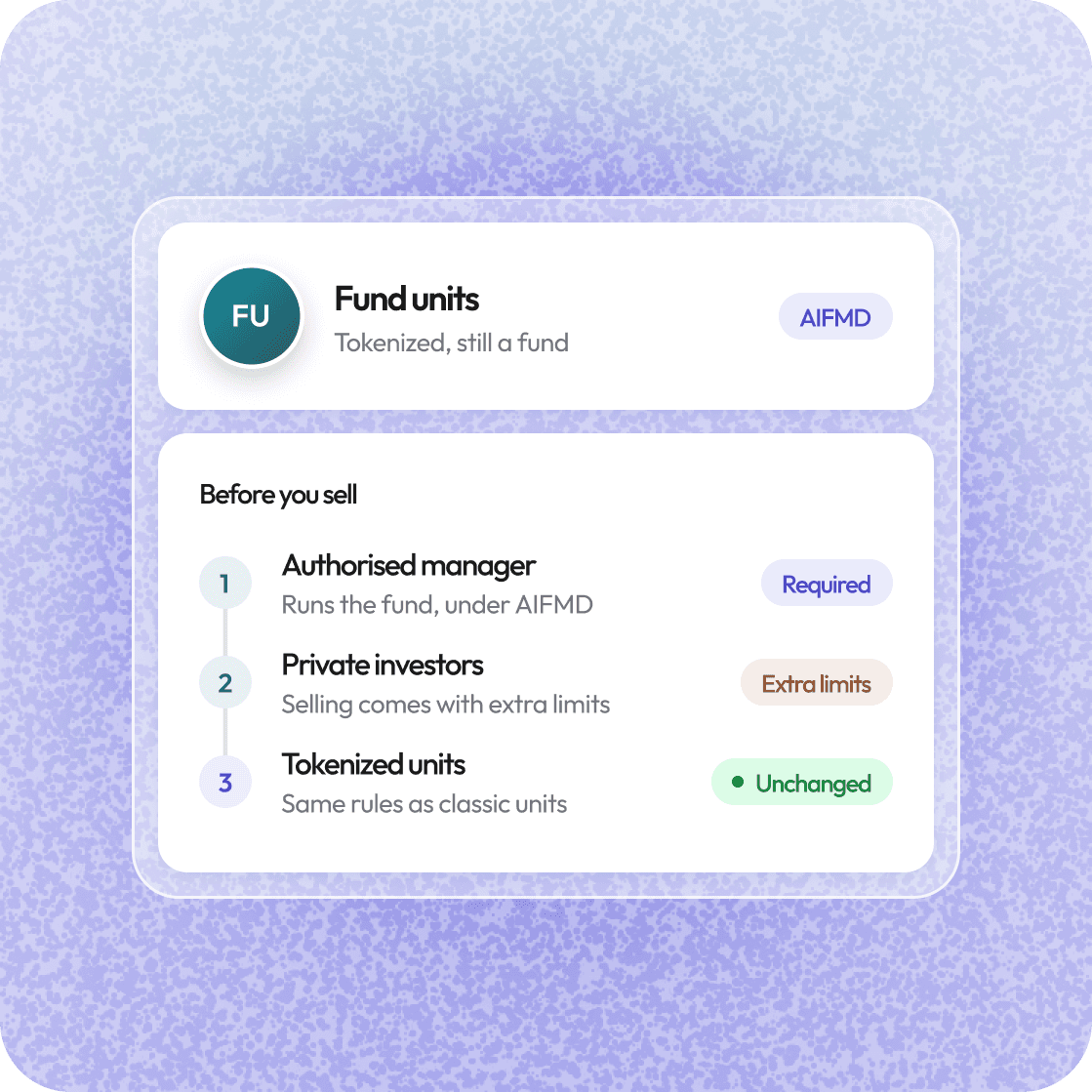
Pooling investor money into a fund brings in fund rules: the EU's AIFMD and Germany's Capital Investment Code. The fund has to be run by an authorised fund manager, and selling to private investors comes with extra limits. Tokenizing the units doesn't change any of that.

Selling fund units

Pooling investor money into a fund brings in fund rules: the EU's AIFMD and Germany's Capital Investment Code. The fund has to be run by an authorised fund manager, and selling to private investors comes with extra limits. Tokenizing the units doesn't change any of that.

Subordinated loans or participation rights

These aren't securities, so Germany's Investment Products Act (VermAnlG) applies instead. A public offer needs a prospectus approved by BaFin and a three-page information sheet for investors. It's a common route for renewable energy and real estate projects.

Investor management card showing total investors and weekly growth on the ONINO platform

PAYMENTS AND CUSTODY

Every euro and every unit, handled by licensed partners

Every euro and every unit, handled by licensed partners

Every euro and every unit, handled by licensed partners

When an investor subscribes, their money goes through a licensed payment institution, which collects the payment and passes it on once the offer closes. The same route works in reverse for interest and other payouts, so every payment in and out is tracked and recorded. Investors see their holdings, payments and documents in their own portal, and your team sees the same records in the dashboard.

Who records ownership depends on the instrument. Classic securities with an ISIN are held by a depository bank. Digital securities sit on an electronic register kept by a licensed register-keeping institution. Tokenized securities go on a crypto-securities register maintained by a BaFin-authorised registrar and are held by a licensed crypto custodian. You contract these partners directly, but they're already connected to the platform, so you don't have to find or integrate them yourself.

REGULATORY THRESHOLDS

Know these three numbers before you raise

Know these three numbers before you raise

Three numbers that decide which rules apply
These thresholds tell you which documents your raise needs and who has to approve them. That's what drives most of the cost and time, before you choose an instrument or a technology.

€ 12 million

Prospectus Exemption

€ 5 million

The floor a country can set

€ 5 million

ECSPR cap

FAQ

Questions issuers ask

If your question is not here, the deeper guides linked above go further.

RELATED SOLUTIONS

Find Related Solutions
Tokenization

Digital Securities

Digital Securities

White-Label