Einblicke
Alternative business financing: 8 non-bank instruments for European SMEs in 2026
The 8 most common alternative business financing options in Europe - tokenized securities, mezzanine, direct bonds, ECSPR crowdinvesting - plus a 2026 decision framework.

Kristina Stark
Junior Growth Manager
Zuletzt aktualisiert

Kristina Stark
Junior Growth Manager
Teilen
Kontaktieren Sie uns
ONINO bietet Infrastruktur für digitale & tokenisierte Finanzierung in der EU und der Schweiz an.
Auf dieser Seite
TLDR;
European SMEs are leaning on alternative business financing in 2026: bank capital rules tightened under the EU's Basel III finalisation (CRR3), ECB SAFE data show firms expecting harder loan access, and venture funding stays concentrated in London, Berlin, and Paris. Europe now produces more new founders than the US, so the bottleneck is the capital stack, not the supply of companies. The right instrument among the eight compared here depends on five variables: ticket size, stage, dilution tolerance, time-to-close, and regulatory readiness. Tokenized securities offerings stand out as one wrapper covering €300K–€900M across debt and equity, and the only option that maps onto every founder-stage route.
How were the eight instruments chosen and scored?
Each instrument is scored across 5 variables: ticket-size range, time-to-close, dilution effect, regulatory load, and best-fit issuer profile. The eight made the cut because each is legally distinct and reaches a different slice of the European issuer population.
What's in scope. Debt, equity, and hybrid instruments available to a European company raising roughly €100K to €900M in 2026.
What's out. Pure VC, angel, and grant routes (that's a founder-stage frame); short-term working-capital products like factoring and merchant cash advances; and public IPOs.
Why are European companies turning to non-bank funding in 2026?
Because banks have gotten harder to borrow from. Three things are pushing companies to look elsewhere.
Tighter bank rules. New capital rules (the EU's CRR3, implementing the final Basel III standards, live since January 2025) raised banks' overall capital requirements and made credit committees more selective. SME lending is partly cushioned by the retained SME supporting factor, but the practical stance toward new SME credit has tightened.
Credit is drying up. The ECB's own SAFE survey confirms it: in Q1 2026, a net 4% of firms expected their access to bank loans to get worse in the coming months, up from 1% the quarter before, with SMEs more pessimistic than large firms.
Policy is helping, but demand isn't fading. The EU and KfW launched the SAFE fund in January 2026 - a guarantee of up to €135M for alternative finance to smaller businesses, aimed at the EU's neighbourhood and enlargement regions rather than domestic EU SMEs - but the appetite for alternative funding inside the EU isn't going away. It's structural now.
Ask companies directly and they say the same things: bank lending rules are too restrictive, they need working capital faster, and Europe's capital markets are still a patchwork that's hard to navigate.
Then there's where the money actually is. In Europe, venture funding clusters in London, Berlin, and Paris. If you're a founder anywhere else, you're fighting over a smaller piece of the same pie. Pan-European tools like tokenized securities, ECSPR crowdinvesting, and direct digital bonds get around that by letting you reach investors across the whole continent in a single offering, instead of chasing the same handful of funds in three cities.
What structural fundraising gaps push founders toward alternative finance?
European founders turn to alternative finance not only because banks pulled back, but also because the conventional capital stack systematically under-serves three groups - companies outside the London-Berlin-Paris triangle, women-led teams, and the supply of new founders the continent is producing faster than the United States.
Caption: Two of the six locks - capital at scale and liquidity at scale - describe the exact problem the instruments in this guide solve. The other four sit upstream and shape why the demand for alternatives exists at all.
Geographic concentration
Capital follows geography in Europe. Founders building from Lisbon, Tallinn, Riga, or Sofia compete for a thinner slice of the same investor base than peers in London, Berlin, or Paris. The structural fix that has emerged is straightforward: tokenized securities and fractionalisation let an issuer in an underfunded region open a single offering to pan-European retail and institutional investors, instead of relying on a local syndicate to write the cheque. ECSPR crowdinvesting and EU grant programmes have served a related function for years; what changed in 2025-2026 is that digital securities now sit alongside them and clear larger tickets.
Diversity gap
Women-led and co-founded companies more than doubled the venture funding they secured between 2020 and 2023 (European Women in VC), but their share of total deal volume against all-male teams remains a fraction of parity. For founders who don't fit the default profile a Series A partner is pattern-matching against, alternative instruments - direct issuance, crowdinvesting, mezzanine, profit participation rights, and fractionalised tokenized offerings - depend less on warm introductions and more on the company's ability to demonstrate cash flow or assets.
EU vs US, the supply side is healthy
Europe has produced more new founders per year than the United States in most years since 2015. State of European Tech 2024 identifies more than 16,000 active founders across the continent. The bottleneck is not founder formation. It's the capital stack: bank credit tightening under the EU's Basel III finalisation (CRR3), public markets thin for sub-€250M issuers, venture concentrated in three cities. That mismatch is what is expanding the alternative-finance market in 2026.
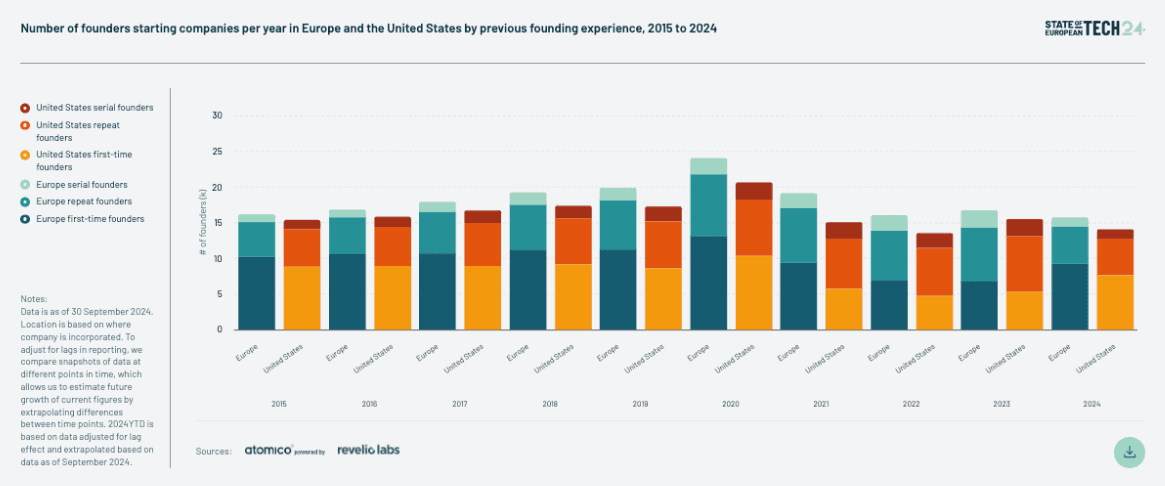
Source: Europe has more founders starting companies than the US - State of European Tech 2024
What is the 2026 European regulatory landscape for non-bank capital raising?
Answer-first: European companies raising capital outside a bank loan in 2026 operate under five overlapping regimes - the EU Prospectus Regulation, ECSPR, Germany's eWpG, MiCAR, and MiFID II - each with a different trigger threshold and supervisor.
Prospectus Regulation. Triggers above €12M / 12 months for public offers - the EU Listing Act harmonised the small-offer exemption at €12M per issuer from 5 June 2026, and member states may lower their national threshold to as little as €5M. Below the applicable threshold, national small-offer regimes and information-document duties still apply.
ECSPR. Applies to crowdfunding platforms intermediating raises up to €5M / 12 months across the EU under a single licence - the regime behind platform-based project financing.
eWpG (Germany). Enables crypto securities and electronic bearer bonds via a regulated electronic register supervised by BaFin. The legal basis for tokenized debt and digital bond issuance.
MiCAR. Primarily a crypto-asset regulation. Most instruments in this guide sit outside MiCAR (they are securities, not crypto-assets), but the boundary matters and is being clarified by ESMA.
MiFID II. The underlying securities-services framework. Governs who can market and intermediate a security, regardless of instrument.
Prospectus and MiFID II touch every public-offer instrument above the applicable exemption threshold (€12M EU-wide since 5 June 2026; as low as €5M in some member states). ECSPR is the regime for crowdinvesting platforms. eWpG is the regime for tokenized securities and direct digital bonds out of Germany. MiCAR rarely applies - check the boundary if the issuance carries token features beyond a pure security.
What are the eight alternative financing instruments in Europe?
Comparison table
Instrument | Type | Typical ticket | Time to close | Dilution | Regulatory load | Best for |
|---|---|---|---|---|---|---|
Tokenized securities offering | Debt or equity | €300K-€900M | 8-14 weeks | Varies | Medium | Issuers wanting digital distribution + secondary liquidity |
Mezzanine financing | Hybrid | €2M-€50M | 8-16 weeks | Low-Med | Medium | Growth-stage companies |
Profit participation rights | Hybrid | €0.5M-€10M | 4-8 weeks | None (cash-flow share) | Medium | SMEs needing flexibility |
Subordinated loans | Junior debt | €0.1M-€5M | 2-6 weeks | None | Low-Medium (VermAnlG VIB) | Bridge & small raises |
SME bond (public) | Debt | €20M-€250M | 12-20 weeks | None | High (prospectus) | Established mid-cap |
ECSPR crowdinvesting | Debt or equity | €0.1M-€5M | 6-12 weeks | Optional | Medium (ECSPR licence) | SMEs with retail reach |
Private placement | Debt or equity | €5M-€100M | 8-16 weeks | Varies | Low-Medium | Institutional-ready issuers |
Direct digital bond | Debt | €1M-€50M | 4-10 weeks | None | Medium (eWpG) | Tech-forward mid-market |
Post-table paragraph (the evolving trend). Tokenization is a wrapper, not a separate asset class. A tokenized securities offering can carry any of the instruments below it - a tokenized profit participation right, a tokenized SME bond, a tokenized fund interest - trading added platform and registry workload for fractionalisation, programmable terms, and secondary-market readiness. That orthogonality is why it leads the table: it expands the ticket range at both ends (€300K micro-raises up to €900M institutional issuances) and it sits across debt and equity rather than picking one. Fractionalised investments are the evolving trend in European alternative finance because they are the only structural answer to all three structural gaps in European fundraising - geographic concentration, allocator bias, and the gap between Europe's founder supply and its capital supply.
The eight instruments - deep dives
Each entry uses five labels: Mechanics · Strengths · Limitations · Best fit · Avoid if.

1. Tokenized securities offering
Mechanics. Securities issued and recorded on a regulated electronic register (in Germany, the eWpG crypto securities register), with digital subscription, KYC, and optional secondary-market readiness. Wraps debt, equity, or hybrid.
Strengths. Fractionalisation down to small tickets, pan-European distribution, programmable interest and amortisation, secondary-market readiness, modern investor experience. The only instrument in this guide that runs through every founder-stage route.
Limitations. Platform and registry workload; smaller universe of advisors and law firms with current operational experience.
Best fit. Issuers wanting digital distribution, retail + institutional in one offering, or a path to secondary liquidity.
Avoid if. The raise is purely institutional, single-investor, and the issuer has no interest in secondary liquidity - a vanilla private placement is usually cheaper.
2. Mezzanine financing
Mechanics. Junior debt or hybrid sitting between senior debt and equity, often with an equity kicker (warrant, conversion) or PIK interest.
Strengths. Less dilution than equity, flexible amortisation, fits growth-stage cap tables.
Limitations. Higher cost than senior debt; covenants and info rights are real.
Best fit. Growth-stage companies with predictable cash flows extending runway without diluting founders.
Avoid if. The company cannot service mezzanine coupons without stressing operating cash flow.
3. Profit participation rights
Mechanics. Hybrid granting investors a cash-flow participation rather than equity ownership; usually structured under German law.
Strengths. No dilution, no board seats, often qualifies as equity-like for ratings, flexible terms.
Limitations. Narrower investor base than senior debt; careful drafting around subordination and profit definition required. In Germany, profit participation rights are usually Vermögensanlagen under the VermAnlG, so a BaFin-filed information sheet (VIB) and, above the exemption limits, a Vermögensanlagen prospectus apply.
Best fit. SMEs wanting equity-like capital without giving up cap-table control.
Avoid if. The investor expects a fixed coupon and clear repayment schedule - use subordinated debt instead.
4. Subordinated loans
Mechanics. Junior unsecured debt, repayable after senior creditors in insolvency; placed bilaterally or via crowdinvesting platforms.
Strengths. Fast to close, no dilution, and a lighter regime than securities offerings. Note that in Germany subordinated loans are typically Vermögensanlagen under the VermAnlG, so a BaFin-filed information sheet (VIB) generally applies even where no prospectus is required.
Limitations. Small ticket sizes; investor-protection rules trigger above thresholds.
Best fit. Bridge financing, small growth capital, working-capital refinancing.
Avoid if. The raise is above €5M and the issuer can access cheaper senior debt.
5. SME bond (public)
Mechanics. Public debt instrument listed on an SME exchange (e.g. the Düsseldorf Stock Exchange's mid-market segment) with a full prospectus and ongoing reporting.
Strengths. Pan-European reach, secondary liquidity, brand visibility, long track record.
Limitations. Prospectus and reporting cost; ratings expectations; visibility cuts both ways.
Best fit. Established mid-caps with €20M+ needs and appetite for public-markets transparency.
Avoid if. The issuer is below €20M revenue or unprepared for ongoing disclosure.
6. ECSPR crowdinvesting
Mechanics. Debt or equity raise via an EU-licensed crowdfunding platform up to €5M / 12 months per issuer.
Strengths. Retail reach across the EU under a single licence, marketing tailwind, brand effect.
Limitations. €5M cap; platform selection matters post-2026 consolidation; IR workload after listing.
Best fit. SMEs with a consumer-facing brand or community of supporters.
Avoid if. The raise is purely institutional or above €5M.
7. Private placement
Mechanics. Securities issued directly to qualified institutional investors under prospectus exemption; debt or equity.
Strengths. Low regulatory load, fast, flexible terms, no public disclosure.
Limitations. Requires institutional relationships; no secondary liquidity unless tokenized.
Best fit. Institutional-ready issuers with existing investor relationships.
Avoid if. The issuer wants retail distribution or secondary-market readiness - then wrap it as a tokenized offering.
8. Direct digital bond
Mechanics. Debt instrument issued as a crypto security under the eWpG, recorded on a regulated electronic register, distributed digitally.
Strengths. No bank syndicate, full term flexibility, no covenants, fast amend cycles, modern investor experience.
Limitations. Issuer takes on IR, registry coordination, paying-agent duties; advisor universe still concentrated.
Best fit. Tech-forward SMEs and scale-ups with direct investor reach in the €1-50M range.
Avoid if. The issuer needs syndicate distribution muscle or has no internal IR capacity.
How do you match a financing alternative to your company stage and capital need?
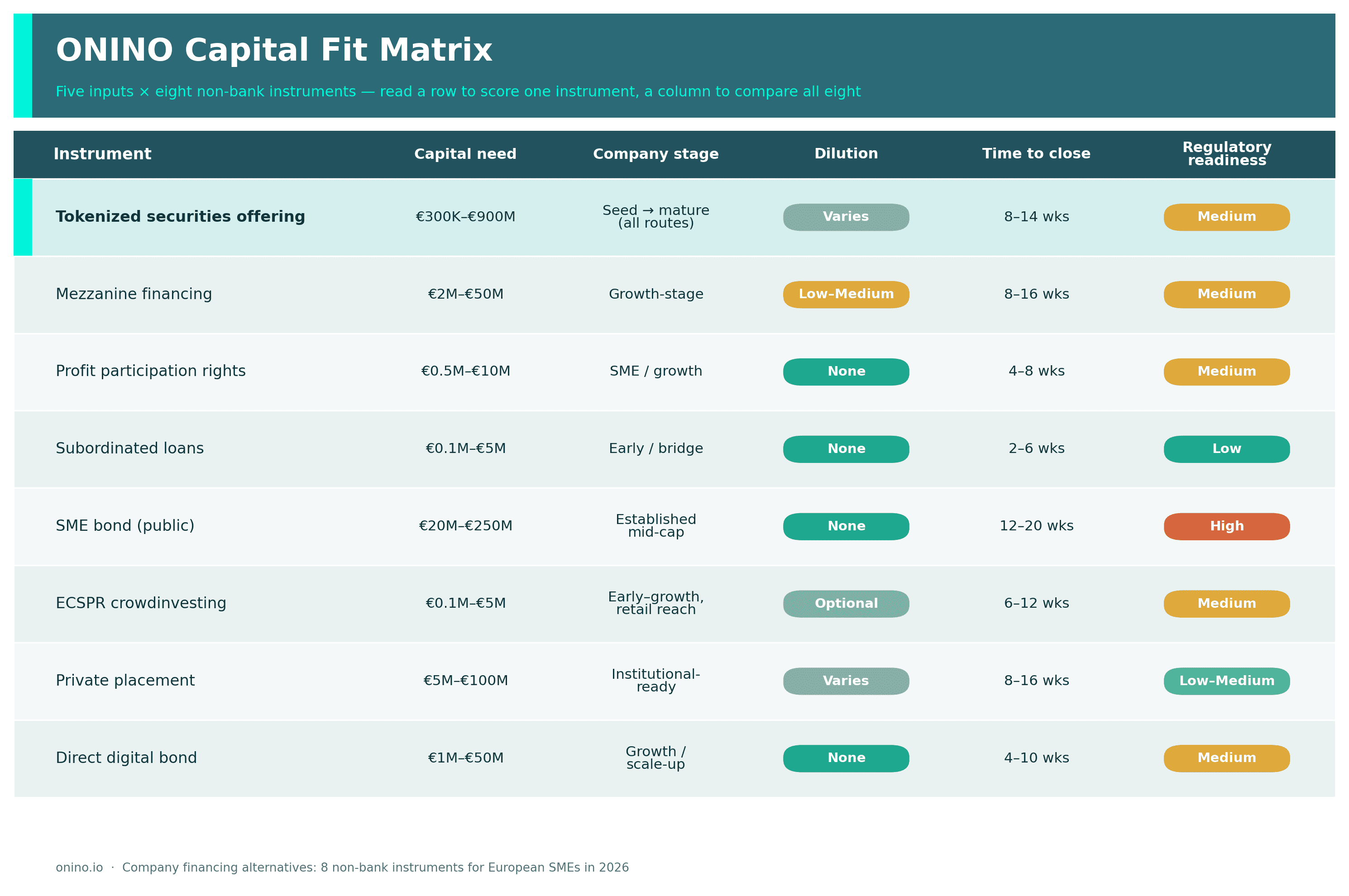
Score your raise against five inputs and read off which of the eight instruments clears all five. The ONINO Capital Fit Matrix (see graphic) does this in one pass.
The five inputs, in the order you apply them:
Capital need - the widest filter; usually removes half the table.
Dilution tolerance - a binary most boards have already settled.
Time horizon - how fast the money must be in the bank.
Regulatory readiness - prospectus, licence, register, and reporting load.
Company stage - a sanity check running underneath the other four.
Worked example - €5M raise, 2018 SaaS at €4M ARR, no dilution, 12-week close:
Capital need rules out the SME bond (€20M floor).
No dilution strikes mezzanine and the equity variants of private placement and crowdinvesting.
The 12-week deadline makes a private placement borderline.
Survivors: a tokenized securities offering wrapping debt, a direct digital bond, or profit participation rights. To pressure-test the survivors against a live issuance setup, book a demo with the ONINO team.
When does a direct corporate bond make more sense than a bank loan?
A direct corporate bond, issued straight to investors without a bank syndicate, makes more sense than a bank loan when you can reach your own investor base, want to control the terms, and can carry the regulatory and operational workload yourself. A loan outsources structuring, servicing, and monitoring to the lender, but you pay for that convenience with covenants, ratio tests, and a term structure you rarely dictate. A direct bond keeps those decisions in-house: you set the maturity, coupon, and repayment profile, and skip the syndication fees, which is worth it when your distribution channel (an engaged community, existing shareholders, family offices) is itself the asset.
The German framework makes this practical. Since 2021, the eWpG lets you issue a bond as an electronic security through a central register or a blockchain-based crypto securities register, with the register entry (not a paper certificate) constituting the bond, which lowers the fixed cost of running your own issuance. On the regulatory side, the pivot is the small-offer exemption threshold - harmonised at €12 million EU-wide since 5 June 2026 under the EU Listing Act, though member states may set a lower national threshold (down to €5 million), so confirm the figure where you are incorporated. A public offer below the applicable threshold, aggregated per issuer over any 12-month period, is exempt from a full BaFin-approved prospectus and in Germany generally needs only a short securities information sheet (WIB), which is why many direct bonds are sized to stay under the ceiling. The trade-off is that you become the issuer, so investor relations, keeping the register accurate, and appointing a paying agent for coupon and principal payments all fall to you rather than a bank's back office.
What regulatory and cap-table consequences should a CFO weigh before choosing?
Regulatory load by instrument. The instrument sets how much regulatory machinery you carry. A public securities offering triggers the full Prospectus Regulation unless exempt; smaller raises may sit under the lighter small-investor regime, and crowdfunding runs through the EU crowdfunding rules. If the instrument is tokenized, classification decides the path: a tokenized bond counts as an electronic security under the electronic-securities regime - licensed register, registration as the constitutive act, notification duties, and sitting outside the crypto-asset regulation - whereas a token that is not a financial instrument falls under the crypto-asset regulation with its own white-paper and possible service-provider licensing.
Cap-table consequences. Equity carries the lasting costs: dilution plus information rights, board seats, drag/tag, and anti-dilution - permanent constraints on control and future rounds. Debt leaves ownership and governance intact. Hence the rule of thumb: debt is finite, equity is typically permanent. Debt matures and disappears; equity, once sold, can usually only be unwound on the investor's terms.
What's evolving next in European alternative finance?
The fractionalisation trend in context, alongside the four other regime shifts.
Fractionalisation moves mainstream. Rising volumes of tokenized securities offerings, with the near-term sweet spot in the €1-10M ticket range (within the instrument's wider €300K-€900M span). Driven by tightened bank credit, lower digital-issuance setup costs, and BaFin's growing comfort with the crypto securities register. This is the evolving trend the whole guide is built around.
Prospectus regime bedding-in. The EU Listing Act's key changes are now in force: the small-offer exemption is harmonised at €12M (since 5 June 2026) and the EU Follow-on and Growth issuance prospectuses apply (since 5 March 2026). Watch the implementing technical standards and each member state's national threshold choice.
ECSPR licence consolidation. Smaller crowdfunding platforms are merging or exiting after the licence-transition period. Diligence platform balance-sheet stability before listing.
eWpG case law and BaFin guidance. More Q&As expected on crypto securities register operations, cross-border distribution, and paying-agent obligations.
MiCAR refinements. Further ESMA technical standards and guidance on the tokenized-securities-vs-crypto-asset boundary are expected in H2 2026 (the core MiCAR regime has applied since 30 December 2024).
About the author
Kristina Stark is Growth Manager at ONINO, leading marketing, content, and sales across the German and UK markets. Her work focuses on educating on tokenization infrastructure, regulated digital issuance, and how European issuers reach retail investors under MiCAR, MiFID II, PRIIPs, and the EU Listing Act. Kristina studied Business Management and Digital Innovation & Entrepreneurship at City, University of London. LinkedIn: linkedin.com/in/kristina-stark-1b760b1bb.
This article is for general information only and does not constitute legal or investment advice. Prospectus thresholds and their national transposition vary by member state - confirm the current position with qualified counsel before any offering.
Last updated 21 July 2026. Reviewed by Lukas Wipf, CPO & Co-Founder at ONINO.
Möchten Sie mehr darüber erfahren, wie Sie dies in Ihrem Unternehmen umsetzen können?
Ähnliche Artikel lesen
The 8 most common alternative business financing options in Europe - tokenized securities, mezzanine, direct bonds, ECSPR crowdinvesting - plus a 2026 decision framework.

