Regulation
How to Launch a Crowdfunding Platform in Europe Under ECSPR (2026 Guide)
A practical 2026 guide to launching an ECSPR crowdfunding platform: licence, EUR 5M cap, capital, KIIS, EU passport, jurisdictions and costs

Kristina Stark
Growth Manager
last updated on

Share
90% of Clients start with a free personal strategy
On this page
Contact Us
ONINO provides infrastructure for digital & tokenized financing to make your next financing a success.
Quick Takeaway
Under ECSPR (Regulation (EU) 2020/1503), one licence lets a crowdfunding platform run investment-based and lending-based offers across the entire EEA, with passporting into new member states just 15 days after notification. Core requirements: own funds of EUR 25,000 or 25% of fixed overheads, a EUR 5 million per-project-owner cap over any 12 months, and a max six-page KIIS per offer. Statutory approval takes three months, realistically six to nine depending on jurisdiction. The biggest cost and timeline levers are software and time-to-authorisation, which is where build-vs-buy matters most.
TTen years ago, building a crowdfunding platform in Europe meant learning 27 different national rulebooks and giving up somewhere around the fourth. That is no longer the job. One EU law has replaced that patchwork, and the European rulebook for regulated financing now gives every founder the same starting line. The law is the European Crowdfunding Service Providers Regulation, or ECSPR. In plain words: it is the single EU rule that says who is allowed to run a website where ordinary people put money into small businesses, and what that website has to do to keep those people safe.
The result is that starting a crowdfunding platform has turned into a project plan. 229 providers held the licence at the end of 2024, and the 181 of them that raised money that year did so across 21 member states, EUR 4.25 billion in total (ESMA, Market Report on Crowdfunding in the EU 2025, 22 December 2025). Those are not pioneers. That is a worn path with signposts on it.
This guide walks the path in six numbered steps, with a realistic timeline for each, and it is written for someone who has never read a financial regulation in their life. It covers what the licence actually lets you do, the requirements that decide whether you qualify, how the application process works and where to apply, what it costs, and how to choose the platform software that will run day to day. If you are deciding whether to build this yourself or buy existing infrastructure, the software and cost sections are written for that decision.
What Is ECSPR, in Plain Words?
ECSPR is the EU law that governs crowdfunding platforms for business finance. It does two things. First, it creates one licence, called an ECSP licence (European Crowdfunding Service Provider, the licence a crowdfunding platform needs in the EU), that lets a platform match investors with businesses raising capital anywhere in the European Economic Area, under one set of rules, instead of applying country by country. Second, it sets the safety rules that platform has to follow: how much money it must keep in the bank, what it must tell investors before they part with cash, and how it has to check the businesses it lists.
ECSPR has applied for years, and the transitional period for platforms running under old national rules is over. It was extended once and cannot be extended again.
The whole playbook rests on one condition being true: that what your platform intends to offer actually falls inside what ECSPR covers. The licence covers two business models, and only two.
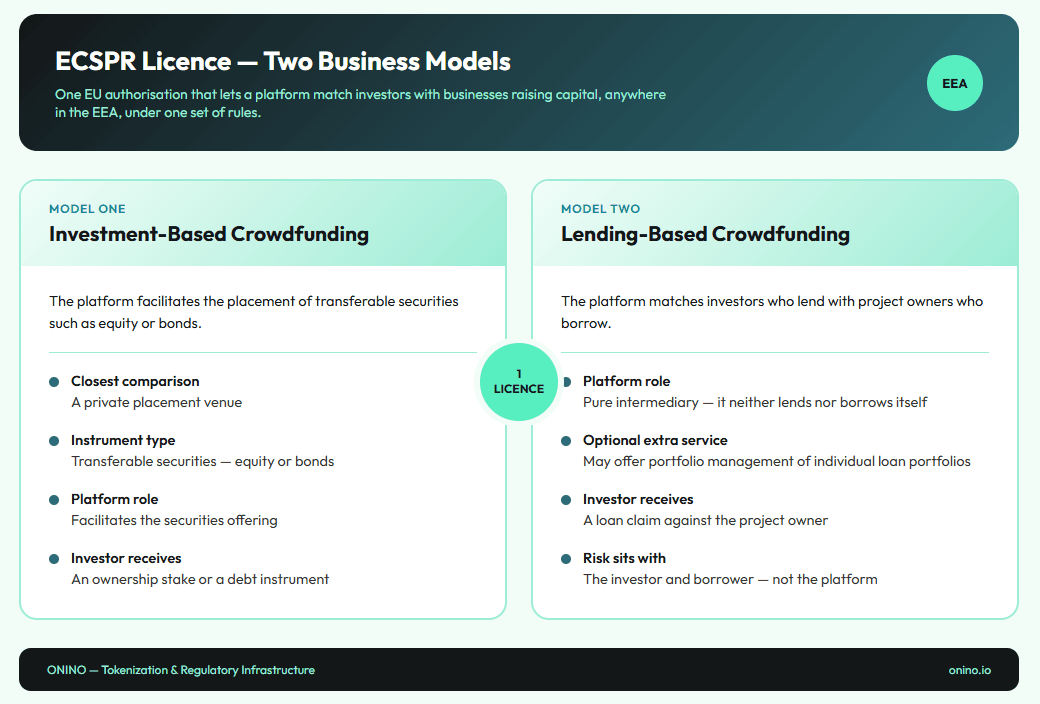
As shown in the graphic, ECSPR covers two business models: model one is investment-based crowdfunding, model two is lending-based crowdfunding, and both sit on one licence. Choosing between them does not change which licence you need.
First is investment-based crowdfunding, where the platform lets a business offer securities such as shares or bonds to investors. The closest traditional comparison is a private placement venue.
Second is lending-based crowdfunding, where the platform matches investors who lend with project owners who borrow. The platform itself neither lends nor borrows; it arranges the loans between the two sides, and it may manage loan portfolios on an investor's behalf.
What an ECSPR Licence Doesn’t Let You Do
It is equally important to understand what falls outside ECSPR. The regulation only covers business finance, so reward-based crowdfunding, donation-based fundraising, and consumer lending are all out of scope. Reward-based crowdfunding exchanges money for a product or perk rather than a financial return, and donation-based fundraising involves no expected return at all, so neither creates a security or loan for ECSPR to regulate. Consumer lending does involve a loan, but it's personal borrowing rather than business finance, so it falls under separate consumer credit rules instead.
On the digital-asset question, the line is drawn by instrument type: where an instrument counts as a financial instrument under MiFID II, the EU's securities-markets rulebook, and is offered through a crowdfunding platform, it sits inside ECSPR; crypto-assets governed by MiCA, the EU's crypto rulebook, sit outside it and need a separate licence, which would be handled by the issuers independently. Knowing which regime applies before you design your offering saves considerable time and paper later. If your idea sits outside that scope, the playbook below is the wrong playbook, and step 1 is where you find out.
The Four Blocks of an ECSPR Launch
Every successful launch in this market is built from the same four blocks, and the six steps below are just those four blocks in order: niche, licence, software, distribution. The niche decides which rules apply to you. The licence gives you permission to operate. The software is what the regulator actually inspects and what your investors actually touch. Distribution is the part everyone underestimates, because a licence brings no investors with it. Founders who fail usually fail because they treated the licence as the finish line, when it is block two of four.
Here is what the calendar looks like across all six steps.
Step | What happens | When it runs |
|---|---|---|
1. Pick the niche | Decide the sector, country and instrument | Months 0 to 1 |
2. Set up the company | Legal entity, two directors, capital in place | Months 1 to 2 |
3. Connect the licensed partners | Payments, KYC, custody where needed | Months 2 to 4 |
4. File the licence application and answer the regulator | The application file goes in, then questions, evidence and demonstrations | Months 4 to 13 |
5. Choose and prove the software | Build, open source or white label, on a parallel track | Months 1 to 3, alongside steps 2 to 4 |
6. Go live and expand | First offer, then cross-border notifications | Months 9 to 15 |
Total: roughly 9 to 15 months from decision to first live offer, and closer to the top of that range in Germany, France, Spain and Italy than in Lithuania or Estonia. Note that step 5 is a parallel track rather than a later stage. It appears after step 4 in this guide because the build-versus-buy argument only makes sense once you have seen what the regulator asks for, but the decision itself has to be made in month one.
Step 1: Which Niche Should Your Platform Own?
Pick the narrowest niche you can defend, because breadth is what kills new platforms. The European market is far more concentrated than its headline size suggests: providers in the top five countries raised over 80% of all crowdfunding volume in 2024, and 46% of projects raised less than EUR 1 million each (ESMA 2025). A generalist platform competing across all of that is competing with everybody. A platform that does solar parks in Bavaria, or bridge finance for Dutch property developers, is competing with three people.
The niche decision is also a regulatory decision, not just a marketing one. The sector you choose determines the instrument you list, and the instrument determines which permissions you and your partners need. Both investment-based and lending-based models sit on the same ECSP licence, which is unusual and genuinely useful, but the moment you want to offer something ECSPR does not cover, such as a German subordinated loan, arranging that product for other people needs its own national permission on top: a full BaFin licence, a lighter investment-broker permission, or tied-agent status under a licensed firm's liability umbrella. Deciding this in month one is much cheaper than discovering it in month nine.
ECSPR is broad enough to support several distinct platform models, and the requirements in step 2 apply across all of them.
Equity crowdfunding platforms facilitate investment into company shares and are a natural fit for angel networks and investor clubs formalising deal flow that has outgrown spreadsheets and email.
Lending-based platforms match investors with businesses borrowing for a defined purpose and carry the additional obligations around credit-risk disclosure and default management.
Real estate crowdfunding platforms, popular across the DACH region, let developers raise project capital from a base of private investors, and they benefit most from infrastructure that can be reused across a pipeline rather than rebuilt for every project.
Across all of these, the operators who scale are the ones who treat investor management as reusable infrastructure. A platform built for investor clubs and networks turns a growing community into a repeatable, auditable process, and the same logic applies to private markets operators running multiple raises in parallel.
Step 2: What Does Starting a Crowdfunding Platform Require as a Company?
Starting a crowdfunding platform requires a real company in an EU or EEA country, with at least two people genuinely running it and money in the bank. You cannot apply from outside the EU: a non-EU founder sets up an EU subsidiary first, and that subsidiary is what gets licensed. The transitional period for platforms that predate the regulation is over, so running an activity the regulation covers without a licence is no longer an option. Before starting the application, it is worth understanding the four requirements that most often determine whether a business qualifies and how it should be structured.
Requirement | What ECSPR sets |
|---|---|
Reserve capital | The higher of EUR 25,000 or one quarter of the prior year's fixed overheads, held as your own capital, an insurance policy or comparable guarantee, or a mix |
Per-project scope limit | EUR 5 million per project owner over any rolling 12-month period; above that, the offer falls outside ECSPR entirely |
Investor disclosure | A key investment information sheet (KIIS), the standard disclosure document every offer carries, maximum six sides of A4, per offer |
EU passport | Services can start once your home regulator confirms the notification, and 15 calendar days after filing it at the latest |
The EUR 5 Million Per-Project Threshold
Any offer above EUR 5 million falls outside ECSPR, measured per project owner over a rolling 12-month period.
It is an exclusion rather than a cap: nothing stops the business raising more, it just cannot raise it here. The 12-month sum covers the securities that project owner has offered, the money they raised as loans through crowdfunding platforms, and their own public offers made without a prospectus. It attaches to the project owner rather than to your platform, and it is measured at the moment a new offer launches. If a business needs more than that in a year, the offer moves into the prospectus regime, the heavier disclosure rulebook for larger public offers, and leaves ECSPR behind. Your platform cannot issue a prospectus itself, so the practical options are to pause a raise at the threshold or to work alongside a licensed investment firm for larger tickets. Because you carry the responsibility to verify the figure rather than simply trust a declaration, this check needs to be built into your onboarding from day one.
Capital: EUR 25,000 or a Quarter of Operating Costs
The capital requirement is deliberately light compared with a licensed investment firm, and this is one of the reasons the market opened up. The regulation sets the buffer at the higher of EUR 25,000 or a quarter of the previous year's fixed overheads, reviewed once a year, and you can hold it as your own capital, cover it with an insurance policy or comparable guarantee, or combine the two. Insurance carries no separate minimum sum and tends to price to a similar annual cost, which is why most operators simply hold the money.
Read that requirement carefully, because the EUR 25,000 is a floor and not the answer. A platform running a EUR 600,000 annual cost base needs EUR 150,000, not EUR 25,000. Regulators also expect the figure to be forward-looking rather than a snapshot, so most operators hold a buffer above the line to avoid a mid-year top-up conversation with their supervisor. Budget for the number your second year of costs implies, not your first.
Step 3: Which Licensed Partners Do You Need to Connect?
You need partners because a crowdfunding platform is not allowed to do several of the jobs it depends on. Holding investor money is a payment or e-money activity and belongs to a licensed payment institution. Verifying investor identity is your responsibility, but it is almost always carried out through a specialist provider. Where an offering is issued as a digital security rather than a plain contract, the register is maintained by a registrar with the relevant regulatory permission, and custody sits with a licensed custodian. Those permissions sit with those partners, never with the software vendor and never automatically with you.
This is the single most misunderstood part of how to create a crowdfunding platform, and getting it wrong is expensive. The rule of thumb that keeps you accurate: the software never needs the licence, the activity does. Name the party performing each regulated activity, write it down in your application, and the regulator's questions get much shorter. Sourcing these partners yourself takes two to four months of contracting. Using a stack where they are already integrated removes most of that, though it does not remove the diligence you still owe on each one.
Step 4: How Do You Get the ECSP Licence?
You apply to the national regulator in the EU country where your company sits, and the clock is the same everywhere: the regulator has 25 working days from receipt to check whether your file is complete, then three months from a complete file to give you a reasoned decision. That is the theory. In practice the elapsed time is decided almost entirely by how complete your file is on the day you send it, because the three-month clock does not start until the regulator agrees it is complete. The file itself is heavier than a simple payment-service registration but lighter than a full MiFID licence application. In practical terms, the submission needs to cover the following.
A programme of operations setting out whether you offer investment-based, lending-based, or both, plus target markets, project-owner sectors, investor types, revenue model, and fee structure.
A 3-year business plan with internally consistent projections, governance arrangements with at least two people effectively running the business, and a conflicts-of-interest policy.
Internal procedures for project-owner due diligence, risk assessment, default and exit disclosures for lending, complaints handling, outsourcing, and record-keeping.
IT and security documentation aligned with DORA, the EU's digital-resilience rulebook, which has applied to crowdfunding platforms since 2025.
Evidence of capital, plus proof that every manager is qualified and has a clean record, and the same for any shareholder holding 20 percent or more.
Real-world timelines run longer than the legal clock once you account for back-and-forth with the regulator, typically six to nine months from filing to decision. That is regulator processing time and it sits inside the wider 9 to 15 months from decision to first live offer. Where you apply matters, both for speed and for supervisory culture, though no national regulator publishes an expected duration, so read the ranges below as observed practice rather than official guidance.
Jurisdiction | Authority | Typical timeline | Notes |
|---|---|---|---|
Lithuania | Bank of Lithuania | 3 to 5 months | English works in practice with the regulator, large passported population |
Estonia | Finantsinspektsioon | 3 to 6 months | Digital-first, strong fit for tech-led platforms |
Germany | BaFin | 6 to 9 months | Thorough process, deep domestic market |
France | AMF | 6 to 9 months | Deep domestic crowdfunding market, high-quality supervision |
Spain | CNMV | 6 to 9 months | Largest retail crowdfunding investor base, process in Spanish |
Italy | CONSOB | 6 to 12 months | Large lending market, longer for complex platforms |
Practical implications:
If you are outside the EU or EEA entirely, you need to establish a subsidiary or entity within a member state first. You cannot apply directly from a non-EU country.
If you're already in the EU/EEA but in a country not on this list (or with a slower regulator), you can still choose to set up your licensed entity in Lithuania or Estonia rather than your home country.
The trade-off is usually a faster and cheaper jurisdiction against a domestic presence and reputation in the market you actually want, for example licensing in France because France is your primary target market.
The passport that comes with the licence is what makes this choice worth making: a platform licensed in Lithuania or Estonia can serve project owners and investors in Germany, France or Spain without a second application, and step 6 sets out how that notification works. For a German operator the practical trade-off is therefore licensing at home with BaFin, which sits closest to your market but runs a longer process, or getting licensed faster in Lithuania or Estonia and passporting into Germany.
The national difference shows up in the outcomes, not only in the calendar. By the end of 2023, only 7% of Germany's active incumbent platforms had obtained an ECSPR licence, against 38% in France and 43% in Belgium (EUROCROWD, Analysis of ECSPR Licensing Adoption in 2023). Of the six German platforms originally licensed under ECSPR, three remained active in early 2026, while France ran around 50 (EUROCROWD via Crowdfund Insider, 3 March 2026).
That trade-off exists because approval speed varies enormously from one national regulator to the next, even though ECSPR gives all of them the same three-month clock. Karsten Wenzlaff, who helped shape the regulation, has seen the gap first-hand:
Expert Quote:
"The regulator was able to process these license applications within six weeks... And in other countries it took them sometimes 18 months because they were going back to the platform, asking for more information and then would drag this process along."
Karsten Wenzlaff
Secretary General, Digital Invest Germany
Step 5: How to Build a Crowdfunding Platform, or Buy One Instead?
This step is numbered fifth but runs first, from around month one, in parallel with everything above. The licence is the legal layer. The platform is the operational layer, and it is where most of the real work sits: investor onboarding, project-owner due diligence, the KIIS workflow, investment flows, payments and escrow, an investor dashboard, and regulatory reporting. There are three broad routes to that software, and only one of them reliably fits inside a first licence timeline. The right one depends on your timeline, budget, and how much regulatory logic you want to own.
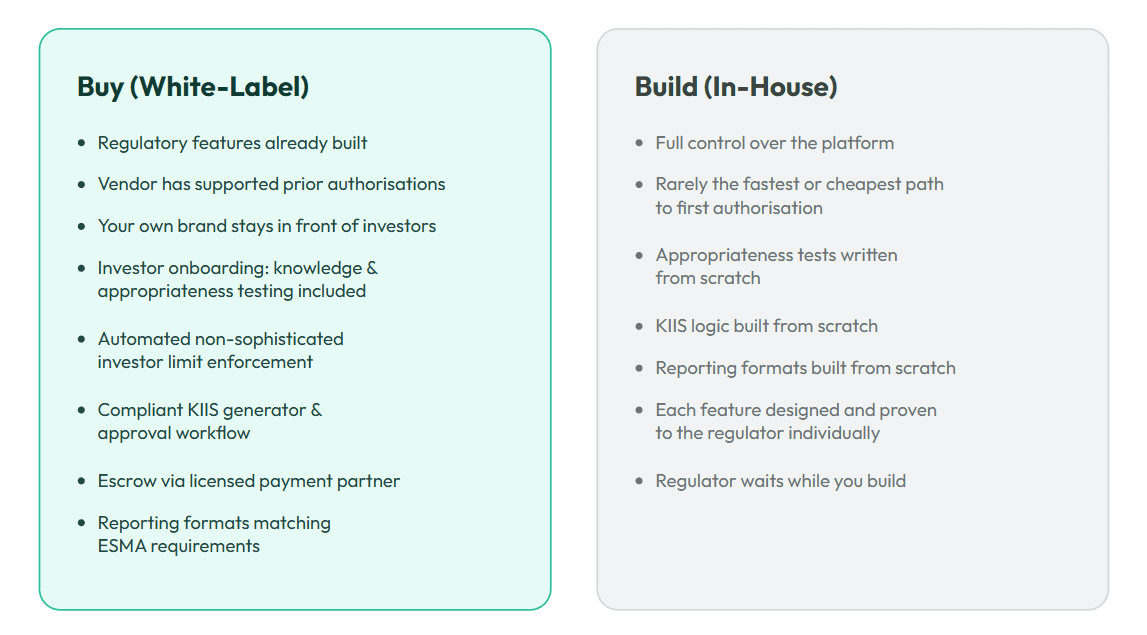
As shown in the graphic, buying white-label means the regulatory features, investor testing, KIIS workflow and ESMA reporting already exist, while building writes each one from scratch and proves it to the regulator one at a time.
Building in-house gives you full control but is rarely the fastest or cheapest path to a first licence, because you are effectively writing the appropriateness tests, KIIS logic, and reporting formats from scratch while the regulator waits. Open-source crowdfunding software lowers the licensing cost of the codebase, but it shifts the compliance burden entirely onto your team, and generic templates seldom encode ECSPR-specific requirements such as investor-tier limits or the four-day reflection period. White-label equity crowdfunding software suits operators who want to reach go-live in a defined timeframe, because the regulatory features are already built, the vendor has typically been through licence applications before, and you keep your own brand in front of investors.
The reason this matters more than a normal build-versus-buy call is that the regulator inspects the software as part of the licence file. A supervisor reviewing a working, previously approved system is reviewing a known quantity. A supervisor reviewing your half-finished prototype is doing discovery on your timeline.
Buying proven infrastructure means the compliance surface is already built rather than something you assemble under regulatory deadline pressure. That surface includes investor onboarding with knowledge and appropriateness testing, automated enforcement of non-sophisticated investment limits, a compliant KIIS generator and approval workflow, escrow or segregated handling of investor funds through a licensed payment partner, and reporting formats that match ESMA requirements. Unlike a from-scratch build, where each of these has to be designed, tested, and proven to a regulator one at a time, a mature white-label platform arrives with them already validated in earlier licence applications, so the regulator is reviewing a known quantity rather than an unproven system. This is precisely the calculation ONINO's white-label investment infrastructure is built to remove: the regulated workflow ships ready to demonstrate, from day one of your application, rather than becoming a dependency your licence timeline has to wait on. To be clear about who does what, ONINO supplies the software. The ECSP licence is held by you as the operator, and licensed functions such as payments, custody and register-keeping run through pre-integrated partners who hold those permissions themselves.
Conversely, a build makes sense in one situation: when the platform is a small part of a much larger regulated business that already has engineering and compliance teams sitting idle. For everyone else, the honest maths is that a build costs you revenue months, and revenue months are the most expensive line item in this entire exercise.
How Much Does It Cost to Launch a Crowdfunding Platform?
There is no single sticker price, but the cost of launching an ECSPR platform breaks into predictable components, and modelling them early prevents unpleasant surprises during the application. First-year budgets across licence, legal, software and compliance operations typically land somewhere between EUR 100,000 and EUR 500,000 depending on route and country. The indicative component ranges below vary by jurisdiction and scope and should be validated with your advisers.
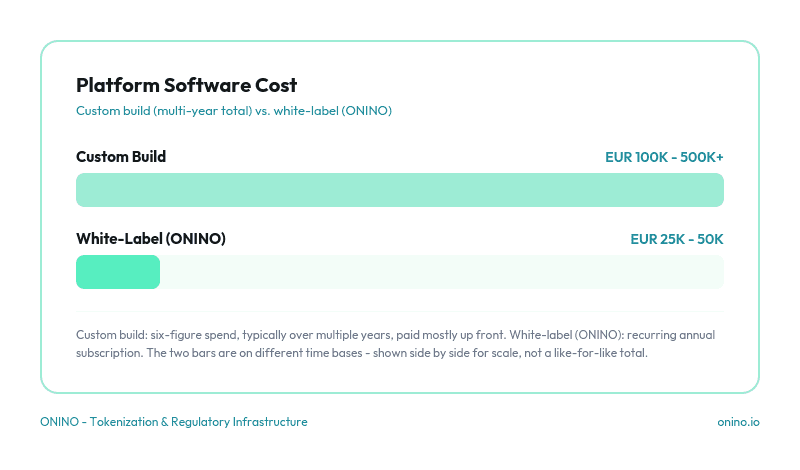
As shown in the graphic, a custom build runs EUR 100K to 500K or more across several years, while white-label sits at EUR 25K to 50K a year. Different time bases, so read them for scale, not as a like-for-like total.
Reserve capital: the EUR 25,000 floor or 25 percent of projected fixed overheads, held as your own capital.
Licensing and legal: advisory support for the application file, legal structuring, and the paperwork proving your managers are qualified, indicatively in the region of EUR 30,000 to EUR 100,000 depending on country and complexity.
Platform software: the largest variable, from a six-figure multi-year spend for a custom build to a white-label subscription commonly in the low-to-mid five figures per year.
Payments and escrow: integration with a licensed payment or e-money partner to hold and settle investor funds.
Ongoing compliance: DORA-aligned IT controls, audits, reporting, and staff time, which recur every year.
The strategic point is that the two largest line items, software and time to approval, are also the two you can most directly influence by your build-versus-buy decision. Proven infrastructure compresses both, which is why the total cost of a bought platform is often lower than a build once the delay in revenue is priced in.
Step 6: How to Set Up a Crowdfunding Platform for Its First Live Offer
Knowing how to set up a crowdfunding platform for its first offer comes down to getting three things working together: the disclosure document, the investor tiers, and the money flow. There is also a clock on the licence itself, because your regulator can withdraw a licence that has not been used within 18 months of being granted, which makes the first offer a compliance deadline as well as a commercial one.
Every offer must come with a key investment information sheet, the short standard document that tells an investor what they are putting money into. It is capped at six sides of A4, produced per project (or at platform level for a pool of loans), and it has to be in front of the investor before they invest. The project owner writes it and carries responsibility for what it says, while your platform is responsible for checking that it is complete, correct and clear. The rule goes further: where you spot an omission, mistake or inaccuracy that could materially affect the expected return and the project owner does not fix it promptly, you must suspend the offer for no longer than 30 calendar days and cancel it if it is still uncorrected when that window closes. Incomplete or misleading information sheets have been among the most common problems regulators find, so treat the KIIS workflow as a core product feature, not an afterthought.
Investor tiers are where the platform logic gets particular. ECSPR sorts investors into two tiers and applies stronger protections to the retail majority.
Dimension
Sophisticated investor
Non-sophisticated investor
Definition
Meets the professional-investor criteria under MiFID II, or self-certifies against income, net-worth, and experience tests
Any investor who is not sophisticated; the default for retail
Onboarding
Lighter procedural steps
Entry knowledge test and a simulation of the ability to bear loss, calculated as 10% of net worth
Reflection period
Not required
Four calendar days, revocable without reason or penalty
Warning trigger
None specified
Any single offer above the higher of EUR 1,000 or 5% of net worth: risk warning, explicit consent, and proof of understanding
These are not settings you bolt on later. They change the shape of your checkout flow, which is why they need to exist before you file, not after you launch. Note also that the warning trigger bites per individual offer accepted rather than on a running annual total, and that it is a three-step gate rather than a banner.
Set expectations on scale honestly while you are at it. The average retail investor on a European crowdfunding platform put in EUR 660 in 2024, professional investors EUR 1,510 and sophisticated investors EUR 2,660, while average project sizes ran to EUR 770,000 for debt-based offers, EUR 640,000 for equity and around EUR 240,000 for loans (ESMA 2025). A EUR 700,000 raise therefore needs hundreds of retail tickets, which tells you exactly how much of your effort belongs in the subscription and onboarding journey rather than in deal sourcing.
Expanding Across the EU After Launch
You expand by notification, not by reapplying, and this is the single biggest advantage ECSPR gives you. You tell your home regulator which countries you intend to serve. That regulator passes the information to the regulators in those countries and to ESMA, the EU securities-markets watchdog, within 10 working days, and you may start providing services as soon as your own regulator confirms it has done so, or 15 calendar days after you filed at the latest. Note that the 15 days is an outer limit rather than a waiting period, and note the word notification. This is a procedure, not an automatic passport, and it does not switch off local rules: host countries keep their own marketing and language requirements, so France, for example, requires marketing material and the KIIS in French.
The passport is used far less than the theory suggests. Fewer than 30% of licensed platforms operated cross-border as of early 2025, and only 8% of funds raised in 2024 came from investors outside the platform's own country (EUROCROWD, April 2025; ESMA 2025). The lesson for a new operator is that cross-border reach is available cheaply but is not a strategy on its own, because the constraint is investor distribution rather than legal permission. Expand when you have a reason to, and treat the notification as the easy part it is.
Beyond the Licence: Investor Operations That Scale
Capital is not what caps a platform's growth. Investor operations are. Fragmented onboarding, manual subscription documents, and reporting rebuilt for every round will limit your volume long before your deal flow does, and these are exactly the gaps a regulator probes during due diligence.
Well-designed infrastructure standardises subscription and documentation, maintains a central and auditable investor record, and supports digital subscription and transfer records where later transferability becomes relevant. That auditability is not a nice-to-have. It is the difference between a supervisory review that takes days and one that takes weeks, and it compounds in value as your portfolio of offers grows. Building this foundation once, and reusing it across every raise, is what separates a platform that scales from a series of one-off campaigns.
What This Actually Looks Like From the Inside
"The question I get asked most is how fast the licence can be done, and it is the wrong first question. The operators who launch on time are the ones who had a working platform to show the regulator in month four. The ones who slip are the ones who were still specifying their KYC flow when the first list of supervisory questions arrived. The licence is not the bottleneck; readiness is." Lukas Wipf, Co-founder and CPO, ONINO.
One more honest note before you plan a launch: a licence does not create a market. ECSPR does not allow a fully functioning secondary market. What it allows is a bulletin board where clients can advertise an interest in buying or selling what was originally offered on that platform. What the platform may not do is bring those buyers and sellers together itself and execute their orders. It works more like eBay. A seller posts an offer, a buyer has to find it and accept it, and eBay does not pair the two or create the contract between them; it just provides the shop front where both parties can find each other. So a bulletin board is not a trading venue, and it is no guarantee that anyone can exit early. Tell your investors that in plain language, because the regulators certainly will.
In Conclusion
Starting a crowdfunding platform in Europe is now a project plan rather than a moonshot, and the evidence is in the register: 229 licensed providers, EUR 4.25 billion raised across 21 member states in a single year. Of the four blocks, the software decision is the one that most reliably decides whether the plan holds, because it is the only block that simultaneously shortens the licence process, defines the investor experience and sets the recurring cost. The 48 licensed providers that ESMA left out of its 2024 analysis because they had not raised any funds, roughly one in five of everyone holding the licence, are the reminder that permission and a business are different things (derived from ESMA's own 229 and 181 figures, ESMA 2025).
Ultimately, the next actor is the founder reading this. Pick the niche this month, decide build versus buy before you file, and let the licence run in parallel with a platform that is already working.
Launch Faster With Regulated Infrastructure
The licence and the technology are two halves of the same launch. The licence proves you can operate; the platform proves you can operate at scale without the operational drag that stalls most new entrants. ONINO provides the white-label investment infrastructure that sits underneath a compliant crowdfunding platform, from onboarding and subscription through to a central investor record, so your team can focus on deal flow and regulatory strategy rather than rebuilding the plumbing. If you are scoping a launch and want to see what a ready-to-demonstrate platform looks like against your own model.
General information only, accurate at the date shown. Not legal, tax or investment advice. Confirm your own position with qualified counsel.
Want to learn more how this can be applied to your business?
Read related Articles
A practical 2026 guide to launching an ECSPR crowdfunding platform: licence, EUR 5M cap, capital, KIIS, EU passport, jurisdictions and costs


