Insights
Security Token vs Utility Token in 2026: Complete Comparison + EU Legal Framework
What's the difference between a security token and a utility token? Complete 2026 comparison covering MiCAR, BaFin classification, and real-world examples.

Lukas Wipf
CPO & Co-Founder
last updated on
Lukas Wipf
CPO & Co-Founder
Share
Contact Us
ONINO provides infrastructure for regulated tokenized financing across the EU and Switzerland.
On this page
Quick Takeaway
A security token represents an ownership right or financial claim in an underlying asset and is regulated as a financial instrument under MiFID II in the EU and the Howey test in the US. A utility token grants access to a product or service inside the issuer's ecosystem and falls under MiCAR in the EU. Both categories are now regulated. Classification is functional, based on what the token actually does, not on what the whitepaper calls it. Mislabelling a token as "utility" when it conveys investment rights is the single most common, most expensive structuring mistake in this market.
Security Token vs Utility Token in 2026: What Issuers Actually Need to Know
What is the difference between a security token and a utility token?
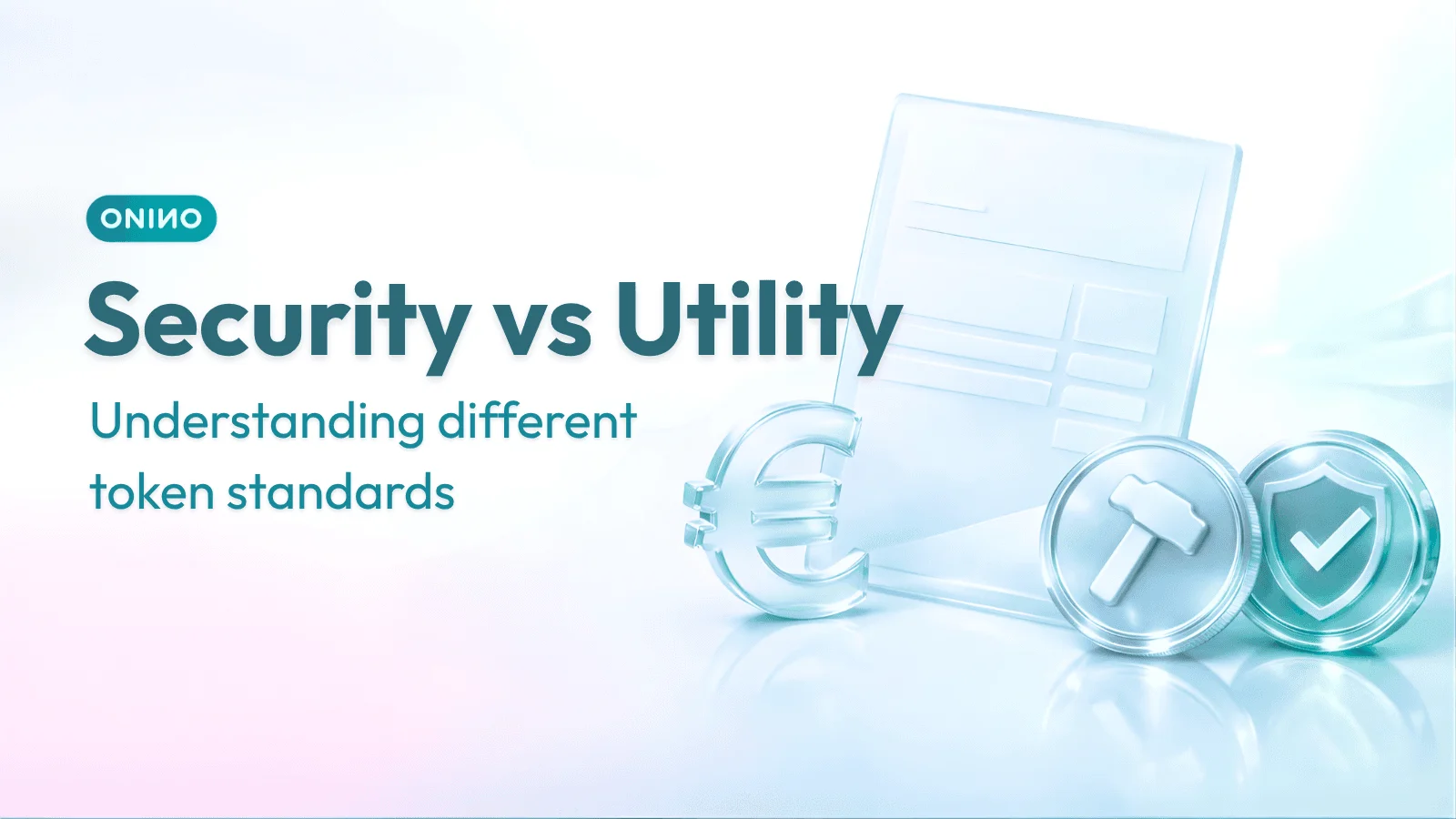
A security token is a digital asset that represents an ownership right or financial claim in an underlying asset, such as equity, debt, fund units, or fractional rights in a real-world asset like commercial real estate. Security tokens are financial instruments and are regulated like traditional securities. A utility token is a digital asset that exclusively provides access to a product, service, or function within the issuer's ecosystem, with no financial return attached. Utility tokens are crypto-assets regulated under the EU's Markets in Crypto-Assets Regulation (MiCAR), fully applicable since 30 December 2024. The classification depends on the rights conveyed, not the marketing label.
How do regulators decide which category a token falls into?
The test is functional, not nominal. Two distinct regulatory frameworks govern this in the world's largest capital markets, and both arrive at a similar destination.
In the EU, ESMA's Guidelines on the qualification of crypto-assets as financial instruments, applied since 18 May 2025, set out the criteria. A token is a transferable security under MiFID II if it conveys rights comparable to shares, bonds, or other financial instruments: economic participation, governance rights tied to an issuer, a claim on future cash flows, or tradability on capital markets. ESMA reaffirmed technological neutrality: a financial instrument remains a financial instrument even when tokenised.
In the United States, the Howey test applies. A token is an investment contract when there is (1) an investment of money, (2) in a common enterprise, (3) with an expectation of profits derived from the efforts of others. The August 2025 Ninth Circuit decision in SEC v. Barry and the SEC's 2025 framework under Chairman Paul Atkins both confirm that despite a more permissive climate, Howey remains the law for any token whose value depends on the ongoing efforts of a central team.
"Tokenized securities are still securities." — Commissioner Hester M. Peirce, U.S. Securities and Exchange Commission, July 2025
Security tokens vs utility tokens at a glance
Security Token | Utility Token | |
|---|---|---|
Legal nature | Financial instrument (MiFID II in EU, investment contract under Howey in US) | Crypto-asset under MiCAR (EU); regulated commodity or non-security where ungated by Howey (US) |
Rights conveyed | Economic participation, voting, claim on cash flows | Access to a product or service in a defined ecosystem |
Primary regime | MiFID II, Prospectus Regulation, AIFMD (EU); Securities Act of 1933, Exchange Act 1934 (US) | MiCAR (EU); state and federal commodities/consumer rules (US) |
Disclosure document | Prospectus, or qualified exemption (e.g. Reg D 506(c) in US) | MiCAR white paper (EU); no prospectus where Howey not met (US) |
Issuer authorisation | Licensed broker-dealer or qualified exemption; ATS or MTF for trading | CASP authorisation (EU); registered exchange not required where token is not a security |
Secondary trading | Regulated venue (MTF, OTF, ATS) | CASP-operated trading platform (EU); spot exchanges where permissible |
Typical instruments | Tokenised bond, tokenised fund unit, equity token, fractional real-estate interest | Platform access token, governance token without dividend rights |
Investor protection | Highest: prospectus liability, MiFID II suitability, fiduciary duties under US securities law | Disclosure and conduct rules under MiCAR; consumer protection where applicable in US |
The practical consequence: security tokens require more infrastructure at launch but unlock regulated secondary markets, institutional investor access, and cross-border passporting.
Why is misclassification so common?
Most teams that get this wrong are not careless. They are optimistic. A token launches as a "utility token" granting platform access. The marketing emphasises scarcity, price appreciation, and early-adopter upside. Buyers acquire the token expecting profit. At that point, the substance of the offering has crossed into securities territory regardless of what the whitepaper says.
Both regulatory regimes look past the label. Skadden partners reviewing the Barry decision noted that "labelling something as a utility token or interim token will not evade Howey if the factual substance indicates an investment scheme." ESMA takes the same position for the EU. Most tokens that fail this test are hybrid tokens that combine access rights with revenue or governance features, and the predominant function determines the applicable regime.
The ONINO Token Classification Test is the three-question filter we use at the structuring stage with every issuer:
What right does the token convey? Access only, or economic participation?
What does the buyer reasonably expect? Use of a service, or financial return derived from someone else's efforts?
Is the underlying instrument already regulated? A bond, a fund unit, a participation right. Anything on that list is a financial instrument, full stop.
If the answer to either of the last two questions points to investment, the token is on the security side. There is no MiCAR or Howey shortcut.
Which token type applies to your offering?
For most issuers working with real capital structures, the security token path is the operationally relevant one. The generic framing that "utility tokens aren't regulated" has been wrong since MiCAR's full application in December 2024 and was never accurate under US securities law.
If you are a wealth manager structuring co-investments for your investor base, you are almost certainly looking at security tokens. The underlying assets, namely private equity, real estate, fund units, carry ownership rights and your investors expect returns.
If you are a real estate developer raising project financing, the instrument you tokenise, typically a debt instrument or fractional ownership interest, determines the classification. These are securities.
If you are a fund manager or SPV operator managing a portfolio of structured instruments, token classification directly shapes your fund lifecycle workflow including subscription, NAV, distributions, and redemptions, and which secondary markets you can list on.
Where does misclassification create real consequences?
Calling a security token a utility token is not a marketing decision. It is a regulatory one with four concrete failure modes.
Regulatory enforcement comes first. National regulators across the EU can order the cessation of an offering that has been issued without a prospectus where the substance is a security. In the US, the SEC continues to bring enforcement actions where the Howey test is satisfied, and case law from SEC v. Telegram to SEC v. LBRY confirms the agency's reach.
Prospectus liability is the second. Selling a security without a prospectus and without a valid exemption creates direct civil liability for the issuer and, in many jurisdictions, personal liability for directors.
Platform lockout is third. Regulated trading venues for security tokens require proper classification. A mislabelled token cannot list on the secondary venues your investors actually want.
Cross-border friction is fourth. EU MiFID II passports and US Reg D exemptions are not interchangeable. Misclassification means operating without authorisation in jurisdictions where your token has been sold or marketed.
The fix is upstream. Classify the instrument before the smart contract is written, before the whitepaper is drafted, and before any investor is pitched.
Ready to structure your offering?
ONINO provides regulated tokenisation infrastructure for security tokens under MiFID II, with white-label deployment in under 24 hours. We work with asset managers, real-estate developers, and fund operators across the EU.
Want to learn more how this can be applied to your business?
Read related Articles
What's the difference between a security token and a utility token? Complete 2026 comparison covering MiCAR, BaFin classification, and real-world examples.