News
What Is a Self-Issuance (Direct Placement)?
A self-issuance means the issuer places securities directly, without an underwriter. Learn which EU Prospectus Regulation exemption applies, and how it differs from private placement.

Kristina Stark
Junior Growth Manager
last updated on

Share
90% of Clients start with a free personal strategy
On this page
Contact Us
ONINO provides infrastructure for digital & tokenized financing to make your next financing a success.
Quick Takeaway
A self-issuance, or direct placement, is when your company offers its own bonds directly to investors, without a bank or crowdfunding platform in between: you set the terms, keep the investor relationship and run the offer under your own name. It fits companies that already have people who would invest, such as customers, members, partners or a strong local network. Under EU rules, bond offers below €12 million in 12 months generally need no full prospectus, the long legal document a regulator must approve before a company offers securities to the public; some countries set the limit at €5 million. Subordinated loans, which are repaid only after the company's other lenders if it gets into trouble, and profit-participation rights are not securities and follow national rules, which are often stricter.
Bank finance is the default for most mid-sized companies, but it rarely covers everything a growing business needs. Banks lend against collateral, limit how much they will take on and set the terms themselves. Many companies already have something a bank cannot offer: customers, members, partners and local supporters who know the business and would invest in it. A self-issuance is the regulated way to raise money from those people directly. This guide explains what it is, when it fits your company and which rules decide how you can do it.
What is a self-issuance, in plain terms?
A self-issuance means your company borrows from many investors at once instead of from one bank. Take a €2 million project: rather than one bank lending the full amount, 400 investors each put in €5,000. Each of them receives interest and gets their money back at the end of the term.
The difference from a bank loan is who decides what: you set the interest rate, the term and the minimum investment, and you deal with your investors directly. "Direct placement" describes the same thing from the market's side: the bonds are placed with investors directly, not through a bank that buys them and sells them on.
Who uses self-issuance?
Self-issuance works best for companies that already have people who would invest in them. A property developer with a track record in its region, a solar or wind project with local supporters, a cooperative with thousands of members, or a family business with loyal customers all fit this shape. Their investors know the company, often use its products, and want to see where their money goes.
That existing network is the real requirement. A self-issuance gives you the route and the tools to raise money, but it does not bring investors with it, so a company without a network usually struggles to fill the offer. Conversely, a company that raises money every year from the same circle of supporters gains the most, because every round gets faster once the setup exists.
What does it take to run a self-issuance?
The legal structure comes first, the technology second. You agree the instrument and the investor document with your lawyer, then run the offer itself: a page where investors sign up, identity and anti-money-laundering checks, collecting the money, and afterwards paying interest and keeping the investor register up to date for the full term. Our step-by-step guide on how to carry out a self-issuance walks through each stage.
A company offering its own bonds does not normally need a financial licence for the offer itself. Plain loans from the public are different: in several countries, Germany included, taking repayable money from the public counts as deposit-taking and needs a banking licence, which is why such raises use bonds or subordinated loans instead. The licensed parts, such as payment handling, custody and the register for digital bonds, run through licensed partners.
How is a self-issuance different from a bank loan, crowdfunding or a private placement?
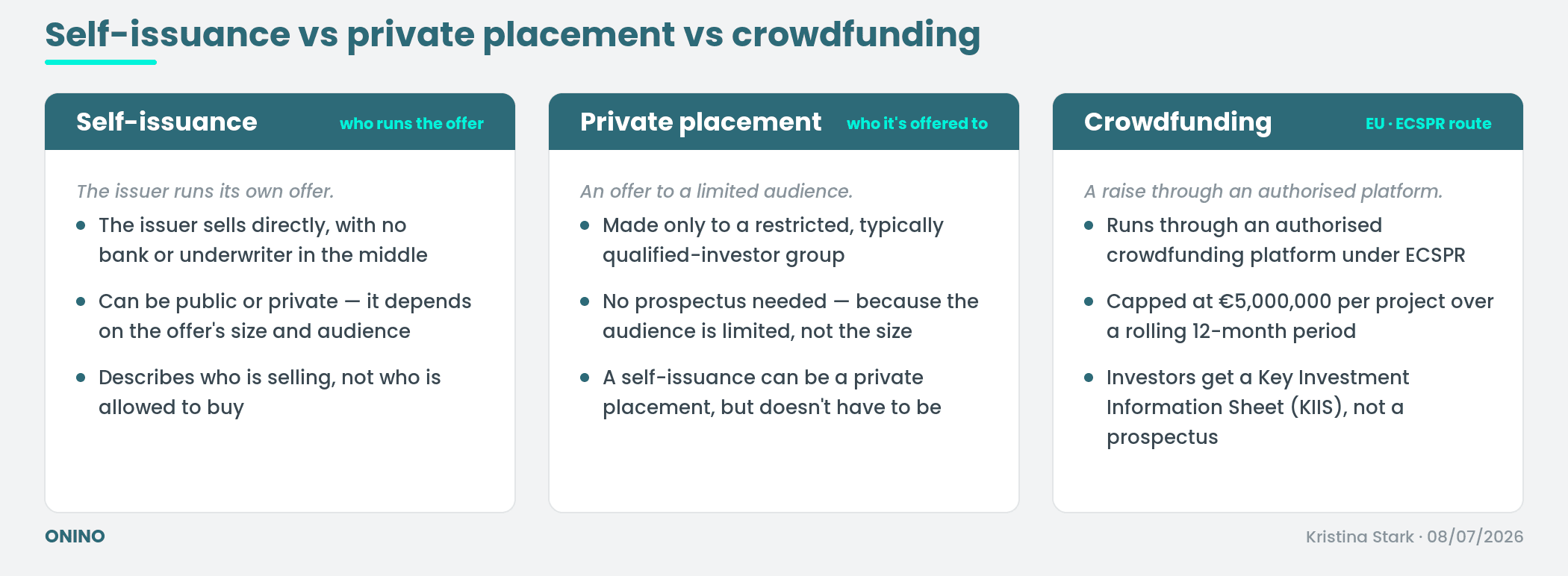
The three alternatives differ mainly in who controls the terms and the investor relationship. A bank lends from its own balance sheet and sets the terms. A crowdfunding platform, licensed under the EU's crowdfunding rules, offers your project to its own investors and is capped at €5 million per company in 12 months. A private placement is an offer made only to professional investors, such as funds and insurers, or to a small circle of fewer than 150 private investors per country.
Bank loan | Crowdfunding platform | Self-issuance | |
|---|---|---|---|
Who provides the money | One bank | The platform's investors | Your own customers, members, partners and network |
Who sets the terms | The bank | You, within the platform's rules | You |
Whose brand investors see | Not applicable | The platform's | Yours |
Who owns the investor relationship | No investors involved | Mostly the platform | You |
Size and document rules | Set by your credit rating and collateral | Hard cap of €5 million per company in 12 months, with a short key investment information sheet | No legal cap. Bonds below €12 million in 12 months need no full prospectus, often a short information sheet instead. Loans follow national rules. |
A self-issuance can also be a private placement: if you offer your bond only to professional investors, it is both at once. Most companies that self-issue, however, want to reach their customers and supporters, which makes the prospectus question the next one to settle.
Do I need a prospectus for a self-issuance?
Usually not, as long as you issue bonds and stay below the threshold. A prospectus is the long legal document, often a hundred pages or more, that the regulator must approve before a company offers securities to the public. Preparing one usually takes several months.
Under EU rules, bond offers below €12 million in 12 months need no prospectus. Some countries set the limit at €5 million, and many ask for a short information sheet instead: in Germany, three pages that BaFin, the German financial regulator, approves within 10 working days for a fee of €5,923. Offers only to professional investors, to fewer than 150 private investors per country, or with a minimum investment of €100,000 are exempt whatever their size. Above €12 million, a full prospectus is the standard route, as our prospectus guide explains.
These thresholds apply only to securities such as bonds. Subordinated loans and profit-participation rights follow national rules, which are often stricter: in Germany, a subordinated loan offered to the public generally has to go through a licensed intermediary, and without a prospectus only through an online platform, capped at €6 million. To raise directly from your own network, a bond is usually the simpler route, so agree the instrument with your lawyer first.
Which instruments can you issue?
The most common choice is a bond: investors lend you money at a fixed interest rate and are repaid at the end of the term. A subordinated loan ranks behind your bank debt if things go wrong, so it usually pays investors a higher rate, while profit-participation rights link the payout to how well the company performs.
Bonds can also be issued in digital form, recorded in a digital securities register instead of on paper. Subordinated loans and profit-participation agreements cannot, because they are contracts with each investor rather than securities; if you want the digital version, structure the instrument as a bond, which can also be subordinated. Going digital changes the admin, not what you owe investors: interest payments, the investor list and transfers run digitally, which helps most with hundreds of investors or a raise every year. Our guide to security tokens and utility tokens explains when a digital version makes sense.
So is a self-issuance right for you?
A self-issuance is the right route when your company already has people who would invest in it and you want to keep control of the terms and the relationship. The instrument you choose decides your legal route more than the size of the raise does. Once the structure is agreed, most of the work is operational: onboarding investors and paying them correctly for the full term. Before you decide, answer three questions: how many of your supporters would realistically invest, which instrument your lawyer recommends, and whether you will raise again. ONINO is a software provider: its white-label platform for direct placements lets you run the whole offer under your own brand, with the licensed partners already connected. You bring the project and the investors. If you want to check whether it fits your raise, talk to our team.
This article is general information, not legal, tax or investment advice.
General information only, accurate at the date shown. Not legal, tax or investment advice. Confirm your own position with qualified counsel.
Want to learn more how this can be applied to your business?
Read related Articles
A self-issuance means the issuer places securities directly, without an underwriter. Learn which EU Prospectus Regulation exemption applies, and how it differs from private placement.


