Business
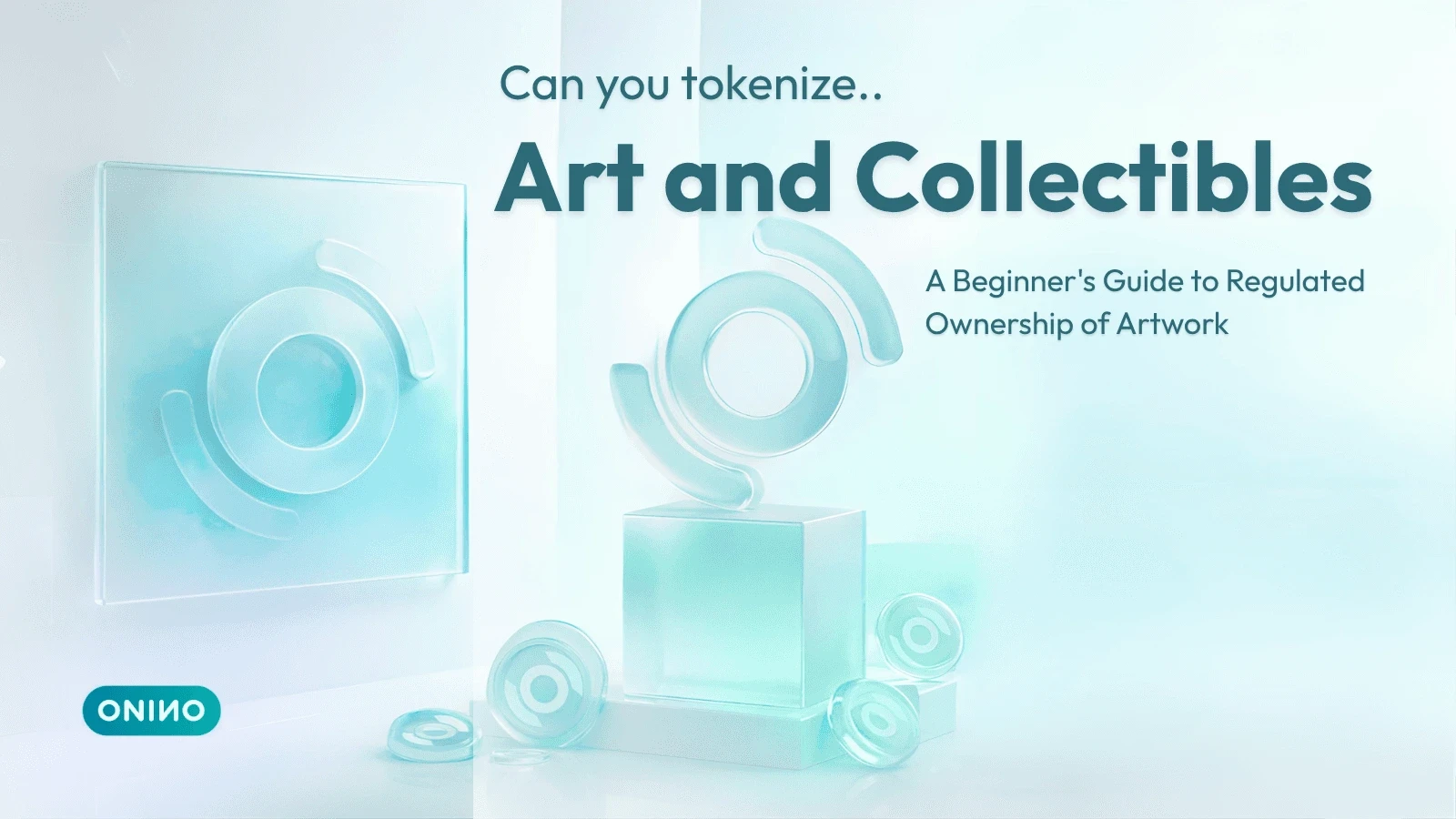
Can You Tokenize Art and Collectibles? A Beginner's Guide to Regulated Ownership
Learn how art and collectibles are tokenized on blockchain, what EU regulation applies, and how tokenized art differs from NFTs

Kristina Stark
Junior Growth Manager
Kristina Stark
Junior Growth Manager
Share
Contact Us
ONINO provides infrastructure for regulated tokenized financing across the EU and Switzerland.
On this page
Quick Takeaway
Art and collectibles can be tokenized, but the structure determines everything. An NFT may certify provenance without conveying ownership, while a regulated security token grants a legally recognized fractional stake via an SPV. In the EU, tokenized art falls under MiFID II or the ECSP Regulation once it conveys economic rights. The category is growing but still faces challenges around subjective valuation, thin secondary market liquidity, and physical custody complexity.
Can You Tokenize Art and Collectibles - And Is It a Regulated Investment?
Yes, you can tokenize art and collectibles. A physical painting, a vintage watch, or a rare trading card can be represented as a digital token on a blockchain - and that token can be bought, sold, or held by multiple investors simultaneously. Whether that token is a regulated investment depends entirely on how it is structured.
This distinction matters more than most beginner guides acknowledge. Tokenized art is not a single thing. It is a category that includes everything from unregulated NFTs to fully regulated security tokens that fall under EU financial law. Understanding the difference determines what investor protections apply, what platforms can legally offer the product, and what rights you actually hold.

What It Means to Tokenize Art or a Collectible
Tokenization is the process of converting ownership rights in a physical or intangible asset into a digital token recorded on a blockchain. In the context of art, this typically means one of two things: a token that represents full or fractional ownership of the underlying artwork, or a token that grants a digital certificate of authenticity or access rights without conveying economic ownership.
The first type - ownership tokens - is what most investors are interested in. A painting worth €500,000 can be divided into 10,000 tokens at €50 each. Each token represents a proportional economic claim on the asset: a share of any appreciation in value, and a share of proceeds if the artwork is sold. This is structurally similar to how real estate is tokenized, and the regulatory implications follow the same logic.
The second type - authenticity or access tokens - is closer to what is commonly called an NFT. These tokens do not necessarily convey ownership of the physical asset. They may simply prove provenance or grant display rights. The legal and regulatory treatment is entirely different.
How the Process Works on Blockchain
The mechanics of tokenizing a physical collectible involve several steps that go well beyond minting a token. First, the asset must be legally transferred into a structure that can issue tokens - typically a special purpose vehicle (SPV) or equivalent legal wrapper. This entity holds the physical asset on behalf of token holders.
Once the legal structure is established, smart contracts are deployed on a blockchain to represent fractional ownership. These contracts enforce the rules of transfer: who can buy, who can sell, and under what conditions. For regulated tokens, smart contracts must include compliance logic - checking that buyers have passed KYC/AML verification before a transfer is allowed. The ERC-3643 standard (also known as T-REX) was built specifically for this purpose and is widely used in European regulated tokenization infrastructure.
The physical asset itself is typically stored with a verified custodian - an insured facility that holds the artwork independently of any single investor. Token holders do not take physical possession; their ownership is recorded on-chain and legally recognised through the SPV structure.
NFTs vs. Regulated Security Tokens
NFTs (non-fungible tokens) and regulated security tokens both live on blockchains, but they are legally and structurally different instruments.
An NFT is a unique digital token. When applied to art, it is commonly used to represent a digital artwork itself, or to certify the provenance of a physical piece. NFTs are generally not considered financial instruments under EU law. They do not typically convey economic ownership of a physical asset, they are not issued under a regulated prospectus, and platforms that sell them do not need a MiFID II or MiCA licence to do so.
A regulated security token representing fractional ownership of an artwork is a different instrument entirely. It conveys economic rights, it is classified as a financial instrument or transferable security under EU law, and both the issuer and the platform distributing it must comply with applicable regulation. Investors receive the protections that come with regulated markets: disclosure requirements, custody rules, and recourse in the event of misconduct.
The practical consequence: if you buy an NFT linked to a painting, you may own a certificate — but not necessarily the painting, or any share of its value. If you buy a regulated security token backed by the same painting, you hold a legally recognised fractional ownership stake with defined rights.
NFT | Regulated Security Token | |
|---|---|---|
Conveys physical ownership | Not typically | Yes, via legal structure |
EU regulatory framework | MiCA (digital assets) | MiFID II / ECSP Regulation |
Investor protections | Limited | Full regulated protections |
Transferability | Unrestricted | Compliance-gated |
Platform licensing required | Varies | Yes |
Are Collectibles a Regulated Investment Under EU Law?
Collectibles — art, wine, watches, rare books — are not automatically regulated investments simply because they are valuable. As physical assets, they sit outside financial regulation. You can buy a Picasso at auction with no regulatory oversight beyond standard consumer law.
The regulatory classification changes when a collectible is tokenized and the token is offered to investors as a financial instrument. At that point, the relevant EU frameworks are MiFID II (Markets in Financial Instruments Directive), the ECSP Regulation (European Crowdfunding Service Providers), and potentially MiCA (Markets in Crypto-Assets Regulation) depending on how the token is structured.
Under MiFID II, a token that grants an economic interest in an underlying asset — including art — and is transferable on a secondary market is likely to be classified as a transferable security. Issuers must either publish a regulated prospectus (or benefit from an exemption, for example offerings under €8 million in most EU member states) and platforms distributing these tokens must be authorised.
Under the ECSP Regulation, platforms can offer tokenized asset investments to retail investors across the EU up to €5 million per issuer per 12 months, under a single EU-wide licence. This is the most accessible regulatory pathway for art tokenization at smaller scale, and several European platforms operate under it.
MiCA, which came into full effect in December 2024, governs crypto-assets that are not already covered by MiFID II. It is most relevant to NFTs and utility tokens. For security tokens representing art ownership, MiFID II remains the primary framework.
What Assets Can Be Tokenized?
Art and collectibles are one category within a much broader universe of tokenizable assets. The practical requirement for tokenization is that the asset can be legally held within a structure that issues tokens, has a determinable value, and can be custodied securely.
In practice, the most commonly tokenized asset classes in Europe today are real estate, private equity, infrastructure, and invoice receivables. Art and collectibles are a growing category but face specific challenges: valuation is subjective, liquidity on secondary markets is thin, and custody of physical objects carries higher operational complexity than, say, a land title.
These challenges are solvable — several regulated platforms already offer tokenized art investments — but they explain why art tokenization remains a smaller share of the overall RWA (real-world asset) market compared to property or financial receivables.
FAQ
Can you tokenize a piece of artwork?
Yes. A physical artwork can be placed into a legal structure (such as an SPV) that issues tokens representing fractional ownership. The token is recorded on a blockchain and can be transferred between investors. The legal validity and investor protections depend on how the token is classified and whether the issuer operates under a regulated framework.
Are collectibles considered an investment?
As physical objects, collectibles are not regulated investments. They become regulated financial instruments when tokenized and offered to investors in a way that conveys economic rights — at which point EU frameworks including MiFID II or the ECSP Regulation apply.
What is the difference between tokenized art and an NFT?
An NFT is a digital token that may certify provenance or represent a digital artwork, but does not typically convey legal ownership of a physical asset or economic rights to its value. A regulated security token representing fractional art ownership does convey those rights and is issued under a regulated legal and compliance framework.
What assets can be tokenized?
Any asset that can be legally held in a structure capable of issuing tokens can in principle be tokenized. Common examples include real estate, private equity, infrastructure, trade receivables, precious metals, and increasingly, art and collectibles.
Summary
Art and collectibles can be tokenized by placing the physical asset into a legal structure that issues blockchain-based ownership tokens.
The regulatory classification of a tokenized art token depends on its structure: NFTs and security tokens are governed by different EU frameworks.
Regulated security tokens representing fractional art ownership fall under MiFID II or the ECSP Regulation and carry full investor protections.
Physical collectibles are not regulated investments; they become so when tokenized and offered as financial instruments.
Art tokenization is a growing but operationally complex segment of the real-world asset market, with secondary market liquidity remaining a practical limitation.
Want to learn more how this can be applied to your business?
Read related Articles
Learn how art and collectibles are tokenized on blockchain, what EU regulation applies, and how tokenized art differs from NFTs