Private placement software for issuers in the EU
Offer bonds, notes or shares to qualified investors or a limited circle, without a public offer and under your own brand.
ONINO is the software for the invite-only offering page, investor onboarding, subscriptions and payouts. Identity checks, payments, custody and any register run through pre-integrated licensed partners.


THE BASICS
What is a private placement?
A private placement is the sale of securities, such as bonds, notes or shares, to a selected group of investors instead of the general public. This can also be a tokenized asset.
In the EU it needs no prospectus, as long as the offer follows one of three routes.
THREE ROUTES
Three routes without a prospectus
Each route has one condition: the number of investors, the ticket size or the type of investor.


INSTRUMENTS
Which instruments fit a private placement
Bonds and notes
Fixed interest and a set term. The most common instrument for a private placement of debt.
Shares and participation certificates
Equity or profit participation in the form of a security, for a defined circle of investors.
Classic or tokenized
Issue the security in classic form or as a tokenized security. Tokenization is optional per offering.





HOW IT RUNS
How a private placement runs on the software
No prospectus does not mean no paperwork.
Every investor still needs an identity check, a classification, signed documents and a matched payment. You also need a clean record of who holds what.


Step 1: Set up and invite
Set up the offering under your brand. Only investors you invite see it.
Step 2: Verify
KYC and investor classification come first.
Step 3: Subscribe
Investors sign online and pay in one go.
Step 4: Pay out and report
One run pays every holder. Investors see positions and documents in their portal.
THE SOFTWARE
What the ONINO private placement software covers
The investor side of your placement, under your brand. Four modules, on every route.
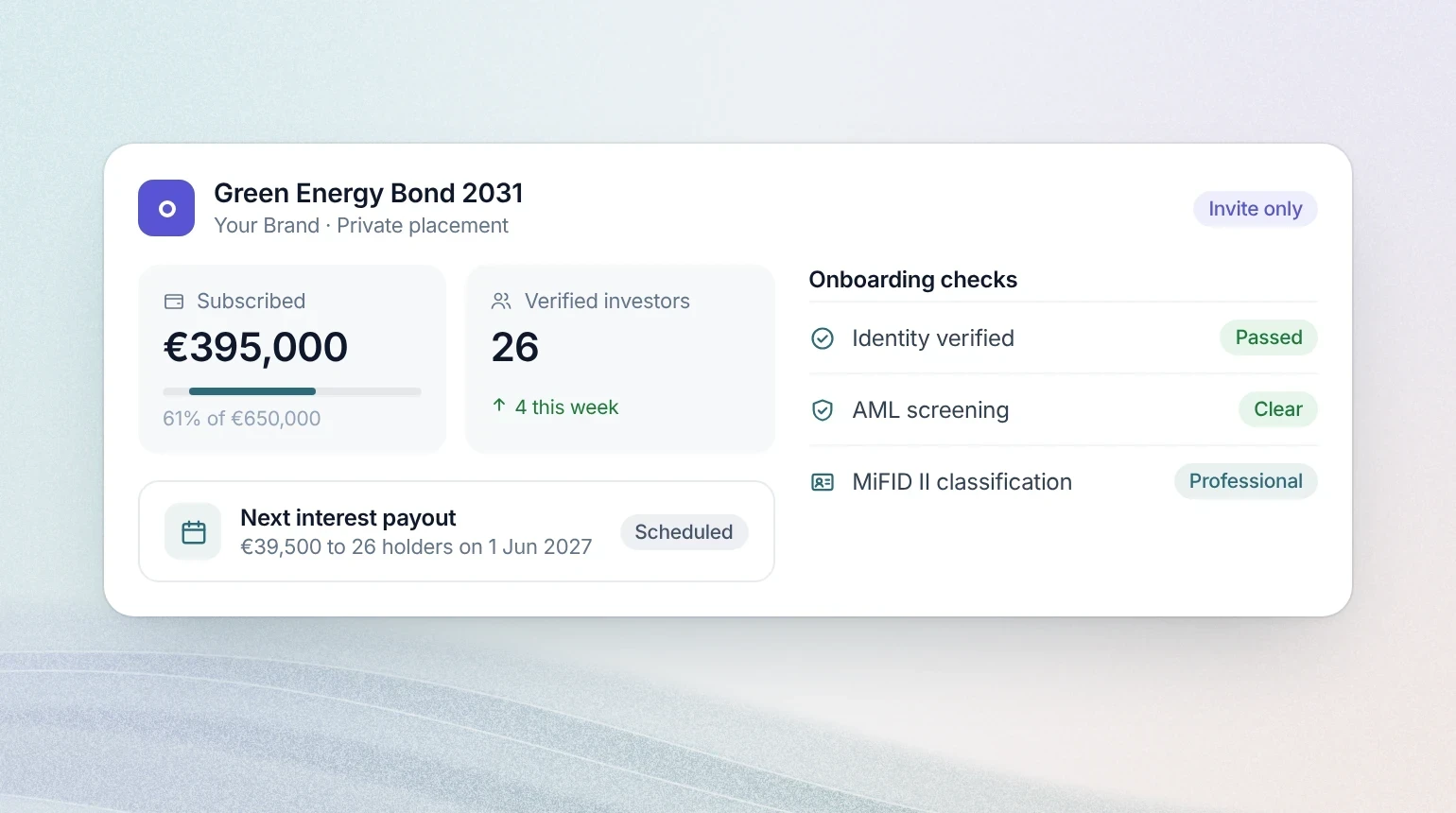

Invite-only subscriptions
A private subscription page on your website. Investors sign online and pay through a licensed payment partner.
Investor onboarding
KYC, AML and MiFID II classification on your domain, before anyone can subscribe.
Interest and payout runs
One run pays every holder, with tax reports for your investors.
Investor portal and reporting
A branded portal with positions, documents and payments.
WHO DOES WHAT
Who does what in a private placement on ONINO


Software, licensed partners and you.
ONINO is a software provider and holds no licence. Each regulated step sits with the party that is licensed for it.
ONINO: the software
The invite-only page, onboarding flow, subscriptions, investor portal and payout runs, under your brand.
Licensed partners: the regulated steps
Identity checks and payments run through connected licensed providers. For tokenized securities, so do custody and any register.
You: the offer
Terms, investor documents, the choice of route and your investor circle stay with you and your counsel.
Distribution: you or a regulated partner
You approach investors yourself or through a regulated distribution partner. ONINO does not broker securities.


INTEGRATIONS
Your stack, already connected.
Payments, identity checks, e-signatures, liability umbrellas, wallets and custody, registers, CRM and support: the providers you need are already connected, so you do not have to source them.


CHECKLIST
What to look for in private placement software
Six points to check before you choose, each with how ONINO covers it.
Invite-only access
Only investors you invite see the offering page.
Onboarding built in
Identity check, AML screening and investor classification before anyone can subscribe.
Subscription and payment in one flow
Investors sign online and pay through a licensed payment partner. You keep a clean record of who holds what.
Payouts and reporting after closing
Interest and repayment runs, tax reports and an investor portal with positions and documents.
Licensed functions already connected
Identity, payment and, for tokenized securities, custody and register providers are integrated. You do not source them.
Your brand, live within one week
The platform runs under your brand and on your domain and is set up within one week. Legal work on your documents comes on top.
WHO IS IT FOR
Who uses private placements: three examples
Companies with an existing investor circle
Issue a bond or note to shareholders, partners and their network instead of taking a bank loan.
Project sponsors with club deals
One project, one vehicle and a small circle of investors with larger tickets.
Asset managers and family offices
Offer notes to professional clients only, with every status on file.
PRIVATE OR PUBLIC
Private placement or public offer?
Three ways to offer securities to investors, compared on document, investors and typical use.
HONEST LIMITS
What a private placement does not change
No prospectus does not mean no rules.
A private placement makes an offer faster to launch, not easier to sell.
It is not unregulated.
KYC, AML, investor classification and marketing rules apply to every private placement.
A resale is a new offer.
Investors cannot pass the securities on to the public without an exemption or a prospectus of their own.
You still bring the investors.
You or a regulated distribution partner approach them; the platform does not fill a placement.
A pool can be a fund.
When pooled money is invested by a defined policy, fund rules under the AIFMD can apply. Counsel checks this first.
FAQ
Private placements: questions from issuers
The questions issuers ask before they start.