Regulierung
Was kostet eine Crowdfunding-Plattform? Kostenüberblick 2026
Was kostet eine Crowdfunding-Plattform 2026? Realistische EUR-Spannen für Software, Lizenz, Recht und Compliance im Vergleich von drei Umsetzungswegen

Kristina Stark
Junior Growth Manager
Zuletzt aktualisiert

Teilen
90% unserer Kunden starten mit einer kostenlosen Strategie.
Auf dieser Seite
Kontaktieren Sie uns
ONINO bietet Infrastruktur für digitale & tokenisierte Finanzierung.
Key Takeaways
Der Start einer regulierten Crowdfunding-Plattform in der EU kostet im ersten Jahr rund EUR 100.000 bis EUR 500.000 und mehr, und nur der Software-Baustein bewegt diese Spanne. / Eine Eigenentwicklung liegt bei EUR 150.000 bis 250.000 und mehr und braucht 12 bis 24 Monate bis zum Marktstart; White-Label-Infrastruktur liegt indikativ bei EUR 100.000 bis 200.000 und 7 bis 10 Monaten. / Lizenz und Rechtsarbeit (EUR 30.000 bis 100.000 zuzüglich Behördengebühren) sowie der laufende Compliance-Betrieb (EUR 60.000 bis 150.000 und mehr pro Jahr) kosten auf jedem Weg gleich viel und fallen wiederkehrend an. / Eine Entwicklungsagentur liefert nur Software; ECSP-Lizenz, lizenzierte Partneranbindungen und der Compliance-Betrieb bleiben beim Betreiber. / Alle kommerziellen Spannen sind Richtwerte aus veröffentlichten Anbieter- und Marktquellen.
Der Start einer regulierten Crowdfunding-Plattform in der EU kostet im ersten Jahr rund EUR 100.000 bis EUR 500.000 und mehr, und nur einer der vier Kostenbausteine bewegt diese Spanne wirklich. Das Budget zerfällt in die Plattform-Software, die ECSP-Lizenz (European Crowdfunding Service Provider, die Zulassung für Schwarmfinanzierungsdienstleistungen nach der EU-Verordnung; Plattformen für Nachrangdarlehen nach § 2a VermAnlG brauchen stattdessen eine Erlaubnis nach § 34f GewO, nach § 15 WpIG oder ein Haftungsdach) samt zugehöriger Rechtsarbeit, die Anbindungen für KYC und Zahlungsverkehr sowie den Compliance-Betrieb, der nach dem Start jedes Jahr weiterläuft. Drei dieser vier Bausteine kosten ungefähr gleich viel, ob die Plattform selbst entwickelt, aus einer Open-Source-Basis angepasst oder als White-Label-Infrastruktur lizenziert wird. Dieser Artikel bepreist jeden Baustein über alle drei Wege: EUR-Spannen für 2026, Behördengebühren in vier Jurisdiktionen, das aufsichtsrechtliche Kapital, das Gründer für eine Ausgabe halten, und den tatsächlichen Leistungsumfang einer Entwicklungsagentur. Damit zeigt sich, warum die belastbare Frage lautet: Was kostet alles um die Software herum?
Die meisten Leitfäden zur Gründung einer Crowdfunding-Plattform arbeiten die Lizenzschritte ab und lassen das Budget als Fußnote stehen. Dieser Artikel macht es umgekehrt und bepreist jeden Baustein der Reihe nach: die Eigenentwicklung, Lizenz und Rechtsaufbau, den Compliance-Betrieb nach dem Start, den tatsächlichen Leistungsumfang einer Entwicklungsagentur, den White-Label-Weg und die Summe, die ein Betreiber in seinen Plan schreiben sollte. Die folgende Tabelle setzt realistische Spannen für 2026, je Kostenbaustein und über die drei Umsetzungswege, zwischen denen Betreiber tatsächlich wählen.
Kostenbaustein | Eigenentwicklung | Open-Source-Basis | White-Label-Infrastruktur |
|---|---|---|---|
Plattform-Software | EUR 150.000 bis 250.000 und mehr Entwicklung vor dem Start | EUR 0 Lizenzkosten; EUR 60.000 bis 150.000 für die Anpassung an ECSPR-Workflows | Einrichtungsgebühr plus Subscription, typischerweise niedriger bis mittlerer fünfstelliger Betrag pro Jahr |
Lizenz und Recht | EUR 30.000 bis 100.000 Beratung und Recht, zuzüglich Behördengebühren | EUR 30.000 bis 100.000 Beratung und Recht, zuzüglich Behördengebühren | EUR 30.000 bis 100.000 Beratung und Recht, zuzüglich Behördengebühren |
Compliance-Betrieb (pro Jahr) | EUR 60.000 bis 150.000 und mehr, jedes regulatorische Update liegt beim eigenen Team | EUR 60.000 bis 150.000 und mehr, jedes regulatorische Update liegt beim eigenen Team | EUR 60.000 bis 150.000 und mehr, plattformseitige Updates liegen beim Anbieter |
Anbindungen (KYC, Zahlungen) | EUR 15.000 bis 40.000 Integrationsaufwand, zuzüglich Gebühren pro Prüfung und Transaktion | EUR 15.000 bis 40.000 Integrationsaufwand, zuzüglich Gebühren pro Prüfung und Transaktion | Vorintegrierte lizenzierte Partner; nutzungsabhängige Gebühren bleiben |
Wartung (pro Jahr) | 15 bis 20 Prozent der Entwicklungskosten, EUR 25.000 bis 50.000 und mehr | Hosting, Patches und Upgrades beim eigenen Team, EUR 20.000 bis 60.000 | In der Subscription enthalten |
Zeit bis zum Marktstart | 12 bis 24 Monate | 9 bis 16 Monate | 7 bis 10 Monate |
Indikative Gesamtkosten im ersten Jahr | EUR 250.000 bis 500.000 und mehr | EUR 150.000 bis 350.000 | EUR 100.000 bis 200.000 |
In den Betreiberplänen, die wir prüfen, wird eine Position häufiger missverstanden als jede andere, und das ist das Kapital. Eine zugelassene Crowdfunding-Plattform muss jederzeit aufsichtsrechtliche Sicherheitsvorkehrungen vorhalten, mindestens den höheren Betrag aus EUR 25.000 und einem Viertel der fixen Gemeinkosten des Vorjahres, zuzüglich drei Monatsbeträgen der Kosten für die Kreditbedienung, wenn sie zusätzlich die Vergabe von Krediten vermittelt. Die Anforderung stammt aus der EU-Schwarmfinanzierungsverordnung (ECSPR); andere Regeln greifen nur, wenn das Unternehmen bereits eine Bank-, Wertpapierfirmen-, E-Geld- oder Zahlungsdiensteerlaubnis mit eigenen Kapitalanforderungen hält. Die Absicherung kann als Eigenmittel bestehen (hartes Kernkapital, Common Equity Tier 1, also die strengste Form von Eigenkapital nach den regulatorischen Abzügen und nicht einfach jedes Eigenkapital in der Bilanz), als geeignete Versicherungspolice oder als Kombination aus beidem.
Eine Plattform, die weniger als zwölf Monate tätig ist, hat kein Vorjahr und rechnet den Betrag stattdessen aus Planzahlen, weshalb EUR 25.000 eine Untergrenze und kein Standardwert ist. Als Eigenmittel gehalten ist das eine Kapitalanforderung und keine Ausgabenposition: Das Geld wird in die Bilanz geholt und muss dort als Eigenkapital bleiben, und die Untergrenze steigt mit den Gemeinkosten, sobald die Plattform wächst. Für Gründer, die eine Seed-Runde einsammeln, entscheidet dieser Unterschied darüber, welcher Teil der Runde Arbeitsbudget ist und welcher Teil in der Bilanz einfach liegen bleiben muss.
Für die Budgetplanung hilft ein Raster, das wir den Crowdfunding-Plattform-Kosten-Stack nennen: Software, Lizenz und Recht, Anbindungen, Compliance-Betrieb. Software ist die Ebene, die sich mit der Beschaffungsentscheidung am stärksten verändert, denn die drei übrigen verschwinden mit ihr nicht: Sie sind durch regulatorische Anforderungen und durch die lizenzierten Partner eines Angebots gesetzt und begleiten die Plattform auf jedem Weg, den ein Betreiber wählt. In den Betreiberprojekten, die ONINO bisher kalkulatorisch begleitet hat, macht die Software über die ersten drei Jahre typischerweise weniger als ein Drittel der Gesamtkosten aus, sobald Lizenz, Recht und Compliance-Betrieb eingepreist sind. Einen unabhängigen EU-weiten Benchmark für diese Kosten gibt es nicht, die Zahl ist daher eine eigene Beobachtung von ONINO. Das legt nahe, dass eine Make-or-Buy-Diskussion, die ausschließlich über Entwicklungsangebote geführt wird, über die kleinere Zahl verhandelt.
Was kostet die Eigenentwicklung einer Crowdfunding-Plattform?
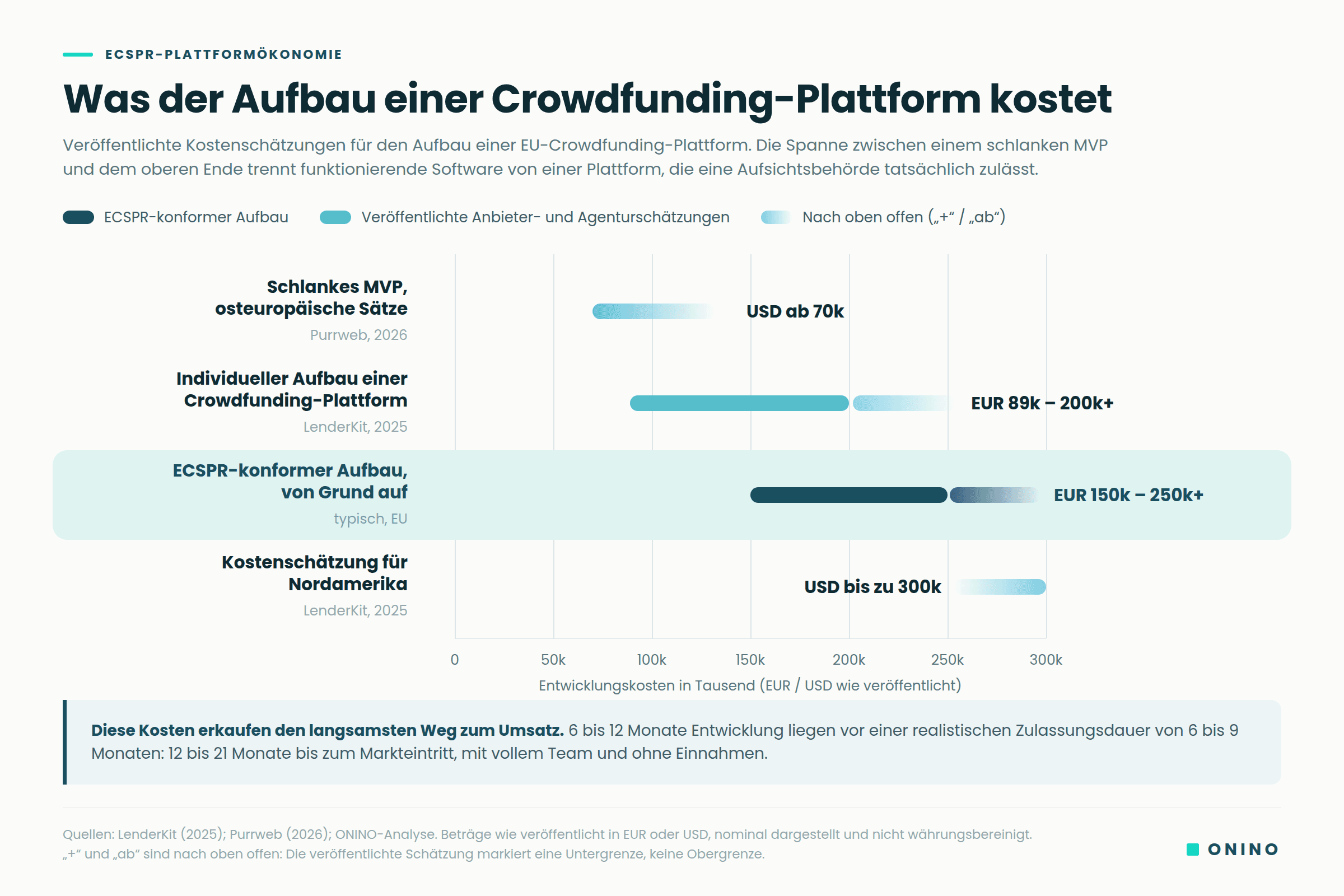
Eine ECSPR-konforme Crowdfunding-Plattform von Grund auf zu entwickeln kostet typischerweise EUR 150.000 bis 250.000 und mehr und dauert 6 bis 12 Monate, bevor die Aufsicht mit ihrer Prüfung überhaupt beginnt. Veröffentlichte Anbieter- und Agenturstudien rahmen diese Größenordnung ein: Die eigene Untersuchung von LenderKit setzt individuelle Plattform-Entwicklungen bei EUR 89.000 bis 200.000 und mehr an, nordamerikanische Schätzungen reichen bis USD 300.000 (LenderKit, 2025), und Agentur-Guides aus 2026 kalkulieren ein schlankes MVP ab etwa USD 70.000 zu osteuropäischen Stundensätzen (Purrweb, 2026). Der Abstand zwischen USD 70.000 und USD 300.000 beschreibt den Unterschied zwischen einem MVP und einer Plattform, die eine Aufsichtsbehörde akzeptiert.
Die Zahl ist hoch, weil eine ECSPR-Plattform regulatorische Software ist und keine Marktplatz-Vorlage. Der Zulassungsantrag muss die Verfahren hinter dem Anlagebasisinformationsblatt (KIIS), dem Standard-Informationsdokument zu jedem Angebot, und hinter den Anlagegrenzen beschreiben, die nicht erfahrene Anleger schützen, also normale Privatanleger. Anschließend prüft die Aufsicht die übrige Mechanik in der Praxis: Kenntnisprüfung beim Einstieg, Verlustsimulation, die vier Kalendertage Bedenkzeit, in denen ein Anleger widerrufen kann, und der KIIS-Workflow selbst müssen vor der Zulassung existieren und nachweisbar funktionieren. Eine generische E-Commerce- oder Spenden-Codebasis enthält nichts davon, weshalb der Großteil des Budgets in Compliance-Funktionen fließt, die ein Erstgründer nie zuvor spezifizieren musste.
Die Entwicklungskosten kaufen zugleich den langsamsten Weg zum Umsatz. Mit 6 bis 12 Monaten Entwicklung vor einer Zulassung, die realistisch sechs bis zwölf Monate in Deutschland, Frankreich und Spanien und etwa drei bis fünf Monate in Litauen und Estland dauert, liegt die gesamte Zeit bis zum Marktstart in den großen Märkten bei 12 bis 24 Monaten, in denen der Betreiber ein komplettes Entwicklungsteam trägt und nichts einnimmt. Für Gründer ist das ein Liquiditätsproblem, lange bevor es ein Produktproblem wird, denn die Finanzierung muss fast zwei Jahre an Gehältern tragen, bevor die erste Emission über die Plattform abgeschlossen ist.
Was kosten ECSP-Lizenz und Rechtsberatung?
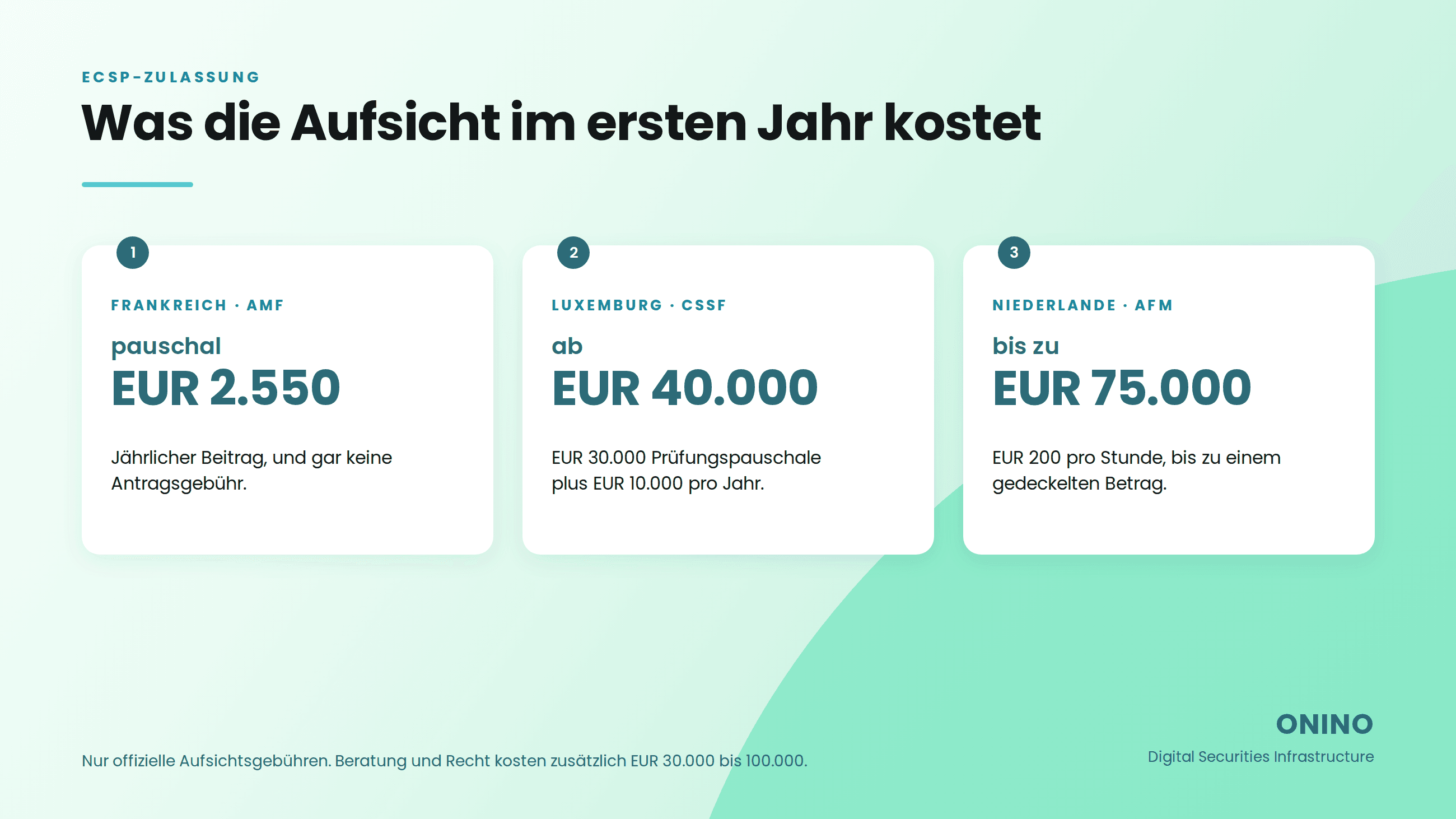
Für Beratung und Rechtsarbeit rund um die ECSP-Zulassung sind EUR 30.000 bis 100.000 einzuplanen, abhängig von Jurisdiktion und Komplexität. Die Behördengebühren kommen hinzu und liegen je Land weit auseinander: Die niederländische AFM rechnet EUR 200 pro Stunde mit einer Obergrenze von EUR 75.000 ab, zuzüglich EUR 700 und EUR 2.700 je Person für die Prüfung von Zuverlässigkeit und Eignung der Geschäftsleiter; die luxemburgische CSSF verlangt eine Prüfungspauschale von EUR 30.000 plus eine Jahresgebühr von EUR 10.000 und eine volumenabhängige Komponente von bis zu EUR 30.000; die französische AMF erhebt einen Jahresbeitrag von EUR 2.550 und überhaupt keine Antragsgebühr; und die BaFin berechnet für die Zulassung nach ihrer Gebührenverordnung (FinDAGebV Nr. 28.1) 5.685 Euro, für eine spätere Erweiterung der Dienstleistungen 2.256 Euro. Ein erstes Jahr, das in Frankreich EUR 2.550 und in Luxemburg über EUR 40.000 kostet, zeigt einen Abstand, der groß genug ist, dass die Wahl der Heimataufsicht ins Budgetmodell gehört.
Dieser Baustein steht in jeder Spalte der Kostentabelle identisch, weil die Lizenz am Betreiber und an der Tätigkeit hängt, nie an der Software. Kein Beschaffungsweg schafft sie ab, kein Anbieter kann sie für den Betreiber halten, und die Fristen der Aufsicht laufen gleich, ob die Plattform hinter dem Antrag gebaut oder gekauft wurde: 25 Arbeitstage für die Prüfung, ob das Dossier vollständig ist, danach eine dreimonatige Bewertung, die erst mit der Vollständigkeit beginnt. Jede Ersparnis auf dieser Ebene entsteht daher aus einem saubereren Antragsdossier.
Ein Punkt zum Umfang hält das Budget ehrlich. Die ECSP-Zulassung deckt Schwarmfinanzierungsdienstleistungen nach der Verordnung ab und sonst nichts. Will die Plattform zusätzlich Produkte anbieten, die außerhalb der Verordnung liegen, etwa qualifizierte Nachrangdarlehen nach deutschem Recht, braucht diese Produktschiene ihre eigene nationale Erlaubnis mit eigenem Rechtsbudget. Das heißt im Kern: Jedes weitere Instrument im Angebot öffnet die Rechtsposition im Budget erneut, weshalb Produkt-Roadmap und Erlaubnisplanung zum selben Zeitpunkt geschrieben werden müssen. Dieser Artikel kalkuliert den ECSPR-Plattformfall; Verbraucherkredite, Rewards und Spenden liegen vollständig außerhalb der ECSPR und folgen anderen Regeln.
Was kostet der laufende Compliance-Betrieb nach dem Start?
Die laufende Compliance ist der Baustein, den Gründer am häufigsten aus dem Modell weglassen, und über die Lebensdauer der Plattform wird sie meist zum größten. Einzuplanen sind EUR 60.000 bis 150.000 und mehr pro Jahr für eine Compliance-Verantwortung im Team, externe Prüfungen, IKT-Kontrollen und Tests nach DORA (dem EU-Regelwerk für die digitale Widerstandsfähigkeit von Finanzunternehmen), aufsichtsrechtliches Reporting sowie die Arbeitszeit für die Prüfung eines Anlagebasisinformationsblatts (KIIS) zu jedem Angebot, oder für dessen Erstellung im eigenen Haus, wenn die Plattform Kreditportfolios verwaltet. Einen veröffentlichten Benchmark, an dem sich diese Spanne messen ließe, gibt es nicht: Die European Digital Finance Association teilte der Kommission im September 2025 mit, dass weder die Wissenschaft noch die ESMA noch nationale Aufsichtsbehörden systematisch Daten zu den Kosten der ECSPR-Zulassung oder zu den Betriebskosten insgesamt erheben. DORA gilt für Crowdfunding-Plattformen seit 2025, der IKT-Teil dieses Budgets ist damit gesetzliche Pflicht. Eine Erleichterung erhalten Crowdfunding-Plattformen dabei nicht: Die vollen Regeln zum IKT-Risikomanagement greifen, eine leichtere Behandlung ist nur für die kleinsten Unternehmen vorgesehen. Gegen eine einmalige Entwicklung von EUR 150.000 bis 250.000 und mehr gerechnet, übersteigen wiederkehrende EUR 60.000 bis 150.000 pro Jahr die Softwareausgaben am Mittelwert beider Spannen innerhalb von zwei Jahren. Ein Modell, das mit dem Marktstart endet, setzt die tatsächlichen Kosten des Geschäfts damit zu niedrig an.
Die Wegentscheidung verändert nur, wer die plattformseitige Arbeit innerhalb dieses Budgets erledigt. Auf einer eigenentwickelten oder Open-Source-Plattform landet jede Klarstellung der ESMA, jede Änderung der Reporting-Formate und jeder DORA-Befund im eigenen Entwicklungs-Backlog, während auf gepflegter White-Label-Infrastruktur der Anbieter die plattformseitigen Updates liefert und das Compliance-Team des Betreibers sie anwendet. Die aufsichtsrechtliche Verantwortung selbst wandert nie: Aufsicht, Prüfungen und Meldepflichten bleiben auf jedem Weg beim lizenzierten Betreiber. Für ein kleines Team ist die praktische Folge eine Personalstelle, denn eine selbst betriebene Plattform setzt stillschweigend eine Entwicklerin oder einen Entwickler mit ECSPR-Kenntnissen voraus, und diese Position ist schwerer zu besetzen, als die Budgetzeile vermuten lässt.
EUROCROWD, das European Crowdfunding Network, beschrieb das Muster im April 2025 so: "Platforms already stretched thin may be forced to consolidate or seek external partnerships to remain compliant. Combined with the slow uptake of DORA and limited interest in FIDA, the sector faces what could be termed 'compliance fatigue.'"
Reicht es, eine Crowdfunding-Plattform entwickeln zu lassen?
Eine Agentur für Plattform-Entwicklung kann die Software-Ebene liefern, und nur diese. Die ECSP-Lizenz, die Verträge mit lizenzierten Zahlungs- und KYC-Partnern und der jährliche Compliance-Betrieb lassen sich nicht als Entwicklungsdienstleistung einkaufen, weil sie am Betreiber hängen: Die Aufsicht lässt Sie zu, das Zahlungsinstitut kontrahiert mit Ihnen, und die Meldepflichten sind Ihre. Das ist das teuerste Missverständnis im ersten Budget, denn es verwandelt drei der vier Kostenbausteine in Überraschungen, die erst eintreffen, wenn die Software bereits bezahlt ist.
Diese Grenze zählt beim Vergleich von Angeboten. Ein Agenturangebot deckt typischerweise Discovery, Design, die Kampagnen- und Funding-Logik, die Zahlungsintegration, ein KYC-Modul und ein Admin-Panel ab, genau der Umfang, der sich in veröffentlichten Komponentenpreisen spiegelt (Purrweb, 2026). Was kein Entwicklungsvertrag enthält: das Nachweispaket für den Zulassungsantrag, die IKT-Dokumentation, die eine Aufsicht erfahrungsgemäß prüft, die lizenzierten Partnerbeziehungen hinter Zahlungen und Identitätsprüfung sowie die Pflege der Compliance-Logik nach der Übergabe. Sobald die Agentur ausgeliefert hat, wird jede ECSPR-Änderung zum bezahlten Change Request auf der Zeitachse des Betreibers.
Nichts davon macht Entwicklungsagenturen zur falschen Wahl für Teams, die ihre Codebasis besitzen wollen. Sie sind die Teilantwort auf eine Frage, die überwiegend regulatorisch ist. Ein Agenturangebot über EUR 150.000 beantwortet eine Zeile der Kostentabelle, die übrigen Zeilen kommen trotzdem, und zwar pünktlich.
Was kostet eine White-Label-Crowdfunding-Plattform?
White-Label-Infrastruktur für Crowdfunding kostet bei den meisten Anbietern typischerweise eine Einrichtungsgebühr plus eine Subscription im niedrigen bis mittleren fünfstelligen Bereich pro Jahr, was veröffentlichte Anbieterpreise mit rund USD 400 bis 2.000 pro Monat bestätigen, dazu ein britischer Anbieter mit GBP 2.500 bis 5.500 und einzelne Anbieter mit Aktivierungsgebühren über USD 20.000 plus einer Beteiligung am Emissionsvolumen (LenderKit, 2025). Im Kostenvergleich mit einer Eigenentwicklung liegt der Unterschied im ersten Jahr typischerweise im sechsstelligen Bereich, und die wiederkehrende Subscription ersetzt sowohl die Wartungszeile als auch den größten Teil der plattformseitigen Compliance-Entwicklung. Das bedeutet, dass die Ersparnis Geld und Reihenfolge zugleich betrifft: Der Betreiber bezahlt kein Entwicklungsteam mehr dafür, die Startlinie überhaupt zu erreichen, und zahlt für eine Plattform, die bereits steht.
Die Gebühr kauft den Teil des Kosten-Stacks, den Software tatsächlich übernehmen kann: fertig gebaute und validierte ECSPR-Workflows (Anlegerkategorisierung, Kenntnisprüfung, Warnhinweise und Zustimmungsschwellen bei Anlagegrenzen, Bedenkzeit, KIIS-Handling), vorintegrierte lizenzierte KYC- und Zahlungspartner, sodass der Integrationsaufwand auf Konfiguration schrumpft, und ein Anbieterteam, das regulatorische Updates ausliefert, wenn sich die Regulierung bewegt. Die Gebühr kauft weder Lizenz noch Kapital noch Verantwortung; diese bleiben auf jedem Weg beim Betreiber, und genau deshalb lautet das ehrliche White-Label-Argument Geschwindigkeit und Planbarkeit.
Das ist die Rechnung hinter der White-Label-Finanzierungsinfrastruktur von ONINO: Der lizenzierte Betrieb gehört Ihnen, die vorintegrierte Plattform darunter wird für Sie gepflegt, und Zulassung und Plattform-Setup laufen parallel, was die Zeit bis zum Marktstart verkürzt.
Womit sollten Betreiber insgesamt kalkulieren?
Ein realistischer Plan für das erste Jahr landet beim Software-Stack bei EUR 250.000 bis 500.000 und mehr für die Eigenentwicklung, EUR 150.000 bis 350.000 auf Open-Source-Basis und EUR 100.000 bis 200.000 auf White-Label-Infrastruktur, jeweils vor den aufsichtsrechtlichen Sicherheitsvorkehrungen, also dem höheren Betrag aus EUR 25.000 und einem Viertel der fixen Gemeinkosten, der damit mit der Kostenbasis mitwächst. Ab dem zweiten Jahr tragen Eigenentwicklung und Open Source die Wartung plus Compliance-Entwicklung, während der White-Label-Weg die Subscription plus den eigenen Compliance-Betrieb trägt. Der Abstand zwischen dem günstigsten und dem teuersten Weg beträgt im ersten Jahr damit rund EUR 300.000, und fast alles davon liegt in einem einzigen Baustein.
Letztlich bepreist sich die Entscheidung als Tausch zwischen Investitionsausgaben und Monaten: Je mehr vom Software-Baustein ein Betreiber selbst baut, desto mehr Geld und Kalenderzeit liegen vor der ersten Emission, während der regulatorische Unterbau auf jedem Weg gleich viel kostet. Unter den vier Bausteinen verdient der Compliance-Betrieb die größte Aufmerksamkeit. Mit EUR 60.000 bis 150.000 und mehr pro Jahr ist er die einzige Position, die nach dem Marktstart weiter wächst, und die einzige, die kein Anbietervertrag für den Betreiber übernehmen kann.
Gründer sollten daher das dritte Jahr durchrechnen, bevor sie sich für einen Umsetzungsweg entscheiden, und die künftige Compliance-Verantwortung neben der Entwicklung in dieses Gespräch holen. Wenn eine Zahl schon in Ihrem Plan steht, ist der nächste Schritt, sie Baustein für Baustein zu prüfen: was die Software-Ebene auf dem Weg kostet, zu dem Sie tendieren, welche Anbindungen bereits über vorintegrierte lizenzierte Partner abgedeckt sind, und welche Positionen bei Ihnen als lizenziertem Betreiber bleiben, ganz gleich welche Plattform darunter läuft.
Bringen Sie Ihr Modell in einen Walkthrough des Kosten-Stacks mit, und wir bepreisen den Software- und den Anbindungsbaustein daran, und benennen anschließend die Positionen, die Ihnen kein Software-Anbieter abnehmen kann.
General information only, accurate at the date shown. Not legal, tax or investment advice. Confirm your own position with qualified counsel.
Want to learn more how this can be applied to your business?
Ähnliche Artikel lesen
Was kostet eine Crowdfunding-Plattform 2026? Realistische EUR-Spannen für Software, Lizenz, Recht und Compliance im Vergleich von drei Umsetzungswegen


