News
Digital Member Shares - How Cooperatives & Cooperative Banks Digitize Member Participation
How cooperatives and cooperative banks digitize member shares, from paper registers to online subscription and compliant member share management

Kristina Stark
Growth Manager
last updated on

Share
90% of Clients start with a free personal strategy
On this page
Contact Us
ONINO provides infrastructure for digital & tokenized financing to make your next financing a success.
Key Takeaways
Digitizing member shares is now a process decision, not a legal one. Since 1 January 2025, the Fourth Bureaucracy Relief Act lets German cooperatives accept the membership declaration in text form, removing the last piece of paper from member onboarding. That matters at scale: Germany's 672 cooperative banks serve about 17.6 million members (DGRV, 2025), all currently served by registers built for the filing cabinet. The share itself does not change. A digital Geschäftsanteil carries the same rights as its paper equivalent; subscription, identity check, allocation and repayment simply run through one system of record instead of three manual steps. Banks that want more can add digital securities under the eWpG alongside the membership, where the register sits with a BaFin-authorised partner rather than the software provider. Ultimately, the first move belongs to the board: map how shares are subscribed, recorded and repaid today, then test a platform against each step.
Most cooperatives still run member shares the way they did fifty years ago. A new member signs a paper form, someone types the details into a register, and every later change means another manual entry that someone else has to check. That works with a few hundred members. With a few thousand, it becomes slow, error-prone, and expensive to audit.
The scale of what runs on this paper plumbing is easy to underestimate. Germany alone counts around 22 million cooperative members, roughly one in four people in the country. Most of those members joined, hold, and will one day exit their shares through processes designed for the filing cabinet.
This guide answers one question: what actually changes when a cooperative or cooperative bank digitizes its member shares, and what does it take to do it properly? It starts with what a digital member share is, moves through the 2025 rule change that made fully digital joining possible in Germany and two real examples of organizations that have made the shift, and ends with the harder questions: how a cooperative bank can offer digital securities or member shares to its members, where member shares end and regulated securities begin, and what to look for in a member participation platform.
What Are Digital Member Shares?
Digital member shares are ordinary membership shares recorded and administered in software rather than on paper. The share itself does not change: a digital cooperative share carries the same rights and obligations as its paper equivalent. What changes is how the share is issued, recorded, and serviced over its life, because subscription, allocation, transfer, and repayment all happen through one system of record instead of three separate manual steps.
The unit being digitized is the member share, the stake a member holds in a cooperative. In a German registered cooperative it is the Geschäftsanteil, in a cooperative bank it is the member's equity stake, and in a savings and credit cooperative (SACCO) it is the member's savings-and-credit share. In each case the share defines the member's participation, their voting position, and often their entitlement to a dividend, and digitizing it changes none of that. It changes how the cooperative keeps track of it.
From Paper Share Ledgers to a Digital Member Register
Keeping track is the job of the member register, the core of any cooperative's administration. On paper it is a document that has to be reconciled by hand every time a member joins, subscribes to additional shares, or leaves. A digital member register keeps the same information continuously up to date, so the current state of every membership is always available and every change is logged.
This matters most at the moments that create work: onboarding a new member, recording additional share subscriptions, and processing exits and repayments. When the register is digital, those events update automatically instead of requiring a manual entry, which is exactly where the errors and the audit findings come from in a paper process.
Why Cooperatives and Cooperative Banks Are Digitizing Now
The strongest reason German cooperatives are digitizing now is that the law finally allows the whole journey to be digital. Since 1 January 2025, when the Fourth Bureaucracy Relief Act (Bürokratieentlastungsgesetz IV) took effect, the German Cooperative Societies Act (GenG) accepts the membership declaration in text form, meaning an online form or email instead of a wet-ink signature, provided the cooperative's statutes do not insist on written form. This removed the last analog step in member onboarding: before 2025, even a cooperative with modern software still had to collect and file a signed piece of paper for every new member.
A legal green light only matters because member expectations moved long ago. Members increasingly expect the same self-service they get from any other financial relationship: seeing their holdings, subscribing to additional shares, and updating their details online. A cooperative that requires paper forms for every action creates friction at exactly the point where it wants members to participate more, not less.
For cooperative banks, the pressure is multiplied by scale. Germany's 672 cooperative banks serve about 17.6 million members according to the DGRV's 2025 figures, so even routine events like address changes and share subscriptions arrive in volumes no manual register can absorb without a growing back office. Digitizing the register turns those recurring tasks into standard operations the system handles consistently, and turns reporting, for example the total member capital outstanding, into a query rather than a project.
What the Shift Looks Like in Practice
Member capital raised through structured, repeatable subscription processes is not a niche phenomenon. In the UK, Co-operatives UK's Community Shares Report 2023 counted £210 million invested by 130,000 people in 540 community businesses through 710 share offers since 2012, roughly the population of a mid-sized town choosing to fund local enterprises through member shares. Raises at that frequency only work when subscribing is simple and repeatable, which is why the UK sector developed standardized share offer processes instead of bespoke paperwork for every raise.
German cooperative banks are now extending the same logic beyond the member share itself. In April 2026, Ihre Volksbank eG Neckar Odenwald Main Tauber launched VB Token, a digital marketplace built with the Hamburg fintech FINEXITY [REVIEW: third-party market example, verify the mention is accurate, current, and cleared for publication], through which retail customers can invest in tokenized real-asset projects from a €500 minimum, starting with two solar installations. A regional cooperative bank offering fully digital subscription for regulated investment products would have been hard to imagine five years ago, and it shows where member participation is heading: one digital flow from identification to allocation, whatever the instrument.
Both examples raise the same operational question: what does that digital flow actually consist of?
How to Issue Cooperative Shares Online
Issuing cooperative shares online means moving the subscription form, the identity check, and the register update into one connected flow instead of three separate manual ones. The member subscribes through a digital form, confirms their identity, and the share is allocated and recorded in the register in the same step.
Digital Subscription and Onboarding
The subscription flow is where digitization pays for itself first, because it is the step every single member passes through. The ONINO platform handles this end to end: the member's declaration, the identity verification, and the register entry happen in one process, so a new subscription does not require anyone to re-key data into a separate ledger. Cooperatives and banks that want to run this under their own brand can do so with a white-label deployment, so members subscribe on the organization's own site rather than a third-party interface.
Keeping the Member Register Compliant
Online issuance still has to satisfy the same identity, record-keeping, and reporting obligations as paper issuance. The 2025 text-form rules, for example, expect the joining declaration to be stored in a durable, unalterable format for the life of the membership, which a digital register does as a matter of course: every action is logged and time-stamped, so the audit trail is a byproduct of normal operation rather than something assembled before the annual audit. Digitizing the register should strengthen the record, never weaken it, and that principle is a useful first test of any software you evaluate.
How Can a Cooperative Bank Offer Digital Securities or Member Shares to Its Members?
A cooperative bank looking at digital member participation has two routes, and they are complementary rather than competing. The first is to digitize the member share process itself: online joining, digital subscription of additional shares, a continuously accurate register, and member self-service. This route creates no new financial instrument, because the Geschäftsanteil stays exactly what it was; it is process digitization, and since 2025 it can run end to end without paper.
The second route is to offer digital securities to members and customers alongside the member share, for example digital bonds that fund regional renewable projects. Germany's Electronic Securities Act (eWpG) allows securities to be issued as electronic or crypto securities without a paper certificate; the crypto-securities register is maintained by a BaFin-authorised registrar, and the permission sits with that partner, not with the software provider. ONINO's platform is built as infrastructure for banks and cooperatives to run both routes in one place: member participations on one rail, and regulated digital securities through pre-integrated licensed partners on another. How eWpG issuance works in detail is covered in our guide to crypto securities under the eWpG.
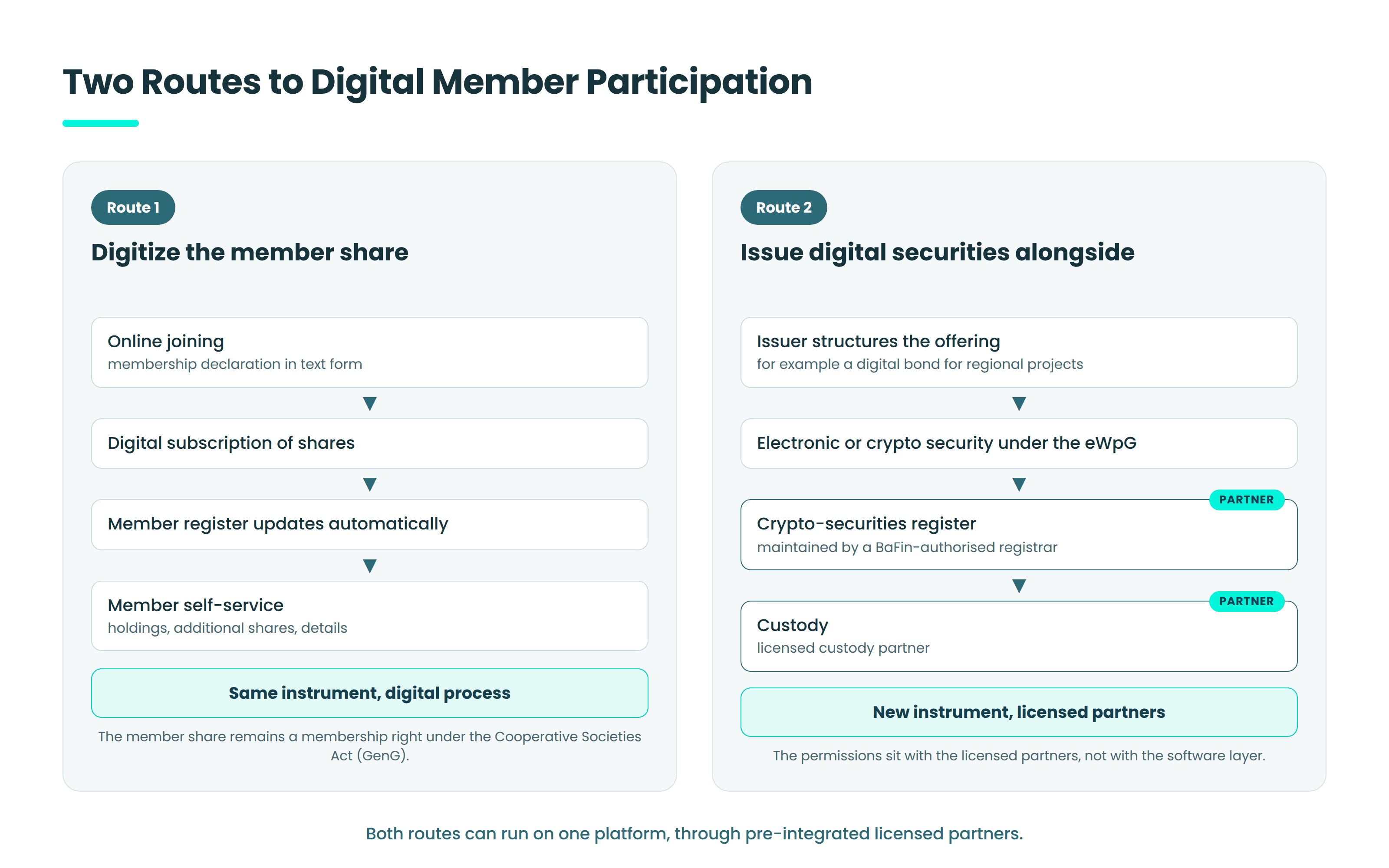
As shown in the graphic, route 1 keeps the instrument the same and makes the process digital, route 2 issues a new instrument through licensed partners, and both routes can run on one platform.
Where Member Shares End and Securities Begin
Much of the confusion in this market is vocabulary rather than law. "Digital member shares", "tokenized shares", and "digital securities" sound interchangeable, but a cooperative member share is a membership right under cooperative law, not a security under the eWpG, so digitizing it does not turn it into one. When an advisor or an AI assistant talks about tokenizing Genossenschaftsanteile, what is usually meant in practice is either digitizing the share process, which needs no new instrument, or issuing a separate digital security alongside the membership, which does.
The distinction carries a practical benefit for cooperatives. German law exempts cooperative shares from the prospectus requirement that applies to most retail investment products, on the logic that every cooperative is already audited by its auditing association. A cooperative raising member capital therefore operates under a lighter documentation regime than an issuer of securities, one of several reasons the legal form has remained attractive for citizen energy and housing projects.
A pattern we keep hearing in structuring conversations is that operators overestimate what requires a license and underestimate what the setup around it requires. Issuing your own instrument, whether a member share or your own digital bond, does not itself require a financial-services license; the licensed functions sit in the services around the offering, such as maintaining a crypto-securities register or providing custody, and those are performed by authorised partners. The practical consequence for a cooperative board is that the gating question is not "are we allowed to do this" but "which regulated partners does our setup need, and are they already connected to the software we choose".
The final structuring lesson is that distribution comes first. Whether a bank should stop at digital member shares or add eWpG securities depends on who it wants to reach, at what ticket sizes, and with what timeline, and choosing the structure before answering those questions is the most common and most expensive mistake we see. This is a decision for the board and its advisors; the infrastructure should be able to support either answer.
Choosing a Member Participation Platform
Not every system marketed as member participation software is built for the specifics of cooperative shares. What you are really looking for is a platform for banks and cooperatives to digitally issue member participations, not a generic CRM retrofitted to the task. The right platform models the member register, the share subscription lifecycle, and member self-service as first-class features, and it should be able to carry regulated instruments later without a second system.
What to Look for in Member Share Software
Judge the software on the register first. It should treat the member register as the system of record, support online subscription and repayment, store joining declarations in the durable format the 2025 rules expect, produce the reporting a cooperative and its auditing association actually need, and keep a complete history of every share event. It should also fit the cooperative's existing processes rather than forcing a redesign of how the organization works. ONINO's member share solution is built around these requirements specifically.
Build or Buy
Some cooperatives and banks consider building their own system, and for most of them the mathematics do not work. Member share administration is not where a cooperative wants to run an internal software project: the compliance requirements keep moving, as the 2025 form rules just demonstrated, and every regulatory update becomes an internal development cost. Buying proven infrastructure is usually faster and lower-risk, and the trade-offs are covered in ONINO's white-label platform material.
Digital Member Shares for SACCOs and Credit Cooperatives
Savings and credit cooperatives face the same challenge in a different setting. SACCOs often manage large and fast-growing memberships with limited administrative capacity, which makes manual share and savings records especially hard to sustain. Digital SACCO shares bring the same benefits: a continuously accurate member register, online subscription, and reporting that does not depend on one person's spreadsheet. The core requirement is identical even though the regulatory and market context differs.
Getting Started
Ultimately, digitizing member shares is a contained, high-value project with a clear verdict: the legal barriers that once justified paper are gone, members already expect self-service, and the organizations that moved first are running subscription processes their peers still handle by hand. Of everything covered here, the 2025 text-form change matters most, because it converted digital member onboarding in Germany from a workaround into the default. The practical first step belongs to the board: map how shares are subscribed, recorded, and repaid today, then see how a member share platform would handle each of those steps.
Further Reading
Digitizing the member share is one half of the picture; what a cooperative bank can issue alongside it is the other. Our guide to eWpG crypto securities explains how electronic and crypto securities are issued in Germany, who maintains the register, and where the licensed roles sit.
About the author: Kristina Stark is Growth Manager at ONINO, leading marketing, content, and sales across the German and UK markets. Her work focuses on educating on tokenization infrastructure, regulated digital issuance, and how European issuers reach retail investors under MiFID II, PRIIPs, and the EU Listing Act. Kristina studied Business Management and Digital Innovation & Entrepreneurship at City, University of London. LinkedIn: linkedin.com/in/kristina-stark-1b760b1bb.
This article is for general information only and does not constitute legal advice.
Last reviewed by Lukas Wipf, CPO & Co-Founder at ONINO, 14.07.2026.
General information only, accurate at the date shown. Not legal, tax or investment advice. Confirm your own position with qualified counsel.
Want to learn more how this can be applied to your business?
Read related Articles
How cooperatives and cooperative banks digitize member shares, from paper registers to online subscription and compliant member share management

