News
Tokenized Asset-Backed Lending: The Operations Case for Asset Managers
Asset managers can originate, service, and report on tokenized asset-backed lending using shared-ledger infrastructure and loan data.

Lukas Wipf
CPO & Co-Founder
last updated on

Share
90% of Clients start with a free personal strategy
On this page
Contact Us
ONINO provides infrastructure for digital & tokenized financing to make your next financing a success.
Key Takeaways
Tokenized asset-backed lending is becoming a practical operating layer for asset managers rather than a fringe experiment: a model in which loans secured by real-world collateral are issued, tracked, and serviced as digital instruments on a permissioned shared ledger, giving managers a more auditable and operationally efficient way to run private credit. Collateral, ownership, and repayment terms live in one shared record, so servicing and reporting stop depending on scattered spreadsheets. Tokenized lending is not a new asset class; it is a new operating layer under lending that already exists. The near-term winners are asset and wealth managers who want to add facilities without rebuilding the back office for each deal. MiCAR applies where the instrument is a crypto-asset rather than a financial instrument; the EU Prospectus Regulation applies to offerings of instruments that qualify as securities, absent an exemption; in Germany, the eWpG gives a bond's electronic register its legal basis.
Private-credit managers are rarely short of deals. They are short of the back-office capacity to service the deals they already have. Tokenized asset-backed lending answers that constraint: it is a financing model in which a loan secured by real-world collateral, such as receivables, real estate, equipment, or a fund position, is issued and administered as a digital instrument on a permissioned shared ledger. The loan terms, the collateral claim, the investor register, and the repayment schedule live in one record rather than a bundle of separate contracts, spreadsheets, and custody statements. The model changes how a loan is originated, serviced, and reported, not what it legally is.
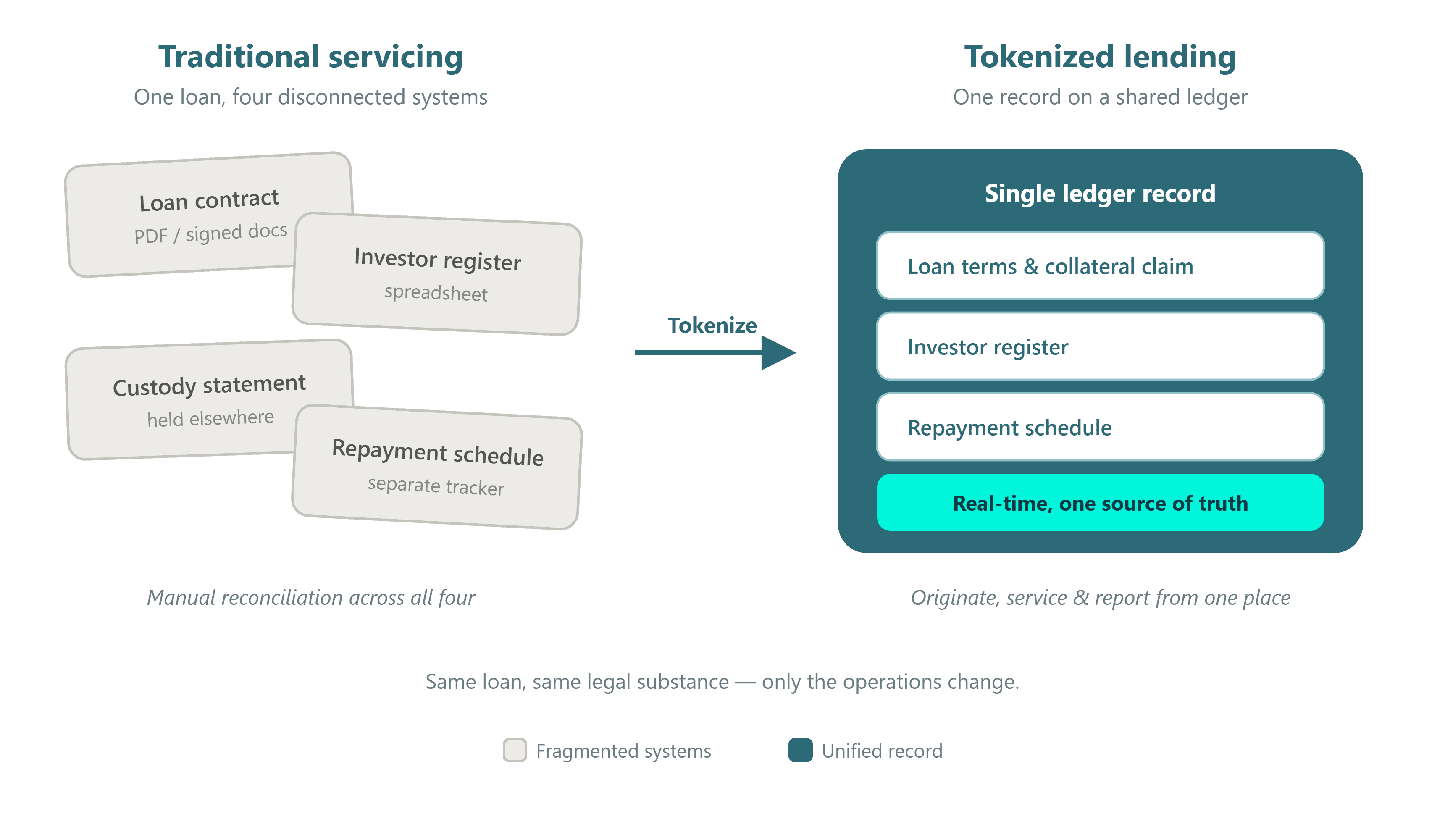
As shown in the graphic, traditional servicing spreads one loan across four disconnected systems: a signed loan contract, an investor register in a spreadsheet, a custody statement held elsewhere, and a repayment schedule on its own tracker, all reconciled by hand. Tokenized lending collapses those four into one shared record holding the loan terms and collateral claim, the investor register and the repayment schedule. Same loan, same legal substance; only the operations change.
How asset-backed lending works on a shared ledger
1. Origination
The process starts the same way any secured loan does. The issuer defines the facility (the loan amount, term, rate, and structure), the borrower pledges collateral against it, and investors are onboarded through KYC and suitability checks before they can participate. Nothing here is new or automated away; the shared ledger picks up after these fundamentals are in place.
2. Off-chain legal step (where required)
Certain types of collateral still require a traditional legal action that no ledger can replace. A real-estate lien, for example, still has to be created and recorded in the land register under existing property law. The ledger doesn't remove this step; it simply records the resulting claim once the off-chain formality is complete.
3. Digital issuance
Once the facility and collateral are set, the loan claim is issued as a digital instrument on the shared record. Instead of the claim existing only as a paper contract or an entry in one party's private system, it becomes a native record on the ledger that authorized participants can reference directly.
4. On-ledger maintenance
The collateral position, the investor register, and the cash-flow waterfall are all maintained on one shared record. Because every authorized party reads from the same source, there's no need to reconcile separate copies of the data after the fact. What one party sees is what every party sees, updated in the same place at the same time.
5. Servicing waterfall
The servicing waterfall is the contractual order in which repayments are allocated: fees first, then interest, then principal. On a shared record this order is applied once and immediately reflected for every holder, rather than being calculated separately by each party and then checked against one another.
How do tokenized loans differ from a traditional facility?
Tokenized loans differ from a traditional facility mainly in operations, not in legal substance - specifically in how the investor register, servicing, collateral monitoring, transfer, and reporting are handled. A tokenized loan is still a debt claim with a borrower, a rate, a maturity, and collateral; what changes is that issuance, transfer, servicing, and reporting run on one record instead of across an arranger, a paying agent, a registrar, and a custodian who each keep their own copy.
Dimension | Traditional asset-backed loan | Shared-ledger asset-backed loan |
|---|---|---|
Investor register | Maintained by a registrar, updated periodically | Single shared record, updated at settlement |
Servicing and cash-flow waterfall | Reconciled across parties, often monthly | Applied once to the record, reflected for all holders |
Collateral monitoring | Assembled from statements after the period | Tracked against the loan on an ongoing basis |
Transfer / secondary sale | Manual, bilateral, slow to settle | Rule-based transfer within a permissioned circle of eligible investors |
Reporting to investors | Periodic PDF statements | Live position and audit trail from the same record |
The practical result is a shorter path from commitment to funded position and a cleaner audit trail, which matters more to a manager running many facilities than any single feature.
Where does tokenized credit fit in a portfolio?
Tokenized credit fits wherever a manager already runs private debt but is constrained by administration rather than by deal supply. The differentiator is operational - settlement speed, granular collateral data, and servicing transparency - not a new place in the asset-allocation mix. Take a receivables-financing facility: borrower reporting often arrives on a different cadence than the investor NAV cycle, so operations teams spend the month reconciling the two. On a shared record, borrower data, collateral coverage, and investor positions update from the same source. The same pattern extends to a private-credit strategy or a real-estate mezzanine position, though each diverges: real estate keeps the off-chain land-register step, and mezzanine adds its own subordination and enforcement waterfall.
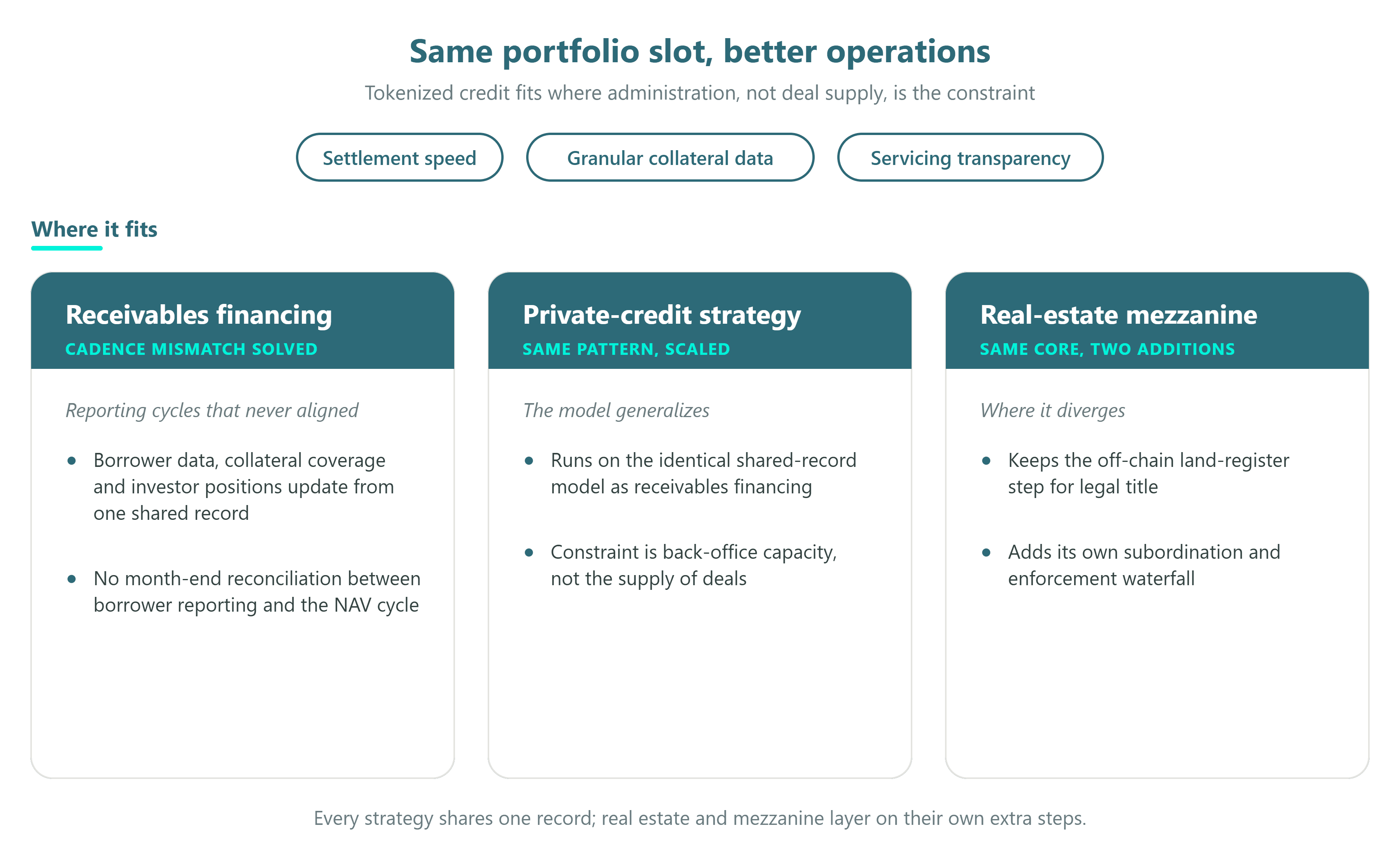
As shown in the graphic, the operational difference sits in three places: settlement speed, granular collateral data and servicing transparency. Across three strategies, receivables financing solves the cadence mismatch so borrower data, collateral coverage and investor positions update from one record; a private-credit strategy runs the same pattern scaled; real-estate mezzanine keeps that core and adds two steps, the land-register step for legal title and its own enforcement waterfall.
Why does tokenized lending matter for asset managers?
For asset and wealth managers, the binding constraint in tokenized lending is usually operational capacity, not origination. In a traditional setup, every new facility means another registrar relationship, another reconciliation cadence, and another reporting stream. Teams end up rebuilding the same administrative scaffolding deal after deal.
A reusable issuance-and-servicing layer removes that repetition. A multi-family office can add loans and investors without a linear increase in back-office work, and compliance and audit teams get a single source of truth. Consider a manager running many receivables facilities: today, each one carries its own registrar and reconciliation relationship. On a shared record, those converge toward a single workflow.
That layer is one origination-to-servicing stack covering origination and eligibility, collateral and register, automated servicing, and controlled secondary transfer. Each stage of the loan lifecycle has one clear home.
Our private credit solutions and asset managers pages show how this maps to live mandates.
What are the risks and the regulatory perimeter?
Risks
1. Standard credit and collateral risk
These are the same risks that come with any secured loan. Putting a loan on a shared record does nothing to reduce default risk, valuation risk, or the need for proper investor protection. The ledger changes the record-keeping, not the underlying obligation - the borrower still has to repay and the collateral still has to hold its value.
2. Operational and legal execution
On top of the credit risk sits the work of issuing the instrument correctly. Structuring, documentation, and issuance all have to be done properly, and errors here create legal exposure that has nothing to do with the borrower's ability to pay.
3. Platform risk
Using a shared ledger introduces a dependency on the platform operator: business continuity, key custody, and liability during an outage or security incident. In practice these sit with the operator under the contract and service-level terms. Those terms should also cover what happens if the operator is wound down or loses its licence - through data escrow and exit rights that keep the register available. Any point the contract leaves silent should be treated as a diligence item.
Regulatory perimeter
1. Legal classification (the unsettled part)
Whether a given secured-loan claim is treated as a security, a fund unit, or a receivable is not yet standard practice. In Germany, an unsecuritised loan claim offered to investors is typically treated as a Vermögensanlage under the VermAnlG (Vermögensanlagengesetz) unless it is structured as a Schuldverschreibung. In a live deal this is usually resolved with securities counsel, and where needed through engagement with BaFin, before issuance.
2. eWpG - bearer bonds
Where the claim is structured as a bearer bond, Germany's eWpG (Gesetz über elektronische Wertpapiere, the 2021 Electronic Securities Act) lets that bond be issued in a crypto securities register (Kryptowertpapierregister). There, the register entry - not a paper certificate - is the record of legal title. Fund units fall in scope on a phased basis.
3. MiCAR - crypto-assets
Where an instrument qualifies as a crypto-asset rather than a financial instrument, the EU's Markets in Crypto-Assets Regulation (MiCAR) applies instead.
4. Prospectus Regulation
Offerings of instruments that qualify as securities still trigger the Prospectus Regulation unless an exemption applies - in Germany, often a lighter BaFin filing rather than none.
5. Enforcement - the collateral's own register controls
On default, the collateral's own register is what counts: a real-estate lien is realised through the land register, not the ledger. The two records therefore have to be reconciled on default, and responsibility for any lag belongs in the platform contract.
See how this works on your own facilities
None of this replaces credit judgement or legal structuring; it changes where the record lives and how much back-office work each new facility adds. The clearest way to judge that trade-off is against a mandate you already run. If your team is onboarding facilities faster than operations can absorb them, a short walkthrough shows how origination, servicing, and reporting converge on one record, and where the off-chain and regulatory steps still apply to your specific collateral.
Keep reading: for a closer look at where positions like these sit in a wider portfolio, read our piece on capital allocation in private markets.
This article is for general information only and does not constitute legal advice.
Last reviewed by Lukas Wipf CPO & Co-Founder at ONINO, 26 June 2026.
General information only, accurate at the date shown. Not legal, tax or investment advice. Confirm your own position with qualified counsel.
Want to learn more how this can be applied to your business?
Read related Articles
Asset managers can originate, service, and report on tokenized asset-backed lending using shared-ledger infrastructure and loan data.

