News
How to Tokenize Private Credit: Loan Portfolios in the EU (2026 Guide)
Private credit tokenization in the EU: why a loan isn't a security, the five steps to issue a loan portfolio as tokens, and which regime applies.

Kristina Stark
Growth Manager
last updated on

Share
90% of Clients start with a free personal strategy
On this page
Contact Us
ONINO provides infrastructure for digital & tokenized financing to make your next financing a success.
Key Takeaways
A loan isn't a security, so private credit tokenization always means issuing something else first: notes from a vehicle that holds the loans. Loans don't appear in MiFID II's list of financial instruments; the notes over them do, and ESMA confirmed in March 2025 that tokenizing a financial instrument doesn't change its classification. MiCAR is the wrong rulebook for these structures. The decision that drives everything is tranching: senior and junior token classes trigger the Securitisation Regulation with a 5% retention, loan-level reporting and retail limits, while a single pro rata class doesn't. Under AIFMD II, which EU countries must apply from 16 April 2026, funds that originate loans (loan-originating AIFs) face leverage caps of 175% of net assets if open-ended and 300% if closed-ended, and a 20% limit on loans to any single borrower that is a financial company, a fund or a UCITS.
Private credit means loans made to companies by non-bank lenders such as funds, and it is one of the least liquid things a professional investor can own. A loan sits on a balance sheet until it matures, it is priced by agreement rather than by a market, and selling a slice of it means finding a buyer, negotiating a transfer, and usually asking the borrower for consent. Private credit tokenization keeps coming up in our conversations with asset managers and private markets firms, but many projects stall because the loans first need a legal structure that trips many people up.
The question this guide answers is straightforward: what does it take to issue a pool of loans as tokens in the EU, and which rulebook are you under once you do? The short answer is that the technology is the easy part, and that is the part ONINO's software covers. The hard part for companies is that a loan isn't a security, so before anything can be tokenized, something else has to be created that can be. This guide is general information, not legal advice.
What is private credit tokenization?
Private credit tokenization, also called loan tokenization, means issuing digital tokens that give investors a share in the returns of one loan or a pool of loans. The tokens aren't the loans themselves. They are usually notes, a simple kind of bond, issued by a company set up only to hold the loans (a vehicle), and recorded on a shared digital register, not a spreadsheet.
A loan agreement is a contract between two named parties, and moving it means formally transferring that contract, often with the borrower's consent. A note issued against a pool of loans is a security, and moving it means updating a register. Tokenization therefore leaves the loan where it is and puts a transferable instrument on top of it.
That transferable instrument is still rare. Tokenised assets on public blockchains were worth about €38 billion in February 2026, less than a fiftieth of one percent of traditional financial markets, according to the European Central Bank's Macroprudential Bulletin of 13 April 2026. The mechanics work and the volumes are small, which means the real limit on what a loan book can become is legal.
Why is private credit a good fit for tokenization?
Private credit suits tokenization for the same reason it is hard to sell: it has no system for recording owners or moving shares between investors, so one has to be built anyway. A listed bond already comes with a security code (ISIN), a bank that holds it for investors and a system that settles trades. A direct loan has a loan agreement, a spreadsheet and a lawyer. Swapping that spreadsheet for a digital register, which can automatically block transfers to the wrong buyers, is a small step. For listed bonds, the same switch means replacing systems that already work.
The fractionalisation argument, that tokens let you split a loan into many small pieces, is real but narrower than it is usually presented. What tokenization changes is the cost of administering many small holders: allocations, distributions, transfer approvals and investor reporting all become operations on a register rather than documents passed between parties, which removes part of why capital allocation stays inefficient in private markets. It doesn't create buyers, and it doesn't make an illiquid loan liquid. An instrument is liquid when someone wants it at a price, and a token wrapper does nothing about that.
The market data supports this reading and also shows how carefully it has to be read. RWA.xyz, the reference dataset for on-chain real-world assets, showed tokenized credit at US$8.17bn in distributed value (tokens investors can actually hold and transfer) but US$36.08bn in represented value (assets only mirrored on-chain) when we checked it on 21 September 2026. The two figures differ more than fourfold, and the category also counts on-chain crypto lending alongside loans to companies. This means the size of the market says little about whether your loan book can be issued; the structure decides that.
For a manager or an originator, the practical consequence is that tokenization is an operations decision: it changes how you administer holders, not who buys or how liquid the loans are. The European Securities and Markets Authority (ESMA), the EU's markets supervisor, puts the same thought in one line in its Risk Monitor of 11 March 2026: tokenisation adoption "remains low but is gaining momentum". That operations work is where a programme is won or lost, and it follows five steps.
How to tokenize a loan portfolio in the EU: five steps
Tokenizing a loan portfolio in the EU takes at least these five steps: check which loans can be transferred, choose the vehicle and instrument, decide on tranching, build the compliance layer and issue, then service the loans for their whole life. Each step limits the next, as it does when tokenizing invoices and trade receivables.
Step 1: Establish what you hold and what you can move
Read the loan agreements before anything else. Assignment clauses, borrower consent requirements, confidentiality undertakings and governing law decide whether the loans can be transferred into a vehicle at all, and which ones have to be left behind. For loans you are originating rather than buying, this step is also where you decide who the lender of record is, because originating loans commercially is a licensed activity in many member states, and the licence rules are national rather than EU-wide. Buying existing loans isn't automatically licence-free either: in some member states, buying receivables on an ongoing basis under a framework agreement, in a way that finances the seller, counts as factoring and needs its own licence, as it does in Germany.
Step 2: Choose the vehicle and the instrument
The loans go into a special purpose vehicle, and the vehicle issues something investors can hold. That instrument is usually a note or bond, and whether it can live on a distributed ledger depends on the member state where it is issued: Luxembourg, France and Germany, for example, each allow debt securities to be issued or recorded on a ledger, but under different conditions. The choice made here decides almost everything downstream: your supervisor, your disclosure obligations, and whether your investors can hold the instrument at all.
Step 3: Decide whether you are tranching
If the notes are split into senior and junior classes so that losses hit one before the other, the structure is a securitisation and the EU Securitisation Regulation (Regulation (EU) 2017/2402) applies. If every token carries the same pro rata claim on the same undivided pool, it isn't a securitisation. This is a binary fork, it is decided at structuring, and it is the single most expensive thing to get wrong.
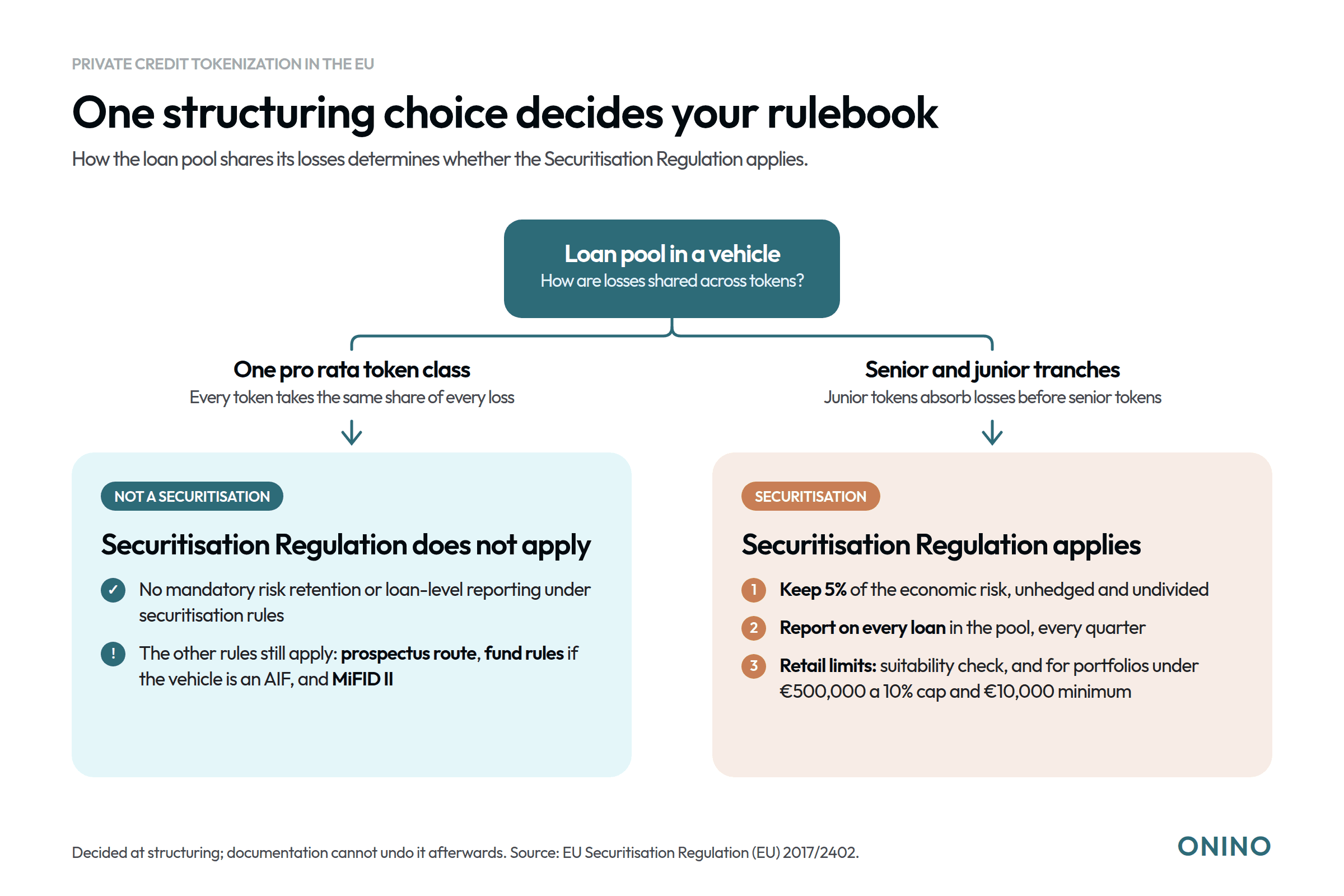
Step 3 carries more weight than the other four, as the graphic shows. A single class of tokens keeps the structure outside the Securitisation Regulation; senior and junior tokens add obligations for the life of the programme, including a 5% retention, quarterly reporting on every loan and limits on retail sales. The table sets the tranching choice next to the four other structuring decisions.
Decision | Options | What it drives |
|---|---|---|
Transfer mechanism | Assignment of existing loans, or origination inside the vehicle | Whether a lending or factoring licence is needed, and by whom |
Instrument | Bearer bond, note, fund unit, participation right | Supervisor and disclosure regime |
Loss allocation | Pro rata single class, or senior and junior tranches | Whether the Securitisation Regulation applies |
Investor base | Professional only, or retail included | Prospectus route, minimum tickets, distribution channel |
Register | Central register, DLT-based register, or private ledger | Which licensed partner records ownership |
Step 4: Build the compliance layer and issue
This step covers investor identity and anti-money-laundering checks (KYC/AML), transfer restrictions enforced in the token contract itself rather than in a side agreement, a prospectus or a documented exemption, and the reporting cadence you will owe afterwards. Transfer restrictions belong in the contract because the point of the register is that it is the source of truth; a whitelist that lives somewhere else reintroduces the manual approval step you were trying to remove.
Step 5: Run the loan book for its whole life
In private credit, servicing is most of the product. Interest collection, covenant monitoring, amortisation, workouts, restructurings and defaults all have to flow through to token holders as payments and as disclosures. A tokenized loan portfolio is a servicing job, done by the issuer or its servicer, with a register attached, and servicing, not issuance, is where programmes most often come under strain.
Legal work decides the cost and timeline of a programme. Reviewing the loan agreements and structuring the vehicle usually take longer than setting up the issuance software, and the main cost drivers are legal structuring, the vehicle itself, registrar and custody fees, and servicing for the life of the loans. Tranching adds the retention and loan-level reporting on top, which is why the single-class route is the lighter one.
The most relevant live case we can show is a bond rather than a loan pool, but it's built on the same instrument a loan-pool vehicle issues in step 2. A German SME raised about €2 million through a digital bond on ONINO's software, recorded by a licensed registrar partner. Roughly 1,000 retail and professional investors took part, about €2,000 each on average. Instead of a full prospectus, the company used a short securities information sheet that BaFin, Germany's financial supervisor, had to clear for publication, and that clearance took up most of the three months to launch. The total cost was 1 to 3% of the volume, roughly €20,000 to €60,000, split about evenly between technology, legal work and distribution. A bank loan wasn't an option, because the company's bank wouldn't have financed a deal that size.
That deal was a bond rather than a loan pool, but a loan programme runs through the same issuance, with two extra steps on top: checking which loans can be moved (step 1) and deciding on tranching (step 3). The lesson carries over directly. The technical setup was the quick part, and the BaFin clearance set the timeline. For anyone planning a loan programme, that means starting the legal and regulatory work first, because it decides both when you can launch and what it will cost.
Which EU rules apply to tokenized private credit?
Which rules apply depends on the choices made in steps 2 and 3, not on the technology. There are six EU rulebooks worth knowing. For a simple setup, one class of notes sold only to professional investors, usually only three matter: securities law (MiFID II), the fund rules (AIFMD II) and the prospectus rules.
MiFID II: the rules for selling your tokens
MiFID II (Directive 2014/65/EU) is the EU's main securities rulebook, and it decides whether what you issue counts as a security. A loan doesn't, because loans aren't on MiFID II's list of financial instruments. A note issued by a vehicle that holds those loans usually does, as long as it passes three tests: it isn't used for payment, it comes in identical units, and it can be traded. For example, a vehicle that holds 200 SME loans and issues €10 million of identical notes is issuing securities, and putting those notes on a blockchain changes nothing, as ESMA confirmed in its March 2025 guidelines on classifying crypto-assets as financial instruments. So MiFID II doesn't cover the loans themselves, but it does cover the tokens you sell over them: whoever places the tokens for others or advises on them needs the right licence, and investors have to be checked before they buy.
MiCAR: the rulebook that usually doesn't apply
MiCAR (Regulation (EU) 2023/1114) is the EU's rulebook for crypto-assets such as stablecoins, and it usually doesn't apply to tokenized private credit. It excludes anything that already counts as a security, and it separately excludes securitisations. So the €10 million note example above sits outside MiCAR because it's a security, and a version split into senior and junior tokens sits outside it twice over. Many articles still discuss tokenized credit under MiCAR, so it's worth knowing you can usually set it aside.
AIFMD II: when your vehicle counts as a fund
The EU fund rules (AIFMD II, Directive (EU) 2024/927) apply if your vehicle counts as an alternative investment fund (AIF), which is any vehicle that pools investors' money and invests it under a set policy, the same test that applies when an asset manager tokenizes a fund. The bar is low: even a vehicle with one investor today can qualify if nothing stops it from taking more. For example, a vehicle that collects money from 50 investors and lends it to companies under fixed lending criteria is likely an AIF, and an AIF has to be run by an authorised or registered fund manager. Since 16 April 2026, funds that mainly make loans, or whose loans reach 50% of their value, face extra limits: they usually have to be closed-ended, their total exposure is capped (a fund with €100 million of its own capital can carry at most €175 million if open-ended, or €300 million if closed-ended), they must keep 5% of any loan they make and then sell on, and they can lend at most 20% of their capital to a single financial company, fund or UCITS. Funds set up before 15 April 2024 get transitional relief, in some cases until April 2029. Securitisation vehicles are exempt from these fund rules, which is one more reason the tranching choice in step 3 matters.
Securitisation Regulation: the cost of tranching
The Securitisation Regulation (Regulation (EU) 2017/2402) applies as soon as you split a loan pool into layers that take losses in a set order. For example, if senior tokens get paid first and junior tokens absorb the first losses, that's a securitisation. Three duties then follow for the life of the programme: you must keep 5% of the risk yourself without hedging it, you must report on every loan in the pool every quarter, and you can sell to retail investors only after a suitability check, with extra caps (at most 10% of their portfolio and a €10,000 minimum) for clients holding less than €500,000 in financial instruments. You'd accept this when investors want different risk levels, for example an insurer that wants a safer senior slice while you keep the riskier junior part. If nobody needs that, a single class of tokens avoids the regulation entirely.
Prospectus rules: how much paperwork a public offer needs
The prospectus rules decide what you must publish before offering your notes to the public. Since 5 June 2026, the EU Listing Act (Regulation (EU) 2024/2809) exempts public offers below €12 million per issuer over twelve months from a full prospectus across the EU; each EU country may lower this limit to €5 million. Germany uses the €12 million limit, up from €8 million, but still asks for a short securities information sheet that BaFin must clear for publication, which is the route the €2 million SME bond above took. Other countries set their own limits, so check yours with local counsel. A loan book aimed at institutional investors will usually go above these limits, so you'd plan either for a full prospectus or for an offer made only to professional investors, which doesn't need one.
ELTIF: the route to retail investors
An ELTIF (European Long-Term Investment Fund, Regulation (EU) 2023/606) is the EU fund format built to let ordinary investors into private markets, and it's the main fund route if you want to sell private credit to retail investors. Since its reform took effect on 10 January 2024, there's no €10,000 minimum and no 10% portfolio cap; a suitability check replaces both. An ELTIF can lend directly to companies, within a 20% limit per borrower that falls away if the fund is sold only to professionals. For example, a manager who wants to offer a private credit fund to private clients through their banks would set it up as an ELTIF, with tokenization as the register underneath, handling investor management at fund scale.
How does tokenizing a loan portfolio differ from tokenizing a bond?
That register looks identical whether it records a tokenized bond or a tokenized loan portfolio, but the structuring problems underneath are different.
A bond is already a security before anyone tokenizes it, whether it comes from a bank-led deal or a direct bond issuance without a bank. The issuer has a credit story, the instrument has terms, and the tokenization question is only where the register sits. A loan portfolio has none of that. The instrument doesn't exist until you create it, the credit story is a pool of separate borrowers rather than one, and the cash flows are irregular because loans amortise, prepay, get restructured and default at different times. National securities law makes the difference concrete: in Germany, for example, a bearer bond can be issued as an electronic security, while a loan or a subordinated loan used in tokenized financing can't, so the bond is the vehicle by which the loan portfolio reaches a register at all.
The second difference is who bears the credit analysis. A bond investor underwrites one issuer. A private credit token holder is underwriting a portfolio they usually can't see loan by loan, which is why the disclosure question matters more here, and why the Securitisation Regulation's loan-level reporting obligations exist in the first place.
Where can tokenized private credit trade?
Disclosure helps a holder judge the portfolio, but selling a token needs a venue, and on-chain secondary trading of tokenized private credit is currently possible only on a handful of authorised EU venues, with very small volumes. The EU's DLT Pilot Regime (Regulation (EU) 2022/858), a sandbox that lets approved venues trade and settle securities on a blockchain, was built to host it, and ESMA's latest official count (its June 2025 review, data as of 31 May 2025) showed three authorised market infrastructures: CSD Prague, 21X AG and 360X AG, with around ten further applicants at various stages. ESMA's review of the regime, published 25 June 2025, described trading activity on them as "extremely limited" and named the causes as thresholds too restrictive to justify commercial engagement, no settlement in central bank money, and no interoperability with existing CSDs and payment systems.
The European Commission proposed a fix in December 2025, which would remove the size caps on each type of security, raise the aggregate ceiling to €100 billion and drop the time limits on permissions. It is a proposal and not law, so nothing in a 2026 offering document should assume it. One of the three causes has since been addressed: on 21 September 2026 the Eurosystem launched Pontes, which links DLT platforms to its TARGET services so that tokenised assets can settle in central bank money. The other two, restrictive thresholds and missing interoperability with existing CSDs, still stand, so plan for investors who hold to maturity, with transfers recorded by the registrar rather than traded on a venue. Where liquidity in tokenized debt does and doesn't come from is covered in where tokenized debt unlocks liquidity.
Between holding to maturity and trading on a venue sits a simpler route. ONINO's platform includes a notice board where holders can signal that they want to sell. It doesn't match orders, set prices or execute trades: any sale is agreed directly between seller and buyer, checked against the token's transfer rules and recorded by the licensed registrar, while trading on regulated secondary markets runs through licensed partners. It isn't a trading venue and doesn't guarantee a buyer.
What decides the outcome of private credit tokenization?
Ultimately, private credit tokenization is a structuring exercise wearing a technology costume. The loan can't be tokenized; a note over a pool of loans can, and everything that decides the cost, the timeline and the investor base of a programme is settled in how that note is built rather than in which chain it runs on.
Of the decisions involved, tranching matters most: senior and junior classes bring in the Securitisation Regulation and its life-long retention and reporting duties, while a single pro rata class is the lighter route. Every other question (the vehicle, the prospectus route, the register, the distribution channel) is easier to answer once that one is settled.
The next action belongs to whoever owns the loan book: read the assignment clauses, decide whether you are originating or acquiring, and decide whether you are tranching. Those three answers settle the main regime, shorten the list of the others and show which licensed partners you need. ONINO's private credit issuance software then supports issuance, investor onboarding and servicing flows, with the register and other licensed functions handled by partners, while the issuer keeps the loan book and the offering obligations. On a short call, ONINO walks through your loan book with you, shows which routes and partner roles could fit and lists what is still missing, while legal structuring stays with your counsel. For the day-to-day view, read the operations case for tokenized asset-backed lending.
Frequently asked questions
What is tokenized private credit?
Tokenized private credit is a digital note, issued by a vehicle that holds a pool of loans, that gives investors economic exposure to those loans. The loans stay in the vehicle; only the note is recorded on a distributed ledger.
Is a tokenized loan a security in the EU?
The loan isn't. Loans don't appear in MiFID II's list of financial instruments, and credit appears only as an ancillary service for investors trading financial instruments. The note or bond a vehicle issues against a pool of loans normally is a transferable security, provided it isn't an instrument of payment, forms a class of securities and is negotiable on the capital market. ESMA confirmed in its March 2025 guidelines that putting a financial instrument on a distributed ledger doesn't change its classification.
Does tokenizing a loan portfolio make it a securitisation?
Only if you tranche it. The Securitisation Regulation applies where the credit risk of a pool is split into segments whose holders bear different amounts of loss. Senior and junior token classes over one loan pool meet that definition; a single class of tokens carrying an equal pro rata claim doesn't. The distinction is made at structuring and can't be undone by documentation afterwards.
Does MiCAR apply to tokenized private credit?
Generally no. MiCAR excludes crypto-assets that qualify as financial instruments, and separately excludes securitisation positions. A tokenized loan-pool note is usually outside MiCAR on the first ground, and a tranched one on both.
Can retail investors buy tokenized private credit in the EU?
Sometimes, and the token isn't what decides it. Retail access to private credit in the EU runs mainly through the ELTIF regime, which since its 2024 reform has dropped its €10,000 minimum investment and its 10% portfolio cap in favour of a MiFID suitability test. Where the structure is a securitisation, separate retail restrictions apply, including a 10% portfolio cap and a €10,000 minimum for clients with financial instrument portfolios under €500,000.
ONINO provides white-label financing infrastructure for asset managers, credit originators and financial intermediaries in the EU, supporting issuance, compliance workflows, investor management and lifecycle operations, with the licensed functions running through pre-integrated partners and the offering-level obligations sitting with the issuer. Tokenization is one optional rail among several, chosen per offering.
Written by Kristina Stark, Growth Manager at ONINO. Reviewed by Lukas Wipf, CPO and Co-Founder of ONINO.
General information only, accurate at the date shown. Not legal, tax or investment advice. Confirm your own position with qualified counsel.
Want to learn more how this can be applied to your business?
Read related Articles
Private credit tokenization in the EU: why a loan isn't a security, the five steps to issue a loan portfolio as tokens, and which regime applies.

