Insights
ONINO vs Tokeny: Which Platform Fits Your Issuance Model?
ONINO vs Tokeny, honestly compared: ERC-3643 vs eWpG, custody and register, white-label scope and pricing. Which Tokeny alternative fits EU issuers?

Lukas Wipf
CPO & Co-Founder
last updated on

Share
90% of Clients start with a free personal strategy
On this page
Contact Us
ONINO provides infrastructure for digital & tokenized financing to make your next financing a success.
Key Takeaways
As of July 2026, ONINO and Tokeny serve different parts of the tokenization market. Tokeny provides institutional ERC-3643 infrastructure that companies build into their own stack, while ONINO offers a turnkey white-label platform for issuing both tokenized and traditional investment products under frameworks such as eWpG, VermAnlG and ECSPR. The key difference is the operating model, not eWpG versus ERC-3643. Tokeny offers greater flexibility and institutional scale, while ONINO focuses on simplifying and accelerating compliant EU issuance through a more integrated platform. In short: Tokeny suits firms that want to build and control their own tokenization infrastructure; ONINO suits firms that want a ready-to-run, branded issuance platform without assembling the full stack themselves.
ONINO and Tokeny answer the same question with two different operating models, which is why most ONINO vs Tokeny comparisons start in the wrong place. The short answer: choose Tokeny to own institutional, multi-jurisdiction tokenization infrastructure; choose ONINO to run branded EU raises under MiFID II, eWpG, VermAnlG or ECSPR on an operated white-label stack. Tokeny is a Luxembourg-based tokenization software provider, founded in 2017, that supplies compliance infrastructure: the ERC-3643 token standard it authored and the T-REX platform issuers assemble agents, custodians and distribution around. Tokeny has been part of Apex Group since a majority-stake acquisition announced on 21 May 2025. ONINO is a German white-label issuance platform, founded in 2021 and based in Karlsruhe, that supplies the issuance software for regulated offerings: subordinated loans and participation rights as Vermögensanlagen under the VermAnlG, plus bonds, equity and funds as securities, with registrar and custody partners pre-integrated. The platform is modular across issuance modes: the same stack runs instruments non-tokenized, as security tokens, or as crypto securities (Kryptowertpapiere) under the eWpG. Any useful Tokeny Solutions comparison turns on the choice between toolkit and turnkey, and between token-only and modular, not on token standards.
ONINO vs Tokeny: tokenization platform comparison at a glance (all figures as of July 2026)
Comparison criterion | Tokeny | ONINO |
|---|---|---|
Company & HQ | Tokeny sàrl, Luxembourg, founded 2017 | ONINO founded in 2021, based in Karlsruhe, Germany. |
Ownership | Majority stake held by Apex Group (announced 21 May 2025, stated path to 100% over three years) | No comparable public ownership disclosure |
Core product | T-REX Platform (no-code SaaS), T-REX Engine (API), DINO distribution network initiative | White-label issuance platform with branded investor portal, KYC/AML onboarding and lifecycle management |
Model | Compliance infrastructure toolkit the issuer assembles a stack around | End-to-end white-label issuance software with registrar and custody partners pre-integrated |
Issuance modes | One mode: ERC-3643 security tokens; every instrument on the platform is a token | Modular: non-tokenized classical instruments, tokenized security tokens, and eWpG crypto securities, selectable per issuance in one platform |
Token standard | Authored ERC-3643 (T-REX) in 2018 | Token standard is an optional layer: under eWpG the register entry, not the token standard, carries the legal effect |
Regulatory anchor | ERC-3643 compliance enforced at transfer level, deployed across 60+ jurisdictions (per Tokeny) | Native workflows for eWpG, VermAnlG, ECSPR and WpPG (WIB for offers of €100k to under €12M per issuer per 12 months since 5 June 2026 under the EU Listing Act, Germany-only) |
Custody & register | Non-custodial, wallet-agnostic; register responsibility stays with the issuer and its appointed agents | Non-custodial software; registrar and custody partners pre-integrated, the BaFin permission sits with the registrar, not with ONINO |
Scale | $32B tokenized, 120+ customers (per Tokeny, figures as stated July 2026) | EUR 55M+ tokenized, platform setup under 24 hours, 7+ live jurisdictions, framework coverage in 24+ EU and Swiss countries (per ONINO) |
Typical client | Financial institutions, fund managers, banks | Investment platforms, private market operators, asset managers, family-office operators |
Pricing model | No public pricing; enterprise custom quotes | Two published modes: Direct Placement (Eigenemission) and White-Label. ONINO publishes no fixed price list; pricing depends on the product, the number of offerings and the instruments. |
What is Tokeny, and who owns it?
Tokeny is a Luxembourg tokenization software provider founded in 2017. It authored the ERC-3643 permissioned token standard and sells the T-REX Platform, a no-code issuance and lifecycle SaaS, alongside the T-REX Engine API. Tokeny's own figures, as stated in July 2026, put 32 billion USD tokenized across 120+ customers in 60+ jurisdictions. Apex Group announced a majority stake on 21 May 2025 with a stated path to 100% over three years, so as of July 2026 Tokeny operates as part of Apex Group. Tokeny is not a custodian and does not maintain securities registers itself; it supplies the infrastructure its clients and their appointed agents operate.
How do ONINO and Tokeny differ in regulatory approach?
ONINO and Tokeny operate at different layers of the same regulatory stack: Tokeny works at the token-transfer layer via ERC-3643, ONINO at the securities-law layer via eWpG, VermAnlG and ECSPR. ERC-3643 is a technical standard that controls how token transfers are restricted; eWpG and its sibling regimes are securities law that controls how the instrument legally exists. The two answer different questions, which is why "eWpG vs ERC-3643" is a category error, not a real choice.
What is ERC-3643? The permissioned token standard
If your instrument is going to be a token, this is the standard your transfer restrictions will most likely run on. ERC-3643 is an open-source token standard for regulated securities, originally called T-REX (Token for Regulated EXchanges).
Tokeny created the standard in 2018 as T-REX and contributed it as an open standard; it was formalized as ERC-3643 in 2021.
The ERC3643 Association, a Luxembourg non-profit that lists more than 100 members as of July 2026, governs the standard today; DTCC joined the Association in March 2025.
An ERC-3643 transfer only executes if the receiver's identity is verified on-chain via ONCHAINID in the Identity Registry and the rules in a modular compliance contract pass.
Why this matters for Tokeny: Writing the standard, and now sitting inside a fund-administration group after Apex Group's majority-stake acquisition of 21 May 2025, are advantages a competitor cannot simply build.
The German legal framework: eWpG
The eWpG is Germany's Electronic Securities Act of 2021, last amended in 2026. An entry in an electronic securities register replaces the paper certificate, with identical legal effect.
As of July 2026, the eWpG covers three instrument groups:
Bearer bonds
Contractual-form fund units
Shares of an AG
Typical unsecuritized participation rights and subordinated loans are not eWpG securities; they are Vermögensanlagen under the VermAnlG. Two lighter routes exist alongside the full VermAnlG prospectus:
VermAnlG + VIB: prospectus-free up to €6M per issuer per 12 months, placed exclusively through a licensed internet service platform (Internet-Dienstleistungsplattform) providing investment broking or advice, with per-investor caps of €1,000 to €25,000
ECSPR crowdfunding: up to €5M per project owner per 12 months via a licensed crowdfunding service provider, with an EU passport; fits unconditionally repayable loans and transferable securities such as bonds; qualified Nachrangdarlehen and typical unsecuritized Genussrechte usually fall outside ECSPR and stay under the VermAnlG
A crypto security under the eWpG additionally needs a BaFin-licensed crypto securities registrar. One practical warning: the StoFöG repealed § 20 eWpG, the BaFin crypto securities list, effective 10 February 2026, so guides that tell issuers to report to that list are out of date. Check any eWpG source you rely on against the current text.
Luxembourg's track: Blockchain Law IV introduced the control agent role and extended DLT issuance to equity securities. ONINO's EU tokenization regulation hub maps these regimes in more detail.
Where both vendors agree: MiCAR doesn't apply
Tokenized securities are not governed by MiCAR. Crypto-assets that qualify as MiFID II financial instruments are carved out of MiCAR and stay under securities law: MiFID II, the Prospectus Regulation, and national regimes like eWpG and VermAnlG.
Why the register, not the token standard, decides
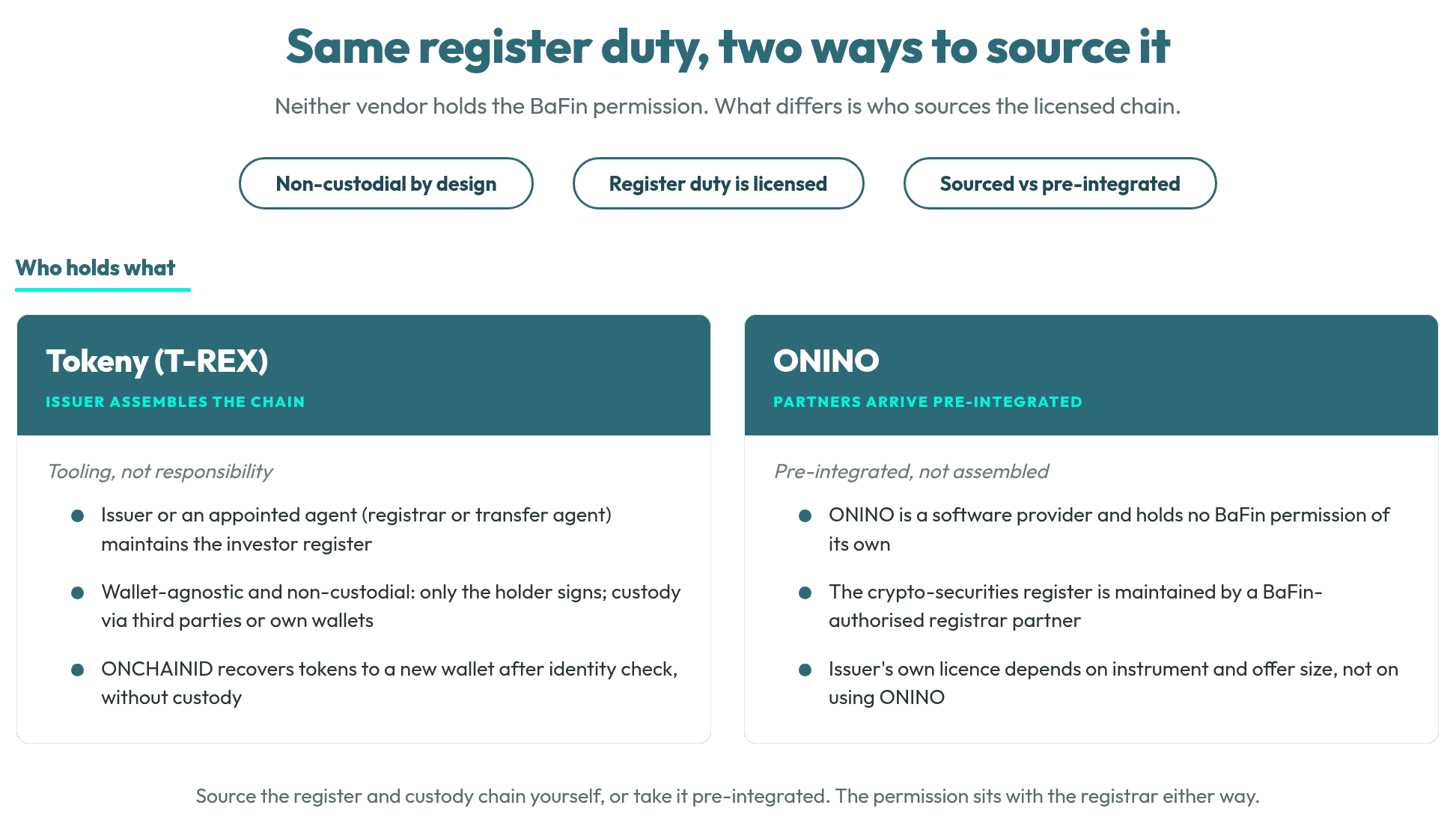
A German crypto security needs a licensed register no matter which token standard mints the token. So the useful question isn't which standard wins, it's how much of the licensed chain you have to source and appoint yourself. That's exactly where ONINO and Tokeny diverge.
Who holds custody and the securities register with ONINO and Tokeny?
Tokeny is not a custodian, and on Germany's eWpG route the crypto securities register is a separate, BaFin-licensed function; those two facts settle most custody questions on an ONINO vs Tokeny shortlist. Tokeny is deliberately wallet-agnostic and non-custodial. The platform integrates third-party custodians and non-custodial wallets, and on the T-REX Platform only the token holder can sign transactions, so neither the issuer nor the platform can act on a holder's behalf. Custody and register responsibility sit with the issuer and the agents the issuer appoints.
In Tokeny's model, the issuer, or an appointed agent such as a registrar or transfer agent, maintains the investor register; the on-chain Identity Registry and admin panel serve as register tooling. ONCHAINID, the identity layer, allows tokens to be recovered to a new wallet after the holder's identity is confirmed, which removes the lost-key objection without making Tokeny a custodian. Tokeny supplies the register tooling; the register responsibility itself never leaves the issuer's side of the table.
On Germany's eWpG route, register responsibility carries a licence. Maintaining a crypto securities register is a licensed financial service in Germany: it requires BaFin authorisation and minimum initial capital of €150,000. Whoever maintains the register for a German crypto security must hold that authorisation, regardless of the token standard used.
ONINO answers the same question with pre-integration rather than assembly. ONINO is a software provider and holds no BaFin permission of its own: the crypto securities register is maintained by a BaFin-authorised registrar, and that partner holds the permission. What differs between the two vendors is how much of that chain the issuer has to source. With Tokeny, the issuer sources and appoints the register and custody chain itself. With ONINO, those partners are already integrated and the workflows are native to eWpG, VermAnlG and ECSPR. Whether an issuer needs its own permission depends on the instrument and offer size, not on which platform it uses. For most shortlists, that is the whole difference.
How modular are ONINO and Tokeny across issuance modes?
Tokeny supports one issuance mode: every instrument on the T-REX platform exists as an ERC-3643 security token. ONINO supports three modes on the same white-label stack: non-tokenized classical instruments, tokenized security tokens, and crypto securities (Kryptowertpapiere) under the eWpG. That modality difference is the second axis of this comparison, and it is the one feature matrices usually miss.
Non-tokenized classical instruments. Subordinated loans, participation rights, bonds and fund interests run through the branded portal with a fully digital subscription process, KYC/AML onboarding and lifecycle management, and no token anywhere in the setup.
Tokenized security tokens. Tokenized Genussrechte or Nachrangdarlehen sit outside the eWpG, but tradability and standardisation can turn them into transferable securities with WIB or prospectus duties, so the classification needs legal review per offering.
Crypto securities (Kryptowertpapiere). The eWpG route for digital securities, where the register is maintained by a BaFin-authorised registrar; that partner holds the permission, not ONINO.
The asset-class range runs on the same stack: Nachrangdarlehen and Genussrechte as Vermögensanlagen, bonds and equity as securities, up to institutional fund structures, with the mode chosen per issuance rather than per platform. The practical payoff is the upgrade path: an issuer can launch a classical non-tokenized raise first, then add tokenization or move up to an eWpG instrument later without re-platforming. On Tokeny there is no path below the token layer, because the toolkit starts where the token begins. That focus cuts both ways: for institutions that already know the destination is institutional ERC-3643 tokens across many jurisdictions, Tokeny's single-mode depth, and the ecosystem behind the standard, is exactly what they are buying.
Which platform is stronger for white-label issuance and investor portals?
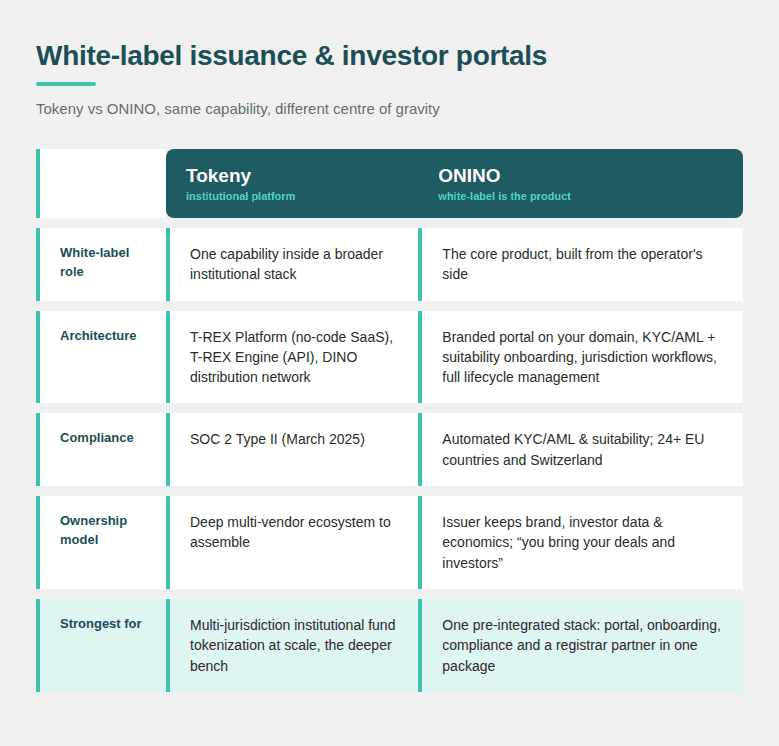
As shown in the graphic, white-label is one capability for Tokeny, which lists SOC 2 Type II from March 2025, while ONINO's workflows cover regulatory frameworks in 24+ EU and Swiss countries. Same capability, different centre of gravity.
ONINO and Tokeny both offer white-label capability, but the weighting differs: for Tokeny, white-label deployment is one listed capability of an institutional platform, while for ONINO the white-label platform is the core product. That difference in weighting is the clearest split between them. Modularity adds a second dimension: because the ONINO stack is modular, one branded portal runs tokenized and non-tokenized offerings side by side, with multiple parallel deals on one branded portal.
Tokeny's stack comprises the T-REX Platform (a no-code SaaS), the T-REX Engine (an API for embedding tokenization into existing systems) and DINO, a distribution network initiative. White-label and API deployment are listed platform capabilities, and Tokeny achieved SOC 2 Type II compliance in March 2025. The reference list Tokeny publishes is genuinely institutional: SkyBridge Capital's $300M hedge fund tokenization on Avalanche (August 2025), Fasanara's tokenized money market fund, ABN AMRO's €5M digital green bond and a partnership with AMINA Bank. For multi-jurisdiction institutional fund tokenization at scale, Tokeny's ecosystem is the deeper bench, and that concession should stand in any honest comparison.
The ONINO issuance platform approaches white-label from the operator's side. The issuer gets a branded investor portal on its own domain, automated KYC/AML and suitability onboarding, jurisdiction-specific workflows and full lifecycle management; per ONINO, a white-label environment is live in under 24 hours and covers regulatory frameworks in 24+ EU and Swiss countries. The issuer keeps its brand, its investor data and its economics; ONINO's own framing is "ONINO is infrastructure; you bring your deals and your investors." That bundle, portal, onboarding, compliance workflows and pre-integrated register and custody partners delivered as one package rather than sourced part by part, is what most issuers mean when they search for a Tokeny alternative.
"ONINO gives us an efficient, compliant and modern way to finance projects - from onboarding to execution."
Johannes Weide, CEO, BLACKVRST Equity
Which platform fits family offices better?
Neither ONINO nor Tokeny sells a family-office product as such; the fit follows from the operating model. A single or multi-family office that runs its own deal flow, SPVs and co-investments under its own brand maps to ONINO's operator model. A family office that allocates into institutionally tokenized funds will more likely touch Tokeny-powered products through its fund managers.
Tokeny positions toward institutions and fund managers: its solutions navigation covers real estate, private equity, funds and debt, and its published references are banks, asset managers and hedge funds. There is no dedicated family-office offering on tokeny.com. That is not a weakness, just a statement of who the platform is built for.
ONINO's use cases read like a family-office operations list: SPVs and investor clubs, private credit, cooperatives and reusable investor onboarding under the family's own brand, with an asset tokenization solution for structures such as tokenized co-investments. Regulators have logged the same shift. IOSCO's Tokenization of Financial Assets report (FR/17/25, November 2025) records tokenization of funds and private assets gaining early institutional traction, describing adoption as incipient and incremental and the market itself as nascent. So a family office should be asking who runs the stack, not which features ship. The test below formalises that.
The Issuance Operating Model Test
Four questions settle the ONINO vs Tokeny decision faster than any feature matrix:
Jurisdiction, instrument and modality. Where do you issue, and what: eWpG securities, Vermögensanlagen under VermAnlG, ECSPR offers, or multi-jurisdiction funds? And does the instrument need to be a token at all: from day one, later, or never?
Stack operator. Who assembles and runs compliance, onboarding and lifecycle: you, with agents you appoint, or the platform?
Register and custody seat. Who legally maintains the securities register and holds the assets?
Investor relationship. Whose brand fronts the raise, who owns the investor data, and who brings distribution?
Answers that cluster around "we assemble, we appoint, we distribute across many jurisdictions" describe Tokeny's model. If they cluster instead around "we bring the deals and investors, the platform operates the stack under our brand", the shortlist is really about ONINO.
How do ONINO and Tokeny pricing models compare?
As of July 2026, Tokeny publishes no pricing on their website; sales run through enterprise custom quotes. ONINO publishes two modes, Direct Placement (Eigenemission) and White-Label. ONINO publishes no fixed price list; pricing depends on the product, the number of offerings and the instruments.
Third-party review sites circulate fee breakdowns for Tokeny, but none of those figures can be verified against Tokeny itself, so this comparison does not repeat them. What is verifiable is the absence of a pricing page and the enterprise sales motion.
ONINO's own contrast: a white-label environment set up in under 24 hours, where a bespoke build runs 6 to 12 months.
Tokeny alternatives: how EU issuers usually shortlist
Issuers searching for a Tokeny alternative are rarely rejecting ERC-3643. They are testing whether a toolkit or an operated platform matches how they actually run a raise. Three profiles recur on EU shortlists.
Same institutional infrastructure model. Independent roundups such as tokenizestartup.com group Securitize, tZERO and Polymesh (formerly Polymath) in the same institutional-infrastructure category as Tokeny. If that is the model you want, the evaluation question is ecosystem depth and jurisdictional reach, and Tokeny's ERC-3643 authorship is hard to beat.
The EU regulatory layer pre-integrated for you. This is where ONINO sits: native eWpG, VermAnlG and ECSPR workflows, registrar and custody partners already integrated with the permission sitting on the partner's side, and, on ONINO's own numbers, a branded investor portal live in under 24 hours.
Distribution rather than infrastructure. Some issuers are better served by placing through an existing regulated platform than by owning an issuance stack at all.
If your shortlist mixes these profiles, you are comparing different products, not different vendors. The Issuance Operating Model Test above separates them.
Who should choose ONINO and who should choose Tokeny?
Choose Tokeny if you are a financial institution or fund manager tokenizing large products across many jurisdictions and you want to own the infrastructure layer. Choose ONINO if you are a platform operator, asset manager or family office issuing EU instruments and you want a branded, operated, end-to-end stack.
The Tokeny case in full: you tokenize funds or large instruments across multiple jurisdictions, you are comfortable assembling your own agents, custodians and distribution, and you value the ERC-3643 ecosystem, including Apex Group's backing, the ERC3643 Association and members such as DTCC. Tokeny wrote the standard the institutional market coalesced around, and that ecosystem is the product.
The ONINO case in full: you issue EU instruments (Nachrangdarlehen, Genussrechte, bonds, funds, equity) under eWpG, VermAnlG or ECSPR, you want the registrar and custody partners already integrated and the compliance workflows native to those regimes, and you want your own brand and investor data on a portal that is live in days, not quarters. The same applies if tokenization should stay optional: a mixed book of classical and tokenized raises runs on one modular platform, a flexibility a token-only toolkit is not built for. Issuers who arrive at ONINO as a Tokeny alternative almost never object to Tokeny's technology. What they object to is the assembly work, since their business is running raises rather than integrating infrastructure.
Neither platform is the wrong answer. The Issuance Operating Model Test above will route most shortlists correctly in under an hour.
General information only, accurate at the date shown. Not legal, tax or investment advice. Confirm your own position with qualified counsel.
Want to learn more how this can be applied to your business?
Read related Articles
ONINO vs Tokeny, honestly compared: ERC-3643 vs eWpG, custody and register, white-label scope and pricing. Which Tokeny alternative fits EU issuers?