Business
Tokenized Gold Explained: What Do You Actually Own?
Tokenized gold explained: how the backing, custody and redemption actually work, what it costs against gold ETFs, and where EU rules leave it

Kristina Stark
Growth Manager
last updated on

Share
90% of Clients start with a free personal strategy
On this page
Contact Us
ONINO provides infrastructure for digital & tokenized financing to make your next financing a success.
Key Takeaways
Tokenized gold is a digital token that represents a claim on physical gold held in a vault by a third party, and the claim is only as strong as the register, the custodian and the redemption terms behind it. The whole asset class is worth about US$5bn and is backed by roughly 35 tonnes of gold, against 4,068 tonnes sitting in gold ETFs. Two issuers, Tether Gold and Pax Gold, hold close to 90% of it. Physical redemption starts at roughly 430 troy ounces, about €1.65m, while a German gold ETC delivers from one gram. No issuer of an asset-referenced token is authorised anywhere in the EU, and Binance removed Pax Gold from EEA spot trading in March 2025 for that reason.
Tokenized gold is a digital token, issued on a blockchain, that represents a claim on a defined quantity of physical gold held in a vault by a custodian. One token normally stands for one fine troy ounce of a London Good Delivery bar, the 400 ounce wholesale bar standard used in the professional bullion market. The token is transferable at any hour, peer to peer, without a broker or a settlement date, which is the same asset tokenization mechanic applied to bullion rather than to property or debt. The gold does not move at all. It stays in the vault, and the token is the record of who is entitled to it. That gap between the thing that moves and the thing that backs it is where every question about tokenized gold lives.
How does a gold token actually get its gold?
A gold token gets its gold through a four step loop: someone pays the issuer, the issuer buys or allocates bullion, the issuer mints tokens against it, and an accountant checks the total once a month or once a quarter. What follows is the investor's view of that loop, which is the part that determines what you own. The issuer's side of it, the custody agreements, the register and the permissions, is a separate job covered in our guide to tokenizing precious metals and commodities.
Take the two products that dominate the market. Pax Gold (PAXG) is issued by Paxos Trust Company, a US national trust bank, against Good Delivery bars held in London. Tether Gold (XAUT) is issued by TG Commodities, S.A. de C.V., an El Salvador company authorised by that country's National Commission of Digital Assets, against bars held in Switzerland. In both cases you can look up the specific bar behind your address: Paxos shows the serial number, purity and gross weight of the bars tied to your Ethereum address, and Tether publishes a look up site that maps addresses to bars.
That bar level detail is real, and it is the strongest thing about the design. It is also where the useful questions start, because a serial number tells you which bar exists. It does not tell you who owns it in law. Paxos describes a PAXG token as "akin to a warehouse receipt representing your beneficial ownership of a pro rata portion of Allocated Gold". Tether Gold's own disclosure is blunter: "Tether Gold does not hold legal title to the Gold Reserves. Instead, the Gold Reserves are held by a custodian on behalf of XAU₮ holders." The custodian in question is a Swiss entity that Tether describes as a related party and does not name.
Adrian Ash, Head of Research at the online bullion marketplace BullionVault, put the consequence to Reuters in February 2026: "If you needed to assert your ownership in a legal dispute, the court might decide that you in fact own only the token, not the gold." That is the distinction the rest of this piece measures each product against.
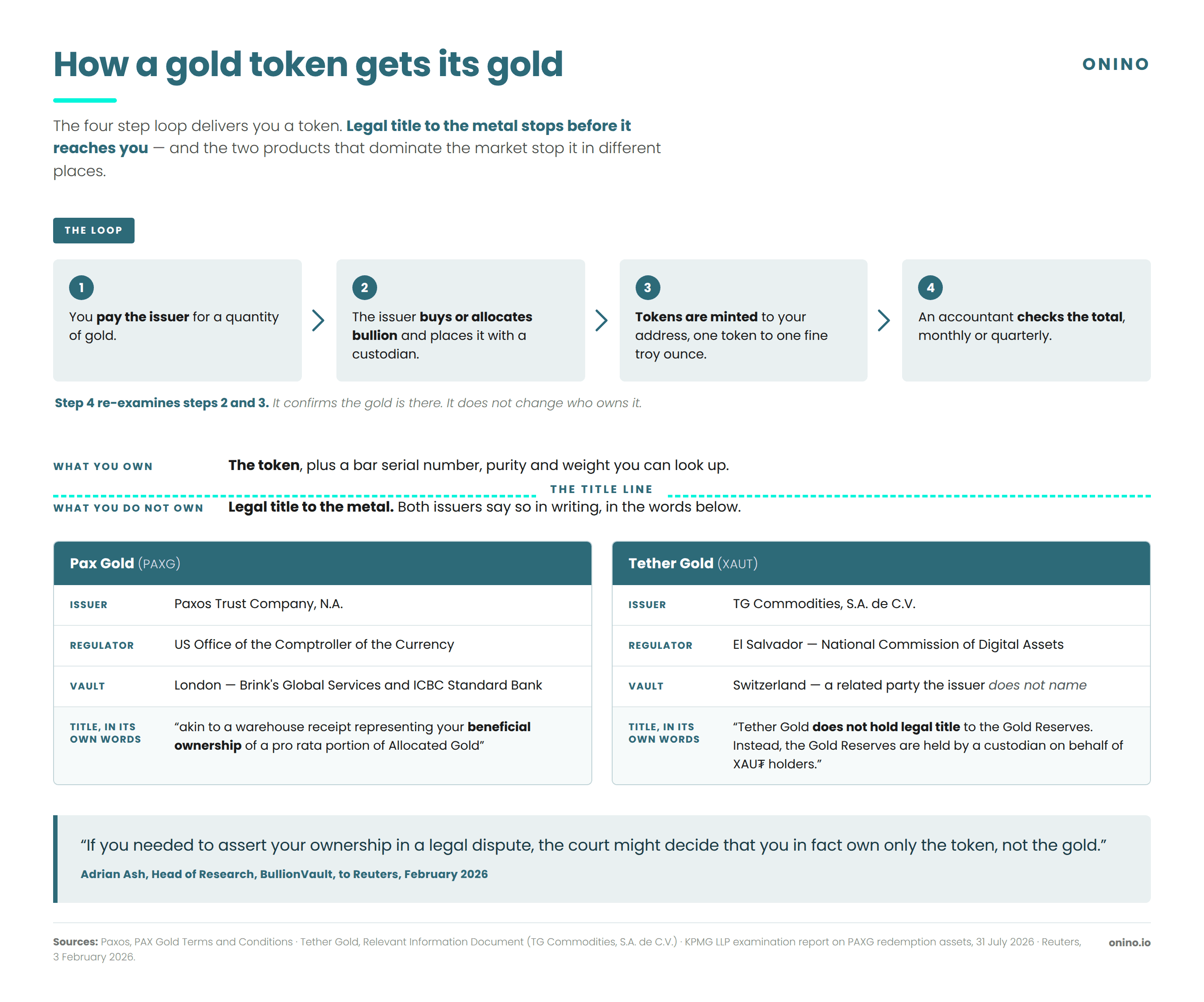
As shown in the graphic, four steps run from your payment to a token, one token to one fine troy ounce, with the total checked monthly or quarterly. Neither of the two issuers puts legal title to the metal in your hands, and both say so themselves.
How big is the market, and how liquid is it really?
About 35 tonnes of gold, and thinner than the 24/7 trading suggests. Thirty-five tonnes is the combined attested reserve behind Tether Gold and Pax Gold, and those two products are close to 90% of the market.
The number lands better with a denominator next to it. Gold ETFs held 4,068 tonnes at the end of July 2026, worth US$530bn, according to the World Gold Council, and central banks bought 289 tonnes in the second quarter of 2026 alone. All the gold ever mined and still above ground comes to roughly 220,700 tonnes. So every gold token in existence is backed by less than one percent of the gold sitting in gold ETFs, and about one part in six thousand of all the gold in the world. Central banks bought eight times more gold in three months than every gold token is backed by.
By market value the picture is the same shape. CoinGecko put the tokenized gold category at US$5.18bn on 31 August 2026; CoinMarketCap put it at US$4.96bn on the same day. Either way it is around 3% of the SPDR Gold Shares ETF on its own, which held US$152.9bn on 28 August 2026. Growth has been fast: CoinGecko's 2026 RWA Report tracked tokenized commodities from US$1.43bn in January 2025 to US$5.55bn by the end of March 2026. But a market growing 289% off a small base is a different proposition from a market with depth.
Depth is where the honest answer gets uncomfortable, and it is worth separating two things that get conflated. Being able to transfer a token at 3am is transferability. Being able to sell a meaningful position at a price close to spot is liquidity, and they are not the same property. Tokenized gold turned over about US$0.4bn in the 24 hours to 31 August 2026, against a Loco London wholesale market that moved US$180bn a day in 2025, so on chain gold trades roughly a quarter of one percent of the volume of the market it prices against. Even the record first quarter of 2026 averaged about US$1bn a day against London's US$180bn, and against US$361bn a day across the gold market as a whole.
Three further things nobody publishes. First, neither issuer's own disclosures nor the major comparison sites publish order-book depth or slippage at size for either token, and the most careful of them declines to estimate it and tells readers to check live quotes for their own order size. That absence is the finding: at institutional size, the exit price is unknown until you try. Second, the 0.5% to 2.5% discount to spot is not noise, it is the market pricing in redemption friction, and it cuts differently depending on your route. Mint at a spot-linked price and sell on chain and you eat the discount; buy on chain and redeem for metal and you collect it. What a round trip costs you is the issuance and redemption fees plus whatever the basis happens to be on the two days you trade. Third, 24/7 trading cuts both ways. When the London market is shut, no arbitrageur can create or redeem to close a gap, so the token can move against you with no mechanism to correct it until Monday. Anyone weighing this should read our honest treatment of secondary markets in tokenization before assuming a token is easier to exit than an exchange-traded product.
What does it cost to hold gold on-chain instead of in an ETC?
Less than a US gold ETF on the headline number, and not obviously less than a German gold ETC once you count the spread.
Both major gold tokens advertise low or zero ongoing fees, and both mean it. Paxos charges nothing to create PAXG, has removed its on chain transfer fee, and charges no storage fee today. Tether Gold charges 25 basis points to issue and 25 to redeem, and no ongoing custody fee. Against a 0.40% annual expense ratio on SPDR Gold Shares, that looks decisive.
Two things spoil the comparison. The first is that tokenized gold does not trade at spot. CoinGecko's own research, updated in May 2026, finds that gold tokens typically trade at a discount to spot of between 0.5% and 2.5%, reflecting redemption costs and market friction. Enter by minting at a spot-linked price, exit by selling on chain at a 1% discount, add the issuance and redemption fees where they apply, and a two year holding period has cost more than three years of a 0.40% ETF fee, without a single fee ever appearing on a statement.
The second is that Paxos has reserved the right to change the deal. Its terms allow it to charge storage fees "by issuing to Paxos new PAXG tokens, thereby diluting the value of existing PAXG tokens", with 30 days' notice, applying to every holder. It also charges US$2.00 a month on any non zero balance dormant for twelve months, which is exactly the profile of a buy and hold gold investor. A zero fee is a policy, not a property of the instrument.
Product | Ongoing cost | Entry and exit friction | Physical delivery from | Where the gold sits |
|---|---|---|---|---|
Pax Gold (PAXG) | 0% today; storage fee by token dilution reserved, 30 days' notice; US$2/month inactivity fee | 0% issuer fee, plus venue spread, gas, and a 0.5% to 2.5% discount to spot | 430 oz (about €1.65m) | London |
Tether Gold (XAUT) | 0% | 25 bps in, 25 bps out, USDT 150 verification fee, plus venue costs and the same discount | 430 oz, full bars, Switzerland only | Switzerland |
SPDR Gold Shares (GLD) | 0.40% p.a. | Equity spread | Not available to retail | London (trust) |
iShares Gold Trust (IAU) | 0.25% p.a. | Equity spread | Not available to retail | US trust |
Xetra-Gold | 0.36% p.a. incl. VAT | Exchange spread | 1 gram, via a bank only | Germany |
EUWAX Gold II | None | Exchange spread | 100 grams, free, to a German private address | Germany |
Read the last two rows again, because they are the comparison nobody publishes. Every tokenized gold explainer benchmarks against a 0.40% US ETF. For a European investor the real competitor is EUWAX Gold II, which charges no ongoing cost at all, delivers metal free from 100 grams to a private address, and keeps the gold in a German vault.
Can you actually redeem a gold token for gold?
In theory yes, in practice almost certainly not. Both Pax Gold and Tether Gold require roughly 430 tokens to redeem one physical bar, because a London Good Delivery bar runs between about 385 and 415 fine troy ounces and neither issuer will split one.
At a gold price near US$4,500 an ounce, 430 ounces is about US$1.93m, or roughly €1.65m. Paxos states the minimum as "a minimum of 430 PAXG tokens plus the fee set forth in the Paxos User Guide, per London Good Delivery gold bar", and the holder then arranges and pays for delivery; once the bars reach the chosen carrier, Paxos has discharged its obligation. Tether Gold's threshold is the same in substance, with one extra restriction that deserves to be read twice: "Tether Gold does not currently offer delivery outside of Switzerland." A German holder who wants the metal collects it in Switzerland or sells it there.
Set that against the two German gold ETCs an investor can buy through the same brokerage account. Xetra-Gold delivers from one gram, though only through a bank rather than to a private address; Stiftung Warentest priced one customer's kilogram bar delivery at about €434 all in, roughly 0.31%. EUWAX Gold II delivers free from 100 grams straight to a German address. The physical redemption right that makes tokenized gold sound like allocated bullion begins, for gold tokens, at about €1.65m. For a product most German retail investors already have access to, it begins at one gram.
Where does tokenized gold stand under EU rules?
Outside them. A gold backed token is an asset-referenced token under MiCAR, and as of the end of August 2026 no issuer of an asset-referenced token has been authorised anywhere in the European Union.
The classification follows from the definition. MiCAR Article 3 defines an asset-referenced token as "a type of crypto-asset that is not an electronic money token and that purports to maintain a stable value by referencing another value or right or a combination thereof, including one or more official currencies". A token pegged to one ounce of gold references a value that is not an official currency, which puts it in Title III rather than in the lighter white paper regime for other crypto-assets. German legal commentary reaches the same conclusion in one line: reference values can include precious metals such as gold. Worth noting what this is not. A gold token is not a regulated digital security, which is a different instrument under a different rulebook with an authorised register behind it, and it is not a utility token either, a distinction covered in our comparison of security tokens and utility tokens. Three categories, three regimes, and the one a product falls into decides what protection its holder gets.
Title III is demanding by design, and it sits inside the wider EU regulatory framework for digital assets. An issuer needs prior authorisation from its national competent authority, which in Germany means BaFin authorisation before the token may be offered to the public or admitted to trading, plus an approved white paper, minimum own funds, and reserve assets ring fenced with qualified custodians and legally segregated from the issuer's estate. Article 39(1) then grants holders exactly the thing today's gold tokens do not give them: "Holders of asset-referenced tokens shall have a right of redemption at all times against the issuers of the asset-referenced tokens".
The register shows how many issuers have taken that on. ESMA's MiCA register listed zero authorised asset-referenced token issuers at the end of August 2026, against 23 e-money token issuers and 331 authorised crypto-asset service providers. Europe wrote a category for gold backed tokens and admitted nobody to it, which has practical consequences: on 31 March 2025 Binance removed nine tokens from spot trading for EEA users, and Pax Gold was on the list alongside USDT, FDUSD, TUSD, USDP, DAI, AEUR, UST and USTC. The world's largest exchange delisted the world's largest gold token in Europe for the same reason it delisted the largest stablecoin.
German tax is the second open question, and it is genuinely open. Physical investment gold and German gold ETCs both fall under section 23 of the German Income Tax Act and are tax free after a one year holding period, because the German Federal Fiscal Court held in June 2020, in case VIII R 7/17, that a gold backed security embodying a claim for delivery of physical gold is not a monetary claim. No Federal Ministry of Finance circular or court judgment addresses gold tokens, and a gold token plainly meets the broad definition of a crypto-asset in the current crypto circular of 6 March 2025. That is harmless while crypto also sits under section 23, and stops being harmless if the July 2026 budget proposal to move privately held crypto under section 20 of the German Income Tax Act passes, since physical gold and gold ETCs would keep the exemption and a crypto-asset would not. Nothing has been enacted, and as of 21 August 2026 the change was absent from the 2026 Annual Tax Act reference draft.
What can the issuer do to your tokens?
Freeze them, and in Paxos' case, destroy the gold behind them. Both issuers hold that power, both disclose it, and none of the top-ranking explainers we reviewed mentions it.
Paxos' terms are explicit. Paxos "has the ability and the right to freeze and upgrade all PAXG tokens (on an aggregate basis), regardless of where the PAXG is being held", and warns that frozen or seized tokens and the allocated gold behind them "may become wholly and permanently unrecoverable and unusable, and in appropriate circumstances, may be destroyed", adding: "we will not be liable to you as a result." The smart contract implements it. Paxos' public repository documents an asset protection role that can freeze any address' balance on chain and "can also wipe the balance of an address after it is frozen", through freeze(), unfreeze() and wipeFrozenAddress(), all three of them live in the deployed contract today. Tether Gold grants itself an equivalent and, on its face, more discretionary power: its terms reserve freezing and confiscation of tokens held in any wallet a holder uses, at its "sole and absolute discretion", where Paxos frames the same capability as one it exercises when compelled by law.
That power is not a scandal. A regulated issuer that could not comply with a court order would be a worse product, and Paxos says as much: the capability exists because its regulators require it. The point is narrower. A one hundred gram bar in a Frankfurt safe deposit box has no wipeFrozenAddress() function. The same design choice that makes on chain gold portable at 3am on a Sunday makes it remotely revocable.
Two smaller things belong here. First, attestation is not audit. Paxos publishes monthly attestations by KPMG LLP; Tether Gold publishes quarterly ISAE 3000 (Revised) opinions signed by BDO Advisory Services S.r.l. Both examine a management assertion about reserves at a point in time, and neither is a financial statement audit. Neither is a full bar count either, though the two differ more than that phrase suggests: BDO's report lists inventory procedures and sample testing of bars, while KPMG's names no physical procedure at all. Tether adds that its custodian's insurance "is not expected to cover the full amount of Gold Reserves", that Tether Gold "is not a beneficiary of any such insurance", and that holders pursuing the custodian "would be required to expend their own resources". Second, concentration: Tether Gold and Pax Gold are 89% of the CoinGecko category, and DWF Labs put them at 97% of tokenized gold market cap in March 2026. Two issuers, two vault jurisdictions, two non EU regulators.
The ONINO Backing Test
Everything above reduces to four questions, and they are the same four questions that decide whether any tokenized asset is what it claims to be. We use them internally when assessing an instrument, and they generalise well beyond gold to real-world assets from property to art.
Who holds legal title? Not who holds the metal, and not whose logo is on the vault. Whether the claim is a proprietary interest in identified assets or a contractual claim against a company decides what happens in an insolvency. Pax Gold and Tether Gold answer this differently, and both answers are in public documents.
Who maintains the register, and under whose permission? A blockchain is a ledger, not a legal register. Someone controls minting, freezing and burning, and that party answers to a specific regulator or to none. For gold tokens today that is the Office of the Comptroller of the Currency in one case and El Salvador's digital assets commission in the other.
What is the redemption floor, in the reader's own currency? A redemption right with a €1.65m minimum and one permitted delivery country is a different instrument from one that delivers 100 grams to a home address, whatever the marketing says.
Whose permission covers the offering where the investor lives? Article 39 would give an EU holder redemption at any time at market value, and nobody has taken up the authorisation that triggers it. Where no permission applies, no investor protection applies either.
A gold token that answers all four well is a good instrument. One that answers them badly is a good instrument for a different holder than the one buying it. The questions are cheap to ask and the answers are almost always published.
What this means if you are considering an allocation
Tokenized gold is a real claim on real metal with a genuinely useful settlement layer and a materially weaker legal wrapper than the products it is usually compared to.
If the reason for wanting on chain gold is the wrapper itself, round-the-clock transferability, use as collateral in a decentralised protocol, or moving value between venues without a bank, then tokenized gold does something no ETC can do and the tradeoffs are worth accepting knowingly. Those are real advantages, and the general case for them is set out in our piece on the benefits of investing in tokenized securities, though gold tokens sit outside the regulated-security perimeter that piece assumes. Michael Ashley Schulman, Partner and Chief Investment Officer at Running Point Capital Advisors, put the tradeoff in one sentence to Reuters in February 2026: "Most of the risk sits off-chain in whether the token represents a direct, bankruptcy-remote claim on specific allocated bars or a contractual claim on an issuer and its custodians."
If the reason is simply owning gold cheaply, the case is much thinner in Europe, because a German gold ETC already offers no ongoing fee, delivery from 100 grams, a German vault and settled tax treatment. Of these, the settled tax treatment matters most, and it is the one an investor cannot fix by choosing a better issuer.
Ultimately the interesting question is not whether to buy a gold token, but whether the infrastructure behind gold tokens will grow up. The World Gold Council thinks it has to: Mike Oswin, its Global Head of Market Structure and Innovation, said in March 2026 that "digital gold has evolved quickly, but the infrastructure supporting it hasn't kept pace", describing "a fragmented ecosystem where each provider is effectively rebuilding the same complex processes". That is a problem for issuers and platform operators to solve, and it is a question of regulated infrastructure for tokenized securities rather than of better marketing. Lukas Wipf, Co-founder and CPO at ONINO, puts the lesson for anyone building an offering plainly: "Gold tokens are a useful warning for anyone structuring an offering. Who holds legal title, which register the claim lives in and what redemption actually costs are all decided before the token exists, and investors inherit those decisions whether or not they read the terms."
General information only, accurate at the date shown. Not legal, tax or investment advice. Confirm your own position with qualified counsel.
Want to learn more how this can be applied to your business?
Read related Articles
Tokenized gold explained: how the backing, custody and redemption actually work, what it costs against gold ETFs, and where EU rules leave it

