Business
Is Tokenized Real Estate Worth It? Liquidity, Legality and Risk in 2026
ONINO and Bitalo partner to make digital financing and tokenized real-world asset distribution more efficient for issuers and investors across both networks

Kristina Stark
Growth Manager
last updated on

Share
90% of Clients start with a free personal strategy
On this page
Contact Us
ONINO provides infrastructure for digital & tokenized financing to make your next financing a success.
Key takeaways
Tokenized real estate is legal in the EU and it works, but not the way it was sold. Tokenization changes how a property stake is issued and recorded, not how quickly you can sell it, and secondary markets for single-asset property tokens are still thin. It is worth it for issuers who reuse one compliant investor workflow across a pipeline of projects, and for investors who want lower-ticket exposure and accept that liquidity is limited.
Is Tokenized Real Estate Worth It? Liquidity, Legality and Risk in 2026
Real estate tokenization in 2026 is the process of issuing digital ownership units in a property, or in a company that holds property, so that investment stakes can be subscribed, held, and transferred as regulated investment instruments. That is the honest version. Much of what still circulates online frames it as instant liquidity and frictionless global property trading, and that framing has not matched reality. This article separates what tokenization actually does from what it was promised to do, covers the three routes an investor can actually take, and looks at what has genuinely changed by 2026.
What Real Estate Tokenization Actually Is
At its core, real estate tokenization means representing a claim on a property asset as a digital security rather than a paper certificate or a manual entry in a spreadsheet. The underlying investment does not change. An investor still holds equity, a loan, or a share in a special purpose vehicle that owns the building. What changes is the infrastructure used to issue that claim, record who owns it, and manage the investor relationship over time.
Two terms get used interchangeably and should not be. Real estate investment tokenization describes the issuance mechanism. Real estate security tokens are the instruments themselves, and in the EU they are typically treated as securities or as regulated investment products, depending on how the offering is structured. A tokenized subordinated loan (Nachrangdarlehen) or participation right (Genussrecht) issued in Germany, for example, is a Vermögensanlage under the VermAnlG rather than a MiFID II security. Whichever regime applies, its prospectus, disclosure, and investor protection rules apply in full. Tokenization does not create a regulatory shortcut.
Tokenized Real Estate vs Fractional Real Estate
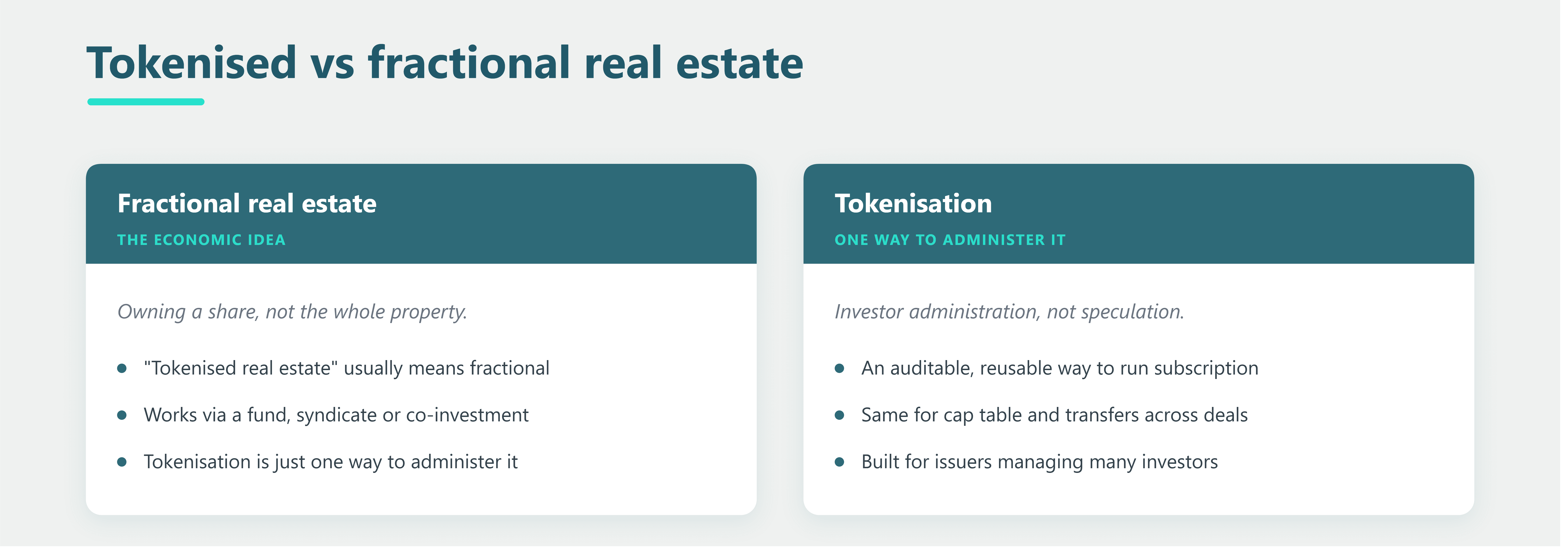
As shown in the graphic, fractional real estate is the economic idea, owning a share not a whole property, via a fund, syndicate or co-investment. Tokenization administers it, a reusable way to run subscription, cap table and transfers across deals.
Fractional Real Estate
Fractional real estate is the ability to own a small share of a property rather than the whole thing, and it is what most people are actually asking about when they search for tokenized real estate. It is an economic model, not a technology. You can run it through a traditional fund, a syndicate, or a co-investment structure without any tokens involved, which is why fractional ownership long predates blockchain.
Tokenized Real Estate
Tokenization is one way to administer fractional ownership. Instead of tracking stakes in a private ledger, the register of ownership sits on a blockchain, and each investor's stake becomes a token that can only move between approved, verified wallets, so the compliance rules travel with the asset. For the real estate issuer managing many investors, this makes subscription, cap table, and transfer more auditable and reusable across deals. It is investor administration that does not have to be rebuilt for each new offering, not speculation.
Fractional Real Estate Investment: The Bigger Picture
Fractional real estate is the larger, more established market, and it's where most of the real demand is. The idea is simple. Property usually requires large minimum investments, which locks out most people and makes it harder for developers to raise money. Fractional models lower that entry point and let more investors in. Digital platforms have made this easier, though easy access doesn't automatically mean you can sell quickly when you want to (more on that below).
Fractional Ownership Platforms
A fractional ownership platform does the work of splitting a property into small units investors can buy, and then managing those investors. Quality varies a lot. Some are loosely run marketplaces. Others are fully regulated, with KYC, subscriptions, and reporting built in. For an issuer picking a platform, this difference matters more than the branding, because the compliance and reporting work doesn't go away, it just shifts to someone else.
Digital Real Estate Investment Options
Digital property investment covers a wide range. On one end are tokenized shares in a single building. On the other are funds that hold a mix of properties. The right choice depends on how much diversification, control, and liquidity an investor actually needs, not on which option sounds the most cutting-edge.
Ways to Invest in Tokenized Real Estate
For investors asking how to invest in tokenized real estate, there are three common routes in 2026, and each has a different risk and liquidity profile.
Route | What you hold | Liquidity reality |
|---|---|---|
Single-asset tokens | A share in one property or its SPV | Limited; depends on a secondary market that may be thin |
Tokenized real estate fund | Units in a managed portfolio | Governed by fund redemption terms, not instant |
Tokenized REIT | A share in a listed or regulated trust | Closest to conventional liquidity |
Tokenized Real Estate Funds
A tokenized real estate fund applies the tokenization wrapper to a managed portfolio. Investors get diversification and professional management, and the token handles subscription and transfer. Redemption still follows the fund's rules, so the sell-anytime promise rarely holds in the way retail marketing implies.
Tokenized REITs
A tokenized REIT is the structure closest to a familiar listed vehicle. It combines the regulatory clarity of a trust with a digital register. For investors who want exposure without single-asset concentration, it is often the most conservative of the tokenized options.
The Reality: Risks and Limits in 2026
The Liquidity Myth
The biggest myth is instant liquidity. A token can be transferred in seconds, but a transfer needs a willing buyer at a fair price. Secondary markets for single-asset property tokens remain thin, and thin markets mean wide spreads and slow exits. Tokenization does not manufacture demand.
Is Real Estate Tokenization Legal in the EU?
Yes, and that is the point: tokenized property investments sit inside financial regulation rather than outside it. Depending on how the offering is structured, the instrument is either a security or a regulated investment product such as a German Vermögensanlage, and the disclosure regime that comes with it applies in full. Offerings above the relevant thresholds may require a prospectus, and every investor still passes KYC and AML checks. This is a feature, not a flaw, but it removes the fantasy of borderless, frictionless trading. For the EU framework in detail, see our guide to EU regulation for digital securities rather than treating this section as legal advice.
Platform and Counterparty Risk
The third limit is the platform and the counterparty. A token is only as sound as the legal structure behind it and the operator maintaining the register. A well-drafted SPV and a serious issuance partner matter far more than the technology label.
Is Fractional and Tokenized Real Estate Worth It?
For investors, fractional real estate ownership is worth it when the goal is diversified, lower-ticket exposure, and the investor accepts that liquidity is limited and returns depend on the underlying property, not the wrapper. It is not worth it as a fast-trading vehicle.
For issuers and developers, the calculation is different. The value is not the token. It is reusable investor infrastructure: one compliant process for subscription, cap table, and reporting that can be applied across a pipeline of projects instead of rebuilt for each deal. That operational efficiency, not speculation, is the reason tokenization has quietly persisted into 2026 while the hype faded.
Your Next Raise Without Rebuilding the Back Office
If the honest version of tokenization is investor administration rather than instant liquidity, then the question worth asking is what that administration currently costs you. For issuers running more than one project, the expense is rarely the legal structure. It is rebuilding subscription, cap table, and investor reporting from scratch every time, and paying for it in operations time instead of in software.
ONINO is white-label financing infrastructure your team runs under its own brand: one compliant investor workflow reused across the whole pipeline, with tokenization as one optional rail rather than the point of the exercise.
The choice of legal wrapper matters just as much as the workflow around it; our comparison of subordinated loans and tokenized bonds walks through both. If that back-office cost is the live question for your next project, our cohort analysis of 250 real estate issuers shows where mid-sized issuers get stuck between bank debt and venture funding.
General information only, accurate at the date shown. Not legal, tax or investment advice. Confirm your own position with qualified counsel.
Want to learn more how this can be applied to your business?
Read related Articles
ONINO and Bitalo partner to make digital financing and tokenized real-world asset distribution more efficient for issuers and investors across both networks

