Financing Real Estate Projects with Private Investors: Subordinated Loans vs Tokenized Bonds
How real estate developers raise capital from private investors: subordinated loans (Nachrangdarlehen) vs tokenized bonds compared on regulation, cost, risk and reach, with real case studies

Kristina Stark
Growth Manager
last updated on

Share
90% of Clients start with a free personal strategy
On this page
Contact Us
ONINO provides infrastructure for digital & tokenized financing to make your next financing a success.
Key Takeaways
Every real estate project has a gap the bank will not lend against, and the wrapper a developer chooses to fill it decides far more than the coupon. Senior debt covers 60 to 70 percent of project costs, and private investors take the layer beneath it through one of two structures: a subordinated loan (Nachrangdarlehen) or a tokenized bond. The subordinated loan is fast and cheap - live in weeks, up to €6 million under the German crowdfunding exemption - but it gives investors little protection, as the August 2023 insolvencies of Project and Euroboden showed, where subordinated lenders stood at the back of the creditor queue. The tokenized bond, legal in Germany under the Electronic Securities Act since June 2021, costs more to set up and earns that cost back on the second and third raise, because it is transferable, security-grade and reusable. Ultimately the deciding variable is repetition, not technology: a developer who raises once should buy simplicity, one who raises every year should buy infrastructure.
Most real estate projects stall in the gap the bank leaves behind, and closing that gap is the central task of real estate project financing. A senior loan typically covers 60 to 70 percent of project costs, the developer adds equity, and the slice in the middle has to come from somewhere else. Private investors fill that slice, and they do it through one of two structures: a subordinated loan or a tokenized bond. Both rank behind the bank, both pay investors more than senior debt, and both are in active use across Europe today. The question this guide answers is simple: which of the two fits your project? It moves from where private capital sits in a deal, through how each structure works and what it costs, to a side by side comparison and a decision framework you can apply to your next raise.
How property developers raise capital from private investors
Raising capital for a real estate project from private investors means filling the middle layer of the funding plan, the part the bank will not lend against and the developer would rather not cover with more equity. That layer has grown into a market of its own: German crowdinvesting platforms channelled more than €400 million of private money into projects in their strongest year, most of it into real estate, according to the Crowdinvest Marktreport. A gap that size is the standard condition of development finance, and private investors have become a standard way to close it. How hard that middle layer is to fill shows in our 250 issuer cohort analysis of mid-sized issuers stuck between bank and venture capital.
Private investor real estate financing takes several forms, from direct participation loans to structured private mortgage lending investment products. Every form shares the same trade: the investor accepts more risk than the bank and is paid a higher return for it, which raises the question of where exactly that risk sits in a project.
Where private capital sits in the capital stack
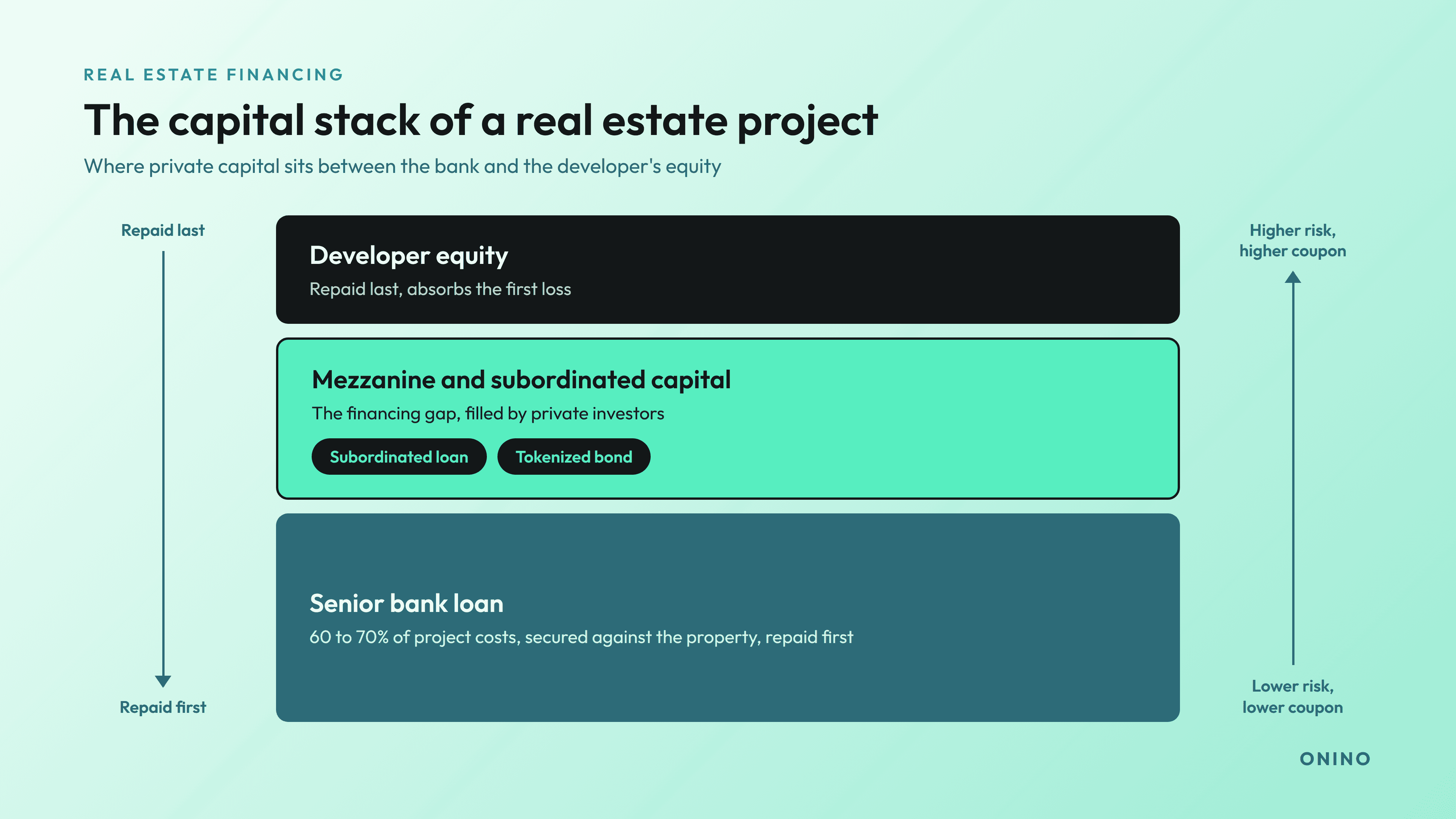
As shown in the graphic, the senior bank loan covers 60 to 70 percent of project costs and is repaid first, while developer equity is repaid last. Private capital fills the layer between them, and that position is what earns the higher coupon.
Risk in a project is ordered like a queue. Senior debt stands at the front: it is secured against the property and repaid first. Equity stands at the back: it is repaid last and absorbs the first loss. Private capital usually enters between the two, in a layer called mezzanine or subordinated capital, which is repaid after the bank but before the owners. Standing further back in the queue is exactly what earns the higher coupon.
Private mortgage lending as an investment
For the investor, lending into that middle layer is an income play. A private mortgage lending investment pays a fixed or floating coupon over the project term and is repaid when the project is sold or refinanced. The coupon is higher than senior secured lending because the capital is exposed if the project underperforms, and the next section puts a number on that premium.
What is mezzanine financing in real estate?
Mezzanine financing in real estate is capital that ranks between senior debt and equity, usually structured as a subordinated loan, sometimes with an equity kicker, meaning a small share of the project's upside on top of the coupon. It is repaid after the senior lender but before shareholders. The premium is real: German crowdinvesting platforms distributed an average interest of 6.4 percent per year across nine years of pooled investments to the end of 2022, as measured by the Crowdinvest Marktreport, at a time when savings deposits paid close to zero. That difference is the price of the queue position described above, not a reward for cleverness.
Mezzanine debt explained
That premium buys the developer something specific: additional leverage without giving up ownership. Because mezzanine debt is contractual debt rather than equity, it does not dilute the developer's stake, and the lender is compensated for the subordinated position with a coupon well above senior rates. It is worth separating mezzanine debt from preferred equity, its nearest neighbour in the capital stack: preferred equity buys a priority share of profits with no fixed repayment date, while mezzanine debt remains a loan that matures, which is why most private investor structures in Europe sit on the debt side.
Mezzanine debt in commercial real estate
Furthermore, mezzanine debt in commercial real estate is standard practice in larger projects, where the gap between senior debt and equity is too big to fund from a single source. Mezzanine financing for commercial real estate lets sponsors reach a higher total loan-to-cost while keeping control of the asset, which is why office, logistics and residential developers all reach for the same structure even though their assets behave differently.
Mezzanine lenders, rates and property development
The lenders behind that structure range from specialist funds to family offices and, increasingly, pools of private investors reached through digital platforms. Real estate mezzanine debt rates reflect the subordinated position and typically run several points above senior margins; for mezzanine funding in property development, pricing depends on project stage, sponsor track record, and the size of the equity cushion beneath the loan. However, agreeing the price is only half the job. The same capital can be documented in two different legal wrappers, and the wrapper decides regulation, cost and transferability: the subordinated loan and the tokenized bond.
Subordinated loans for real estate projects
A subordinated loan real estate structure is the more direct wrapper of the two. In Germany it is the Nachrangdarlehen, a loan whose repayment ranks behind all other creditors by contract, classified as a German investment product (Vermögensanlage) rather than a security. That classification is the point: within volume limits, it can be offered to private investors without a full securities prospectus, which keeps setup measured in weeks rather than months.
How subordinated debt works in property development
The mechanics sit in one clause. Subordinated debt in property development is documented as a loan agreement with a qualified subordination clause (qualifizierter Rangrücktritt), under which the investor agrees to rank behind senior creditors and to defer repayment entirely if paying would push the project company into insolvency. In exchange, the coupon is materially higher than a bank deposit or a senior bond. The same clause that keeps the product simple to offer is the clause investors feel when a project fails.
Subordinated loans and crowdfunding
That failure risk is documented, not hypothetical. Subordinated loan crowdfunding is the model behind most real estate crowdinvesting platforms: many small tickets pooled into one subordinated loan to the project company, offered under exemptions that cap the raise, in Germany at €6 million per issuer per year under the crowdfunding exemption of the Investment Products Act (VermAnlG), and at €5 million under the EU crowdfunding regime (ECSPR). Real estate accounts for roughly 80 percent of the German crowdinvesting market, so when developers struggle, subordinated private investors feel it first.
In August 2023 alone, several established German developers filed for insolvency, among them the Project group in Nuremberg and Euroboden in Munich, as Börse Online reported, and subordinated investors stood at the back of the creditor queue in each case. The instrument is honest about its position, and the coupon is the price of that position. For the developer, the trade-off is the mirror image: fast and cheap to launch, but limited investor protection to offer, no easy secondary market, and a structure that has to be rebuilt for every raise.
Tokenized bonds: a digital alternative
The tokenized bond exists to fix exactly those weaknesses. It is a debt security issued and recorded on a digital register rather than on paper: in Germany, the Electronic Securities Act (eWpG) has allowed this since June 2021, either as an entry in a central electronic register or, in its crypto securities form, as a token in a crypto-securities register (Kryptowertpapierregister). That register is maintained by a BaFin-authorised registrar, so the regulatory permission sits with that specialist, not with the issuer or its software provider. Tokenized bond real estate financing therefore gives the project a genuine security, with a defined coupon, maturity and, where structured accordingly, collateral, whose ownership and transfers are recorded natively instead of through paper assignments.
The format has a longer track record than most developers assume. As early as July 2019, BaFin approved a €250 million tokenized real estate bond from Fundament Group, one of the first tokenized securities cleared for public offer to retail investors in Germany, as Forbes reported. In April 2021 the European Investment Bank issued a €100 million two-year digital bond on a public blockchain, giving the format an institutional stamp. The wider market has kept compounding since: RWA.xyz, which tracks assets on public ledgers, counted roughly $32 billion of tokenized real-world assets by mid-2026, close to three times the level of a year earlier.
Nevertheless, the honest reading of that data matters. Directly tokenized property, meaning fractional ownership of buildings, remains a small corner of the market, a pattern we unpack in the honest truth about tokenization. What is scaling is tokenized debt, the bond that finances the project without touching ownership of the asset, which is why the practical question for a developer is not whether to tokenize the building but whether to issue the bond digitally.
For developers asking which platform can issue such a bond and raise capital from private investors in Europe, the answer is white-label infrastructure rather than a marketplace: the issuer keeps its own brand and its own investors. Issuers can manage the full lifecycle, from subscription and KYC to interest payments and redemption, on ONINO's white-label infrastructure for tokenized real estate issuances, where the licensed functions an offering needs run through pre-integrated partners.
Subordinated loans vs tokenized bonds, side by side
Set side by side, the two wrappers differ on four factors: regulation, cost, transferability, and the type of investor you want to reach.
Factor | Subordinated loan | Tokenized bond |
|---|---|---|
Legal nature | Contractual loan, often subordinated | Debt security |
Typical regulation | Lighter, within volume thresholds | Securities regime, prospectus or exemption |
Investor protection | Limited | Higher, security-grade documentation |
Transferability | Difficult, assignment required | Native transfer on ledger |
Secondary market | Rare | Possible where a venue exists |
Setup cost | Low | Higher upfront, lower ongoing admin |
Best for | Fast, small-to-mid raises | Larger raises seeking transferability |
Read the table as a rule of thumb: the subordinated loan wins on speed and setup cost, the tokenized bond wins on everything that compounds. Security-grade documentation gives investors stronger protection, native registration cuts ongoing administration, and transferability widens the pool of investors willing to commit, because an exit no longer depends on finding someone to accept a paper assignment.
Which route fits your project?
If the raise is modest, speed matters, and the project is a one-off, the subordinated loan is usually the pragmatic choice: the German crowdfunding exemption carries it to €6 million with light documentation, and the structure can be live in weeks. If you are raising beyond the exemption thresholds, want to offer a transferable instrument, or plan a pipeline of projects on the same setup, the tokenized bond repays its higher setup cost, because the second and third issuance reuse what the first one built. Many developers run the sequence deliberately: they begin with subordinated loans (in Germany, Nachrangdarlehen), prove the investor base, and move to tokenized bonds as volume grows, which is how they come to finance real estate projects repeatedly with private investors instead of rebuilding the structure for each raise. Ultimately the deciding variable is repetition rather than technology: a developer who raises once should buy simplicity, and a developer who raises every year should buy infrastructure. That call sits with the developer's finance lead, and it is worth making before the next project needs the money rather than while it does.
For further reading, our guide on how real estate tokenization works walks through a digital issuance end to end, from structuring the instrument to onboarding investors.
The verdict: subordinated loans suit fast, modest, one-off raises; tokenized bonds suit larger or repeated raises that need transferability and security-grade protection. The deciding variable is repetition, not technology.
This article is for general information only and does not constitute legal advice.
Last reviewed by Lukas Wipf, CPO & Co-Founder at ONINO, 14.07.2026.
General information only, accurate at the date shown. Not legal, tax or investment advice. Confirm your own position with qualified counsel.
Want to learn more how this can be applied to your business?
Read related Articles
How real estate developers raise capital from private investors: subordinated loans (Nachrangdarlehen) vs tokenized bonds compared on regulation, cost, risk and reach, with real case studies