How to Set Up a Branded Investor Portal
What a branded investor portal is, the four features that matter, how KYC and licensing really work, and whether to build or buy one in 2026.

Kristina Stark
Growth Manager
last updated on

Share
90% of Clients start with a free personal strategy
On this page
Contact Us
ONINO provides infrastructure for digital & tokenized financing to make your next financing a success.
Key Takeaways
Reworked 2026 guide to branded investor portals: what one is, who needs it, the four core features (onboarding, KYC/AML, register, reporting), licensing via partners (Haftungsdach model), build vs buy with real market evidence, and a distribution-first launch checklist.
Most people who start signing up for a financial product online never finish. Roughly two in three Europeans have abandoned a financial application partway through, according to research by the identity firm Signicat, usually because the process asked for too much and took too long. For anyone raising capital from investors, that is not a statistic about banks. It is a statistic about your front door.
A branded investor portal is the fix: a private, white-labelled space where your investors sign up, verify their identity, subscribe to a deal, and track their holdings, all under your name rather than a third party's. The question this guide answers is a practical one: what does it actually take to set up an investor portal under your own brand, and are you better off building it or buying it? We will cover what a portal is and is not, who needs one, the four features that separate a real portal from a login page, how identity checks and licensing work underneath, the build versus buy decision, and a launch checklist that starts one step earlier than most.
What a branded investor portal is (and what it isn't)
The term gets used loosely, so it helps to be precise. A branded investor portal is the investor-facing layer of your capital-raising stack. It handles registration, identity checks, subscription documents, and ongoing access to statements and updates. "Branded" means it carries your logo, colours, and domain, not the vendor's.
What it isn't: a dashboard. A dashboard shows numbers. A portal runs a workflow, taking an investor from first click to a confirmed, compliant holding, and then keeping them informed for years afterwards. The distinction matters because a dashboard bolted onto spreadsheets still leaves you handling onboarding, document collection, and register updates by hand, which is exactly the work a portal exists to remove.
In the stack, the portal sits at the top. Underneath it sit the compliance workflows, the register of who holds what, and, where an offering calls for it, the rails for issuing digital securities. The portal is what the investor sees. The layers below are what keep the raise orderly, and they decide most of the setup work, so it is worth knowing who they serve before choosing any of them.
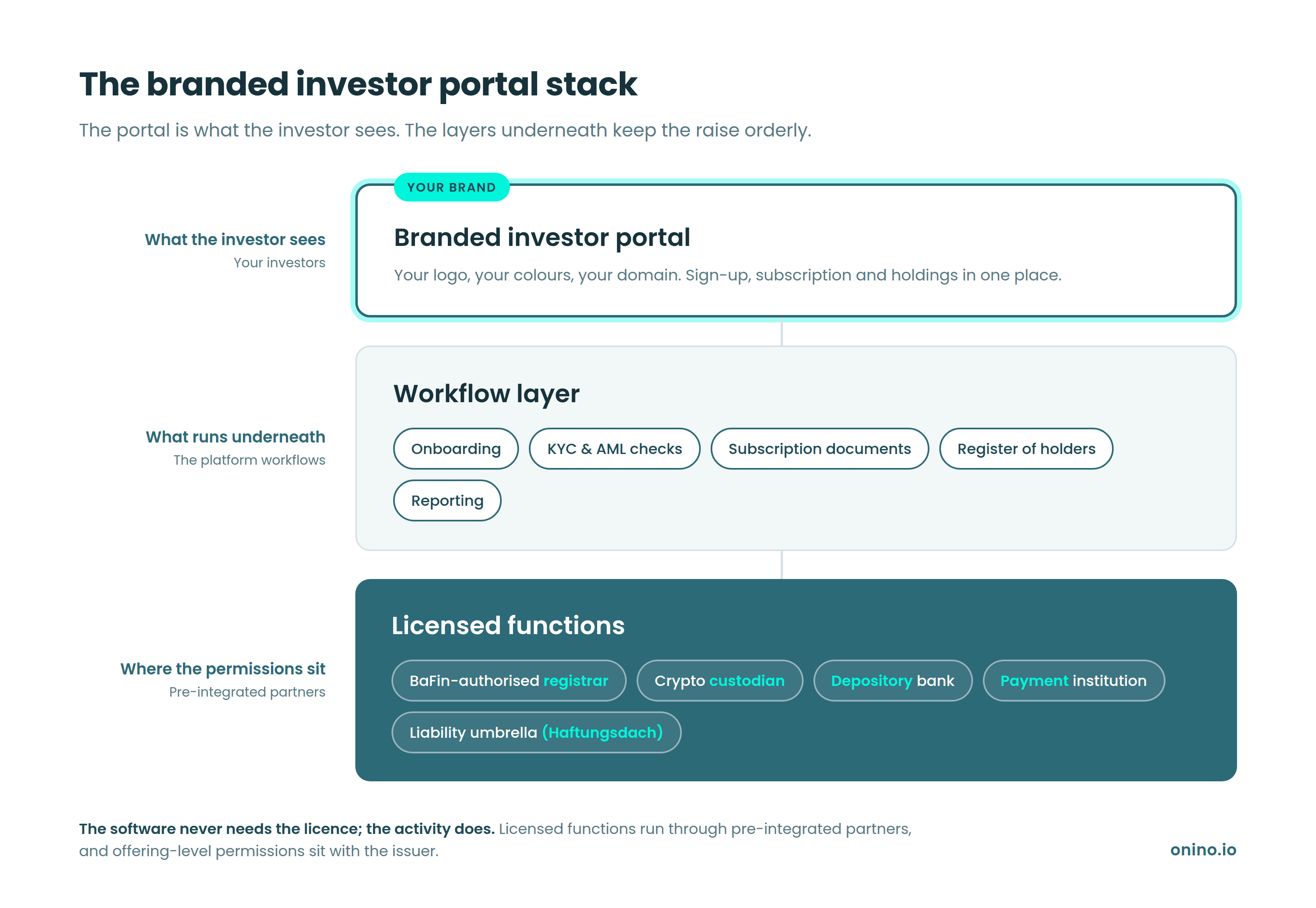
As shown in the graphic, the stack has three layers: your branded portal on top, a workflow layer with five functions beneath it, and five licensed partner roles at the base. The investor only ever sees the top layer.
Who needs one
The clearest case is fund managers and SPV operators running recurring raises. If you raise from the same base of investors across multiple vehicles, a portal removes the repeated friction of onboarding each investor for each deal. ONINO's SPV solution is built around exactly this pattern, standardising subscription flows across many vehicles, and the same logic applies to angel clubs and syndicates managing subscriptions at scale.
The second group is issuers in private markets more broadly: real estate sponsors, private equity and venture managers, renewable energy developers, and private credit originators raising from qualified or professional investors. Family offices running co-investments sit here too, and they tend to ask the sharpest questions about access control, since one portal often serves members with very different rights. For all of them, a credible self-serve investor experience is what ONINO's white-label platform is designed to deliver under the client's own brand.
If you raise once and never again, a portal is overkill. If raising is part of how your business runs, it pays for itself with every repeat investor who does not need to be onboarded twice.
The four features that separate a portal from a login page
Digital investor onboarding comes first, and it is where raises quietly leak. Signicat's Battle to Onboard study, a 2022 survey of 7,600 consumers across 14 European countries, found that 68% had abandoned a financial application, and that the average person gave a provider under 19 minutes before walking away. Those respondents were opening bank accounts, not subscribing six-figure tickets, so treat the number as a floor rather than a forecast. The mechanism still transfers: every extra document request and email round-trip in your subscription flow is a point where a willing investor can stall, which is why self-serve onboarding is the single biggest driver of completion.
KYC and AML checks are the second feature, and they must be built in, not bolted on. Identity verification, sanctions screening, and record retention have to happen inside the same flow the investor is already in. A portal that sends investors to a separate tool to verify loses a share of them at the handoff, for the same reason the abandoned applications above were abandoned: each switch resets the clock on the investor's patience.
An accurate register is the third, and for most managers it is the feature that finally retires the spreadsheet. Once an investor subscribes, they should see their position, and you should see the register update automatically. Manual cap-table maintenance is where errors and disputes originate, which is why so many teams end up replacing Excel cap tables and email subscriptions with a single system of record.
Reporting and communication round it out. Statements, updates, and documents should live in the portal so investors return to one trusted place rather than chasing you for a PDF. Repeat raises depend on this: the investor who can check their position without emailing you is the investor who subscribes again. Identity checks, though, are where most operators have the sharpest questions, so they deserve a closer look.
How does a portal handle KYC and AML for digital securities?
The short answer is that the portal orchestrates checks that licensed specialists perform. When an investor subscribes, the portal collects identity documents, runs verification and sanctions screening through integrated providers, gates the offering by investor category where the offering requires it, and retains the records an audit will later ask for. Done well, all of this happens inside one uninterrupted subscription flow, which is the practical meaning of "KYC built in".
For tokenized instruments the division of labour matters more, not less. Where an offering uses crypto securities under Germany's eWpG, the crypto securities register is maintained by a BaFin-authorised registrar; the permission sits with that partner, not with ONINO. In structuring conversations we keep hearing that the hardest integration question in any branded setup is not the branding at all but how KYC data flows between the platform and the licensed partners behind it. Pre-integration is the answer to precisely that question: the partners an offering needs are already connected, so the data flow is solved before your first investor arrives. The fuller picture of the checks themselves belongs in a guide of its own. What pre-integration does not answer is a question one layer up: whether you need a licence of your own.
Do you need a licence to run a branded portal?
ONINO is a software provider, not a legal advisor, so read this as a map of the terrain rather than advice on your case. That said, one pattern comes up in nearly every structuring conversation we hear: founders assume the portal itself triggers a licence, and counsel keeps correcting them. Issuing your own instrument to investors does not, by itself, require one. Licences attach to the regulated services around an offering, such as brokering, custody, or operating a crowdfunding platform, and in a well-built setup those services run through partners who already hold the permissions.
This is the model one adviser summarised as your brand in front, the licence in the footer. There is a market of licensed institutions with no interest in running their own retail brand; they lend their permission instead, through arrangements such as a liability umbrella (Haftungsdach). The investor sees your platform, your colours, your flow. The licensed partner appears in the terms of service. Offering-level permissions still sit with you as the issuer, for example an ECSP licence if you operate a crowdfunding platform under ECSPR, but the heavy institutional permissions do not have to be yours.
Two boundaries keep coming up in those same conversations. First, the secondary market is the wall: letting investors subscribe to your offering is one thing, but brokering positions between investors or holding them is a licensed activity, so scope your portal's promises accordingly. Second, depth follows audience. Retail investors rarely interrogate the structure behind a portal; an institutional investor's lawyer will decide the whole deal on it. Knowing which of the two you are building for determines how much structure you need, and it is the first fork in the build versus buy decision as well.
Build versus buy
The strongest evidence on this question is what the largest managers actually do. When Hamilton Lane, a private markets firm managing hundreds of billions in assets, wanted to open its $2.1 billion Equity Opportunities Fund V to a wider investor base in January 2023, it did not build its own portal. It launched through an existing digital infrastructure provider, Securitize, with minimums of $20,000 against the roughly $5 million such funds traditionally required. A firm with every resource to build chose to buy, because the value was in reaching investors quickly, not in owning the plumbing. That is the same trade-off a mid-market issuer faces, only at a scale where the answer is harder to dismiss.
The surrounding market has settled the investor-expectation side too. Under the EU's crowdfunding regime, ESMA's market data counted over €4 billion raised in 2024 across 181 authorised platforms in 21 member states, with retail investors making up roughly 88% of participants. In other words, regulated self-serve investing is no longer novel to European investors; it is what they expect a serious offering to look like, which raises the bar for anyone considering a hand-built flow.
Decision factor | Build | Buy (white-label) |
|---|---|---|
Time to launch | Many months of engineering before the first raise | Weeks: configure branding, rules, and documents |
Compliance upkeep | You track every regulatory change and rebuild for it | Vendor and licensed partners keep the engine current |
Licensed functions | You source registrar, custody, and distribution partners yourself | Pre-integrated partners, connected before day one |
Register and reporting | Built from scratch, then maintained for years | Included as the system of record |
Control | Total, including over every mistake | Full control of brand and rules, shared control of the engine |
However, building is not always wrong. If the portal is your product, if your workflows are unusual enough that no vendor models them, or if you already run a regulated technology business, owning the stack can be rational. For everyone else, the timeline argument tends to end the debate: if you need to be live this quarter, building is off the table, and a white-label launch measured in weeks rather than months is the realistic route. The platform matters less than what you decide before configuring it, which is where the checklist should start.
A launch checklist that starts one step earlier
Most setup checklists begin with branding. In structuring conversations, the advice we keep hearing is to begin one step before that, because structure is downstream of distribution: no adviser can pick your setup until you know who you are raising from, at what minimum ticket, and whether this is one raise or a pipeline. Answer those three questions first and most portal decisions, from investor categories to document depth, fall out of them.
From there the sequence is short. Configure branding and access: your logo, colours, and domain, plus who can see which deals. Connect onboarding and compliance: switch on identity and AML checks and define the subscription documents each investor completes. Then launch and invite: migrate existing investors, open the portal, and send invitations to your raise. The instrument itself can run on whichever rail the offering calls for, from non-tokenized investment products to classic or digital securities, on one platform through pre-integrated licensed partners, with tokenization as an option per offering rather than a requirement.
The verdict
Ultimately, a branded investor portal is worth setting up the moment raising becomes repeatable, and for nearly every issuer the right way to get one is to buy the infrastructure and keep the brand. Of everything above, the onboarding evidence matters most: when two in three people abandon financial applications that ask too much of them, completion is won or lost at the front door, and the front door is exactly what a portal controls. The next move belongs to the issuer: decide who you are raising from and at what ticket, then judge any platform, ONINO's included, by how fast it turns that answer into a live, compliant raise under your own name. For a closer look at the vendor field, our guide to white-label platforms in the EU is the natural next read.
General information only, accurate at the date shown. Not legal, tax or investment advice. Confirm your own position with qualified counsel.
Want to learn more how this can be applied to your business?
Read related Articles
What a branded investor portal is, the four features that matter, how KYC and licensing really work, and whether to build or buy one in 2026.