Insights
Capital Raising in the EU: 3 Ways to Issue Securities
The three routes to capital raising in the EU - self-issuance, bank placement, or public listing - and where tokenized securities fit. A guide for CFOs.

Alexandre Lehr
CEO
last updated on

Share
90% of Clients start with a free personal strategy
On this page
Contact Us
ONINO provides infrastructure for digital & tokenized financing to make your next financing a success.
Key Takeaways
Capital raising in the EU runs through three fundamental routes - self-issuance, intermediated issuance through a bank or arranger, and public listing - and the right one depends on your offer size, investor base, and how much control you want to keep. Tokenization doesn't add a fourth route; it's a delivery format that can make any of the three faster and cheaper to run. Disclosure requirements scale primarily with your offer size under the EU Prospectus Regulation - though the crowdfunding route uses its own ECSPR disclosure document below €5M, and a regulated-market listing triggers a prospectus at any size. In most EU markets, issuers under €12M never need a full prospectus, though a few member states cap the exemption at €5M and a short national disclosure document may still apply.
Capital Raising in the EU: 3 Ways to Issue Securities
If you're trying to raise capital for your business by issuing a security in the EU, the choice comes down to three routes: placing it yourself, placing it through an intermediary, or listing it publicly. Each route answers a different question - who runs the offer, who it reaches, and what that triggers under EU disclosure law - and most of the confusion issuers run into comes from mixing those questions up before picking a route.
This guide maps the three routes side by side, the instrument types that run through them, and where tokenization actually changes the picture. It's written for mid-sized business CFOs, real estate developers, and the financing consultants who advise them - anyone weighing how to structure a capital raise before they've committed to a specific instrument or platform. Treat it as the overview; if you already know you're running a self-issuance, the project financing solution and the direct placement product page go deeper than this piece does on purpose.
What Does "Issuing" a Security Actually Cover?
Issuing a security means creating and placing a financial instrument - equity, debt, or a hybrid - with investors in exchange for capital.
It's different from a bank loan (no tradeable instrument, no distributed investor base) and from crowdfunding in the ECSPR sense (a licensed platform sits between issuer and investor). What all three issuance routes share is a single regulatory question underneath them: once you offer a security to the public, does the EU Prospectus Regulation (Regulation (EU) 2017/1129) require disclosure, and how much? That question only arises once an offer is public and transferable in the first place - a friends-and-family loan or an employee share grant with no public marketing and no distributed investor base generally sits outside this framework entirely, which is why the three routes below are specifically about placing a security with outside investors, not every way a company can raise money.
What Are the Three Routes to Issue a Security?
Self-issuance means the issuer places the security directly with investors, running the terms, the distribution, and the placement risk itself, without a bank underwriting the offer. Intermediated issuance hands that placement role to a bank or arranger, which typically takes a fee and, for larger deals, absorbs some placement risk. Listing puts the security on a regulated market or MTF, opening it to continuous public trading rather than a one-time subscription window.
Route | Who runs it | Best fit | Typical disclosure driver |
|---|---|---|---|
Self-issuance | The issuer, directly | Issuers with an existing investor base, offers under ~€12M | Offer size (exemption ladder) |
Intermediated | A bank or arranger | Larger offers needing distribution reach the issuer doesn't have | Offer size + underwriting agreement terms |
Listing | Issuer + exchange + often an underwriter | Issuers wanting ongoing tradability, not just a one-time raise | Full prospectus + exchange listing rules |
Most Mittelstand issuers and real estate developers raising under €12M start with self-issuance simply because a bank isn't economical at that size. The €12M figure is the harmonised EU exemption threshold under Article 3(2) of the EU Prospectus Regulation as amended by the EU Listing Act (Regulation (EU) 2024/2809), applicable from 5 June 2026 and replacing the previous €8M national ceiling. Member states may still reduce it to as low as €5M, so confirm the figure that applies where you're incorporated. FIN LAW's guidance on the self-issuance privilege is a useful primary reference here (written in 2023 - the licensing analysis still holds, but the volume thresholds it cites predate the 2026 Listing Act changes). Intermediated issuance earns its fee back once distribution reach becomes the bottleneck rather than paperwork - a bank's existing investor network can place a larger offer faster than an issuer cold-marketing to the same audience. That reach is worth pricing in before you rule a bank out on cost alone.
What Instrument Types Run Through These Routes?
The route you pick doesn't lock you into one instrument, but some pairings are far more common in practice. The practical rule of thumb: the more upside and control an instrument gives an investor, the more scrutiny the offering attracts, independent of which of the three routes carries it.
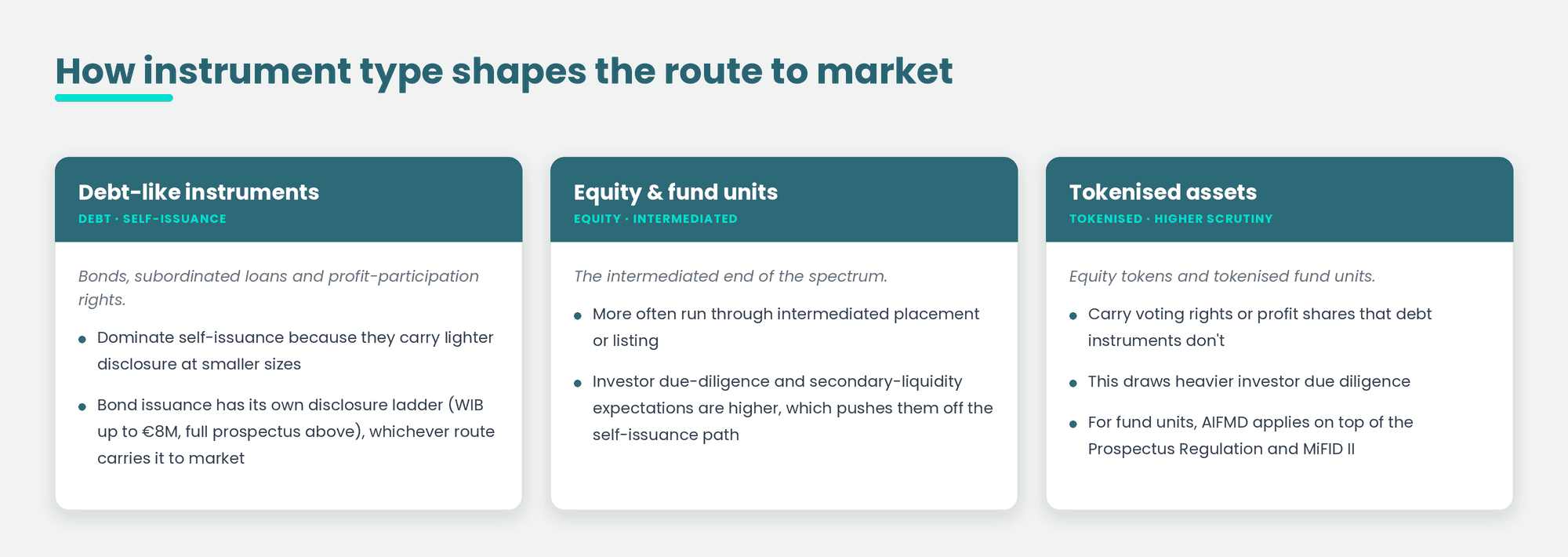
Debt-like instruments - bonds, subordinated loans, and profit-participation rights
Dominate self-issuance because they carry lighter disclosure at smaller sizes
Bond issuance specifically has its own disclosure ladder in Germany: up to the €12M exemption threshold, a short BaFin-approved securities information sheet (WIB) stands in for the prospectus; above €12M, a full prospectus is required. (With effect from 5 June 2026, the Standortfördergesetz raised the WIB band from €8M to €12M in step with the EU Listing Act - and offers placed through a licensed crowdfunding platform use the ECSPR key investment information sheet instead.)
Equity and fund units
More often run through intermediated placement or listing, because investor due diligence and secondary liquidity expectations are higher
Equity tokens and tokenized fund units
Sit at the other end of the spectrum: they carry voting rights or profit shares that debt instruments don't
This draws heavier investor due diligence
For fund units specifically, AIFMD considerations apply on top of the Prospectus Regulation and MiFID II
What Rules Apply, at a High Level?
Three EU frameworks do most of the work. The EU Prospectus Regulation ((EU) 2017/1129) sets disclosure obligations for public offers, scaling from exempt (small offers) to a lighter national document to a full prospectus as the offer size grows. ECSPR ((EU) 2020/1503) governs crowdfunding-platform-intermediated offers up to €5M per issuer per 12 months, with its own Key Investment Information Sheet rather than a prospectus. MiFID II classifies the instrument itself, whatever the route or size - though its conduct rules bind the licensed firms handling the instrument, and crowdfunding platforms operate under ECSPR's own regime instead. National regimes layer on top - Germany's eWpG being the clearest example - but they modify the disclosure and registration mechanics, not the three-route structure itself. Exact thresholds and exemptions are detailed in ONINO's regulation guide; treat the numbers here as directional, not a substitute for counsel.
This is also where the EU's single-market design matters most for anyone issuing across borders: once a full prospectus is approved by one national regulator, it can be "passported" to every other EU member state without a second approval process, which is the main reason larger issuers accept the cost of a full prospectus rather than staying under the national exemption ceiling. ECSPR works the same way for crowdfunding-platform offers - a single national authorisation lets a platform distribute an offer EU-wide up to the €5M cap. Self-issuance under a national exemption doesn't passport at all; it's a national-market tool by design, which is exactly why it suits issuers whose investor base is domestic to begin with. Since 5 June 2026 the exemption threshold is harmonised at €12M across the EU under the Listing Act, but member states may still lower it to as little as €5M, so an identical offer size can trigger a different disclosure document depending on where the issuer is incorporated - a real consideration for any group with entities in more than one EU country, and a reason to confirm the applicable national threshold with counsel rather than assume the €12M default applies everywhere.
Where Does Tokenization Fit In?
Tokenization is not a fourth route. It's a settlement and record-keeping format that can sit underneath any of the three - self-issuance, intermediated issuance, or a listing. It doesn't change who runs the placement or what the investor ends up holding. What it changes is how the security is recorded, and how the operational work around it gets done.
What actually changes
Instead of a paper certificate or a central-depository book entry, ownership lives on a distributed register. That pulls a set of steps issuers have traditionally run across disconnected tools onto a single system:
Investor onboarding and KYC/AML checks
The subscription and signature flow
The cap table and register of holders
Coupon, interest, and dividend payouts
Handled this way, those steps run end-to-end rather than through separate spreadsheets, PDFs, and manual bank transfers. The payoff is operational, not regulatory: fewer reconciliation points, a cleaner audit trail, and a faster primary issuance.
The legal mechanism, in Germany
The eWpG created the legal category of the crypto security - an electronic security whose register entry, not a signed certificate, is the act that brings the security into legal existence. That makes the register itself legally constitutive, which is why the format depends on a BaFin-licensed crypto securities registrar rather than a notary or a paper trail. ONINO's guide to issuing digital securities in the EU covers this mechanism and the operator requirement in full.
What it doesn't solve
A digital format makes primary issuance faster and the operational record cleaner. It does not automatically create a secondary market. Tradability is a separate authorisation, not a byproduct of going digital. As of ESMA's latest register of authorised DLT market infrastructures (updated January 2026), six infrastructures EU-wide hold a DLT Pilot Regime authorisation, and only five of them operate a trading venue for these instruments. For most issuers, that means treating tradability as a later, deliberate decision, not an assumed feature.
The ONINO Issuance Map
The map names the four decisions in the order issuers actually need to make them:
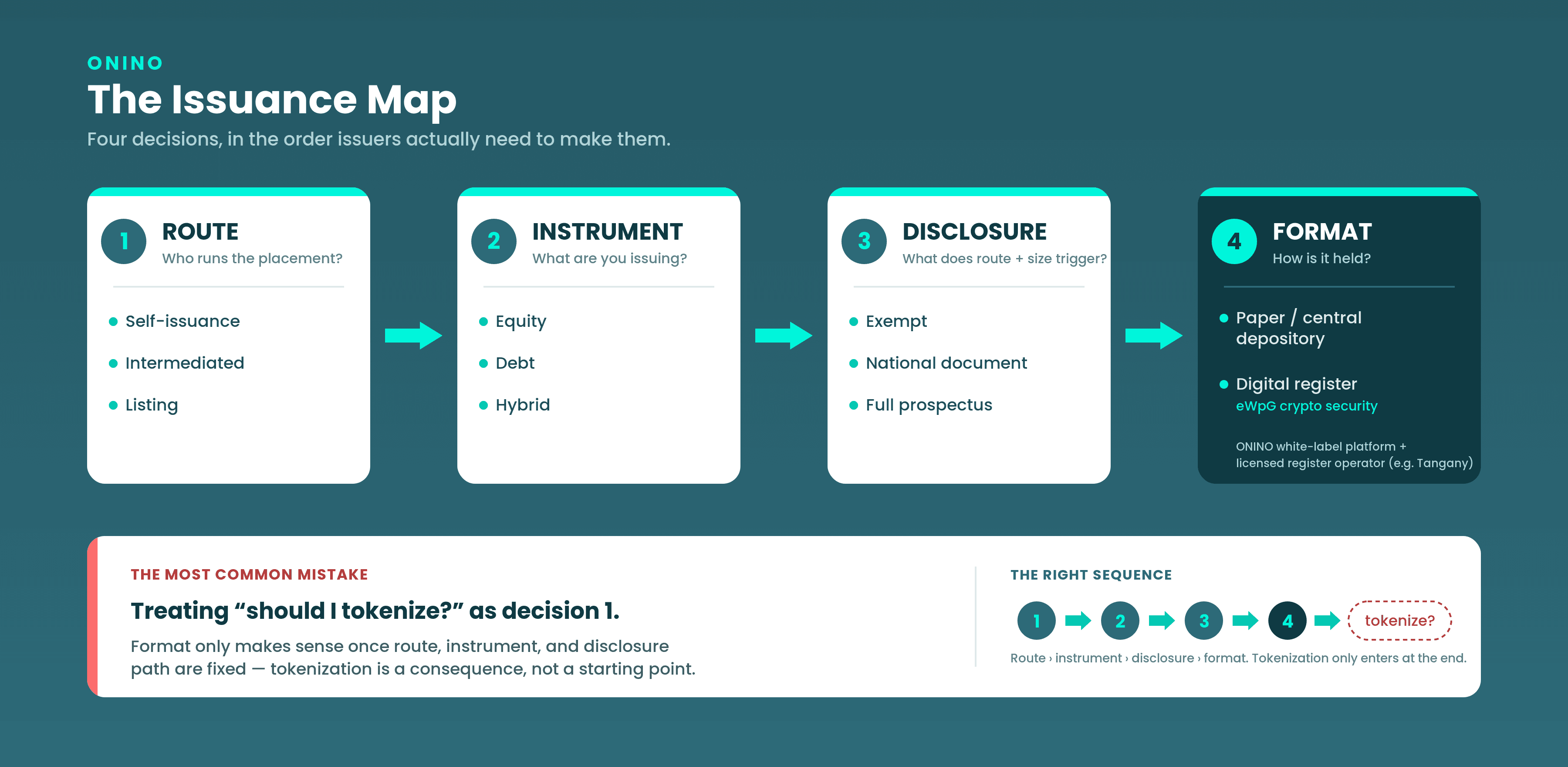
Route - who runs the placement: self-issuance, intermediated, or listing.
Instrument - equity, debt, or hybrid.
Disclosure path - which document that route-plus-size combination triggers: exempt, national document, or full prospectus.
Format - paper/central-depository or a digital register such as eWpG's crypto security, which ONINO's white-label platform is designed to support for issuers going digital, including the licensed register-operator relationship the format requires (via partners such as Tangany).
The mistake we see most often is issuers treating "should I tokenize" as decision one. It only makes sense once the first three are fixed.
In our own client conversations, the decision issuers most often sequence wrong is Format. Prospects arrive already set on "let's tokenize," sometimes before they've settled who runs the placement or which document their raise triggers. One founder told us he was "inclined to just have a go at it and make sure it's tokenized," even while acknowledging it might be overkill for a first issuance. Our standard response is to reset the order: get the first raise done through the most lightweight self-issuance route possible, confirm there's real investor demand, and only then decide whether a digital register earns its place. Tokenization is rarely the problem worth solving first, and treating it as decision one tends to add cost and delay to raises that didn't need it yet.
How Do You Choose the Right Route?
Three questions, in order
These three questions map onto the first three steps of the ONINO Issuance Map above - the practical sequence for anyone raising capital. Tokenization (step four) only becomes relevant once they're answered.
Question 1: Size
Under roughly €12M, self-issuance is usually the most capital-efficient, because it avoids underwriting fees. Above that, the disclosure burden converges regardless of route, so intermediation's distribution reach starts paying for itself.
Question 2: Investor base
If you already have an investor base - an existing client base, a regional network, a prior project's subscribers - self-issuance lets you use it directly. If you need to reach investors you don't have, intermediation or a listed offer buys you that reach.
Question 3: Liquidity expectation
If investors expect to trade the position afterward, only listing (or a tokenized structure paired with a licensed secondary venue) delivers that. Self-issuance and most intermediated placements are buy-and-hold by design.
A fourth factor: control vs. cost of capital
Self-issuance keeps the most control and, below the exemption ceiling, the lowest direct cost - but the issuer absorbs the placement work itself. Intermediation trades some control and margin for a bank's distribution reach and market credibility. Listing costs the most and gives up the most in ongoing disclosure obligations, in exchange for continuous access to capital markets rather than a single raise.
Common mistakes to avoid
Some issuers pick a route based on which one sounds most sophisticated rather than which fits their size and investor base - paying for intermediation or listing infrastructure that self-issuance would have covered just as well.
Others structure the offer first and check the disclosure threshold second, risking an offer size that accidentally crosses into a heavier disclosure tier for no strategic reason.
And some treat the choice of instrument and the choice of route as one decision. In practice, the route determines who runs the placement; the instrument determines what investors actually hold. Conflating the two tends to produce a structure that fits neither the investor base nor the capital need cleanly.
A worked example
Take a real estate developer with an existing base of regional investors who wants to raise €3M for a project.
At that size, a bank-led placement would be economically lopsided relative to the underwriting fee, and the developer already has the investor relationships a bank would otherwise be selling access to. So route one, self-issuance, wins on both the size and investor-base questions.
The instrument decision follows the capital structure the developer wants: a bond for fixed-return debt without diluting control, or a profit-participation right if investors expect a share of project upside. One regime distinction matters here: in Germany a bond is a security under the Prospectus Regulation's exemption ladder, while subordinated loans and most profit-participation rights are Vermögensanlagen under the VermAnlG - a parallel regime with its own information sheet (the VIB) and its own prospectus duties, not the €12M securities exemption.
Since €3M sits below the €12M exemption threshold, a bond at this size triggers only the lighter national document - in Germany, the WIB - rather than a full prospectus. (A Vermögensanlage of the same size would follow the VermAnlG's own disclosure ladder instead.)
Only at that point - route, instrument, and disclosure path already fixed - does it make sense to ask whether a digital, eWpG-based format is worth the operational upgrade over a paper structure.
This is illustrative, not a specific ONINO deal; real numbers vary by project and should be modelled with counsel.
Issuers weighing these three routes to raise capital via a bond, subordinated loan, or tokenized structure can see how ONINO supports issuance end to end across all three, with the eWpG register included for issuers going digital.
See how the routing works in practice
The decision above is easier to make when you can see each route modelled against your actual numbers rather than in the abstract. ONINO is white-label issuance infrastructure that supports all three routes end to end - subordinated loans, bonds, and participation rights - with pre-built compliance workflows for MiFID II, ECSPR, and MiCA (the latter for non-security tokens - tokenized securities themselves sit outside MiCA), plus the eWpG crypto securities register for issuers moving to a digital format.
If you are weighing self-issuance against an intermediated or listed structure, a short walkthrough will show you how the size, investor-base, and disclosure questions map onto a live deal setup, and where the operational upgrade to a digital format pays off.
Book a demo to see how ONINO structures issuance for your raise, or explore how ONINO supports digital financing across all three routes.
General information only, accurate at the date shown. Not legal, tax or investment advice. Confirm your own position with qualified counsel.
Want to learn more how this can be applied to your business?
Read related Articles
The three routes to capital raising in the EU - self-issuance, bank placement, or public listing - and where tokenized securities fit. A guide for CFOs.