Regulation
ECSPR vs VermAnlG vs Prospectus: Which Regime Should Your Crowdfunding Platform Operate Under?
Which regime should your crowdfunding platform operate under? Compare ECSPR, VermAnlG and the prospectus route on thresholds, investors, documents and reach.

Kristina Stark
Junior Growth Manager
last updated on

Share
90% of Clients start with a free personal strategy
On this page
Contact Us
ONINO provides infrastructure for digital & tokenized financing to make your next financing a success.
Key Takeaways
Your crowdfunding platform should operate under ECSPR if it needs EU-wide reach, under VermAnlG if it runs German subordinated-loan and participation-right deals, and alongside the securities prospectus rules if its deals exceed EUR 5 million. The three regimes differ on how much one project may raise, who may invest and how much, which document the platform produces, and whether the platform can cross a border, so the regime effectively chooses the product. ECSPR caps a project owner at EUR 5 million per 12 months but notifies into all 27 member states. VermAnlG allows EUR 6 million per issuer but imposes hard per-investor caps the platform must police, and stops at the German border. Since 5 June 2026 the securities route runs prospectus-free to just under EUR 12 million, and since 10 February 2026 an issuer can place those securities itself, without a platform.
One premise, stated up front: everything below assumes a platform operator based in the EU, running public offers aimed at retail investors. Deals sold only to professional investors are left out of this comparison: they need no prospectus or VIB, although a platform providing crowdfunding services to them still falls under ECSPR and are excluded here, because they need neither a platform nor a disclosure document written for retail buyers.
Crowdfunding regulation is the set of rules that decides who is allowed to run an investment platform, what that platform must tell investors before they put money in, and how large a single deal on that platform may be. In the EU three separate regimes answer those questions differently. ECSPR is the European Crowdfunding Service Providers Regulation, the single EU rulebook for platforms that match investors with projects. The German Investment Products Act, or VermAnlG, is Germany's own older rulebook for investments that are not shares or bonds, such as subordinated loans and profit participation rights. The Prospectus Regulation is the EU rule that says once an offer of shares or bonds passes a certain size, the company must publish a long document about itself that the regulator has checked. Choosing between them is usually treated as a legal question. It is a business-model question wearing a legal costume.
Which crowdfunding regulation applies to your platform? Work down this decision tree
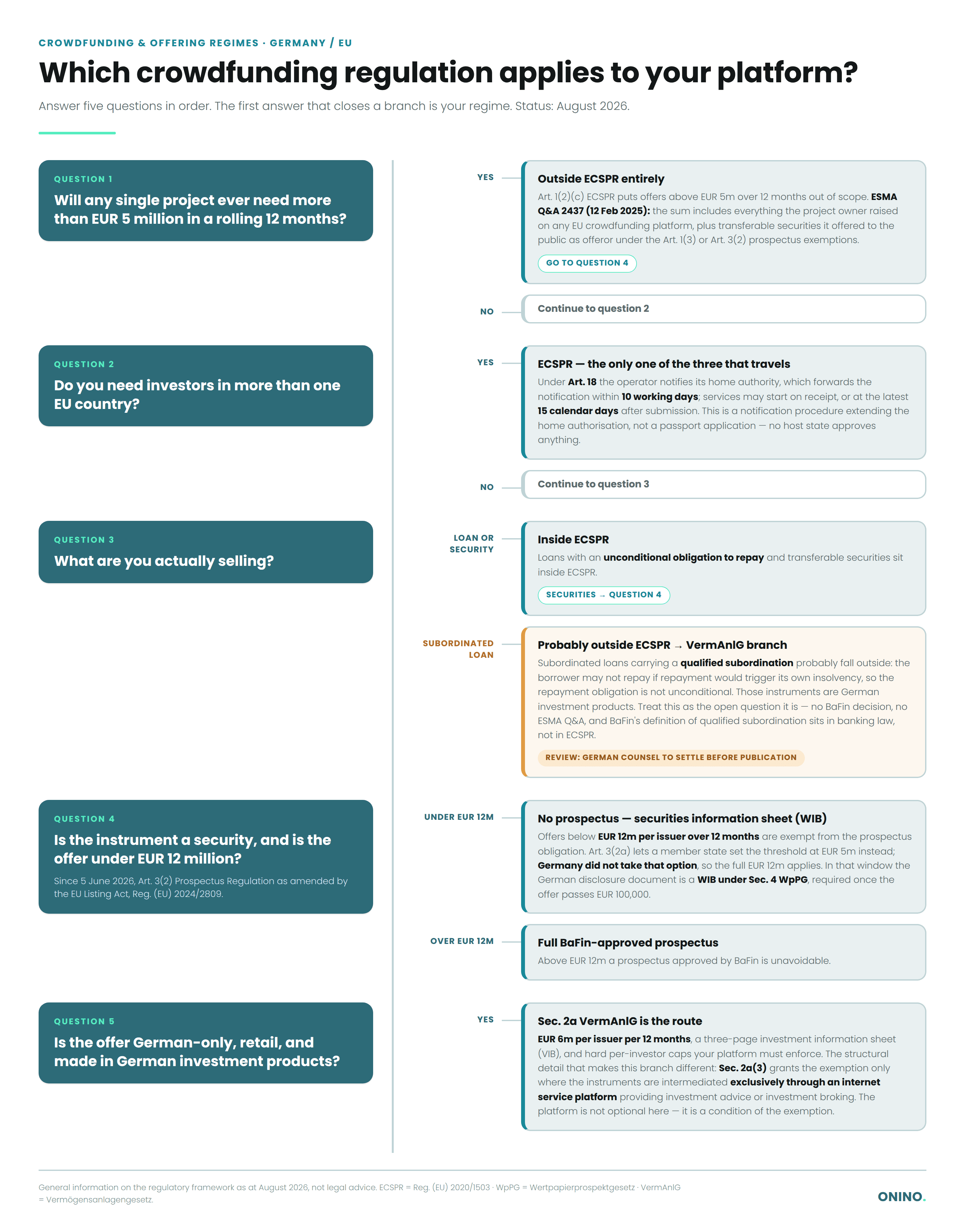
Answer five questions in order. The first answer that closes a branch is your regime.
1. Will any single project on your platform ever need more than EUR 5 million in a rolling 12 months?
If yes, that project is outside ECSPR entirely. The regulation simply does not cover offers above EUR 5 million counted over a rolling 12 months, and ESMA, the EU securities regulator, confirmed in February 2025 that the count includes everything that project owner raised through any crowdfunding platform anywhere in the EU, plus any securities it offered to the public under the prospectus exemptions. Go to question 4. If no, continue.
2. Do you need investors in more than one EU country?
If yes, ECSPR is the only one of the three that travels. You notify your home regulator, which forwards the notification within 10 working days, and you may start serving the new country on receipt, or at the latest 15 calendar days after you filed. This is a notification that extends the licence you already hold, not a second application, and no other country approves anything. If no, continue.
3. What are you actually selling?
Loans with an unconditional obligation to repay, and transferable securities, sit inside ECSPR. Subordinated loans carrying a qualified subordination probably do not, because the borrower may not repay if repayment would trigger its own insolvency, so the repayment obligation is not unconditional. Those instruments are German investment products and belong in the VermAnlG branch. Treat that as the open question it is: neither BaFin nor ESMA has ruled on it, and BaFin's published definition of qualified subordination comes from banking law rather than from ECSPR.
4. Is the instrument a security, and is the offer under EUR 12 million?
Since 5 June 2026 an issuer can raise up to EUR 12 million over 12 months with no prospectus at all. Member states were allowed to hold the limit at EUR 5 million instead, and Germany did not take that option, so the full EUR 12 million applies. Below that line the German disclosure document is a securities information sheet, the WIB, a short standard form required once the offer passes EUR 100,000. Above EUR 12 million, a full prospectus approved by BaFin is unavoidable.
5. Is the offer German-only, retail, and made in German investment products?
Then the German small-offer route under VermAnlG is yours: EUR 6 million per issuer per 12 months, a three-page investment information sheet, the VIB, and hard per-investor caps your platform must enforce. Note the structural detail that makes this branch different: the exemption applies only where the deal is sold exclusively through an online platform that advises on or brokers investments. The platform is not optional here, it is a condition of getting the exemption at all.
ECSPR vs VermAnlG vs prospectus: how do the three regimes compare?
What the operator needs to know | ECSPR (EU crowdfunding regulation) | VermAnlG small-offer route (German investment products) | Securities: WIB route, then full prospectus |
|---|---|---|---|
Ceiling per 12 months | EUR 5,000,000 per project owner, aggregated across every EU platform | EUR 6,000,000 per issuer | Prospectus-free below EUR 12,000,000 per issuer; above that, full prospectus, no ceiling |
Document produced | KIIS (key investment information sheet), max 6 A4 pages, drafted per offer, not pre-approved by BaFin | VIB, max 3 A4 pages, filed with BaFin and published only once BaFin permits | WIB, max 3 A4 pages, 4 for electronic securities, BaFin permission required; or a full prospectus, BaFin approved, up to 300 pages |
Who may invest, and how much | Anyone. Above the higher of EUR 1,000 or 5% of net worth the platform must warn, obtain express consent and check understanding. A warning trigger, not a cap | Anyone, but hard caps: EUR 1,000; EUR 10,000 with a self-declaration of EUR 100,000 in liquid assets; or twice average monthly net income, maximum EUR 25,000. The platform must police them. Corporate investors are exempt from the caps | Anyone. No legal per-investor caps since 10 February 2026, when Germany repealed its own limits |
Instruments covered | Loans with an unconditional repayment obligation, and transferable securities | Subordinated loans, profit-participating loans, participation rights, and the catch-all category, where not issued as securities | Securities only |
Investor-protection mechanics | Entry knowledge test, simulation of ability to bear a loss of 10% of net worth, four-calendar-day reflection period | Suitability and cap checks at subscription; blind-pool offers prohibited | Disclosure only. The document is the protection |
Operator permission | ECSP licence from BaFin. Reserve capital of the higher of EUR 25,000 or a quarter of last year's fixed costs | A German investment-broker permission from the trade office, tied-agent status under a licensed partner, or an investment-firm licence under § 15 WpIG | An investment-firm licence, or tied-agent status under a licensed partner |
Cross-border reach | One notification covers all 27 member states, live within 15 days | None. German market only | A full prospectus travels to other EU countries. The WIB route does not |
Is a platform structurally required? | Yes, by definition of the service | Yes. The exemption requires the deal to be sold exclusively through an online platform | No. Since 10 February 2026 the issuer may self-place |
What does an ECSP authorisation under EU crowdfunding regulation let your platform do?
An ECSP licence, short for European Crowdfunding Service Provider, lets one company run one crowdfunding platform across the entire EU under a single set of rules. The regulation has applied for years now, and the grace period during which platforms could keep operating under national law is long over. Furthermore, the licence is genuinely portable: 72 of 227 licensed platforms had notified for cross-border operation by January 2025, declaring an average of 11 member states each, and 19 of them declared all 27.
The reach is real but the volume is not yet. ESMA's Market Report on Crowdfunding in the EU 2025, published 22 December 2025, counted 229 licensed providers at the end of 2024, of which 181 actually raised money, together EUR 4.25 billion across 21 member states. More specifically, only 8% of that funding came from outside the provider's home country, so most licensed platforms bought EU-wide reach and then sold domestically anyway. This means the cross-border notification is worth paying for only where selling into other countries is a real go-to-market plan rather than an aspiration on a slide.
Above all, ECSPR decides what your onboarding funnel looks like. Every new investor has to pass a knowledge test and run a simulation showing they could absorb a loss of 10% of their net worth. Ordinary retail investors then get four calendar days from the moment they commit to change their mind, without giving a reason and without paying a penalty. Above the higher of EUR 1,000 or 5% of net worth you must show a risk warning, get explicit consent and check the investor understood it, but the regulation also says in plain terms that you may not stop them from investing. That distinction is the most misread rule in European crowdfunding regulation, and it is why ECSPR platforms can take a EUR 20,000 retail ticket that a VermAnlG platform legally cannot.
One boundary, stated so nobody guesses: an ECSP licence covers crowdfunding services only. It does not let you hold crypto-securities in custody, which needs a separate banking permission, and it does not cover crypto services, which need a licence under MiCAR, the EU's crypto rulebook.
Why do most German platforms still operate under VermAnlG, and what does the VIB require?
Most German platforms stayed on the national route because the national route was cheaper and the instrument they sell does not fit ECSPR. As at early 2025, seven German platforms held an ECSP licence while roughly 25 continued under national exemptions such as the VermAnlG small-offer route or as tied agents under a licensed partner, per the EDFA position paper. In other words, about one German platform in five took the EU licence. EuroCrowd, counting six original German licensees, reported in February 2026 that only three remained active, which suggests the EU licence has not yet repaid its cost for most operators.
The VermAnlG route is defined by two things: a bigger ceiling and much smaller tickets. It lifts the prospectus obligation for offers up to EUR 6 million per issuer per 12 months, above ECSPR's EUR 5 million. However, it then caps each investor at EUR 1,000, or EUR 10,000 if the investor self-declares at least EUR 100,000 in bank deposits and financial instruments, or twice average monthly net income to a maximum of EUR 25,000. These are hard caps the platform is legally obliged to check, not warnings, and only corporate investors escape them, which means a VermAnlG platform needs roughly six times as many retail investors as an ECSPR platform to fill the same EUR 6 million book. Therefore the regime is not choosing your paperwork, it is choosing your customer acquisition budget.
The document is the VIB, a three-page fact sheet filed with BaFin, publishable only once BaFin permits it, and carrying a mandatory loss warning on page one directly under the heading. Conversely, the ECSPR document, the key investment information sheet or KIIS, runs to six pages, is drawn up by the project owner for each offer, checked by the platform for completeness, correctness and clarity, and needs no approval before it goes out. Two documents, two operating models: the VIB puts a regulator in the critical path of every deal launch, the KIIS puts drafting and liability on the project owner and a verification duty on the platform.
Why did the 2026 prospectus exemption thresholds make your platform optional?
The 2026 German reform raised the prospectus-free ceiling and removed the reason issuers needed a platform at all, and operators have not priced that in. The Business Location Promotion Act, or StoFöG, did two separate things on two separate dates. From 10 February 2026 it scrapped the German per-investor caps on securities offers, which had run on the same EUR 1,000 to EUR 25,000 scale VermAnlG still uses, and with them the requirement to sell through a licensed investment firm. From 5 June 2026 it removed the old German ceiling, so the EU-wide EUR 12 million exemption applies directly. Any source quoting a lower German prospectus-free ceiling is describing the regime that doesn’t apply.
Read those two changes together from an operator's chair. An issuer of securities in Germany can now offer up to just under EUR 12 million to the public, with a three-page WIB instead of a prospectus, with no legal per-investor caps, and place it itself. Against ECSPR's EUR 5 million and VermAnlG's EUR 6 million plus hard caps, the securities route is now the most permissive of the three on both volume and ticket size, and the only one in which the platform is legally optional. Platforms competing for securities mandates above EUR 6 million are therefore selling convenience, distribution and compliance automation rather than necessity.
Two boundaries, again so nobody guesses. Dropping the prospectus-law requirement to use an intermediary does not settle whether whoever markets the offer needs a German licence of its own, so "self-placement" means no distribution duty under prospectus law, not "no licence anywhere". And the PRIIPs rules, which require a standard key-information document for packaged retail investment products, still apply wherever such a product is sold, whichever of these three regimes governs the offer.
The ONINO Regime Fit Test: four questions that decide the product, not the paperwork
Four variables decide the answer for a platform operator, and only one of them is legal.
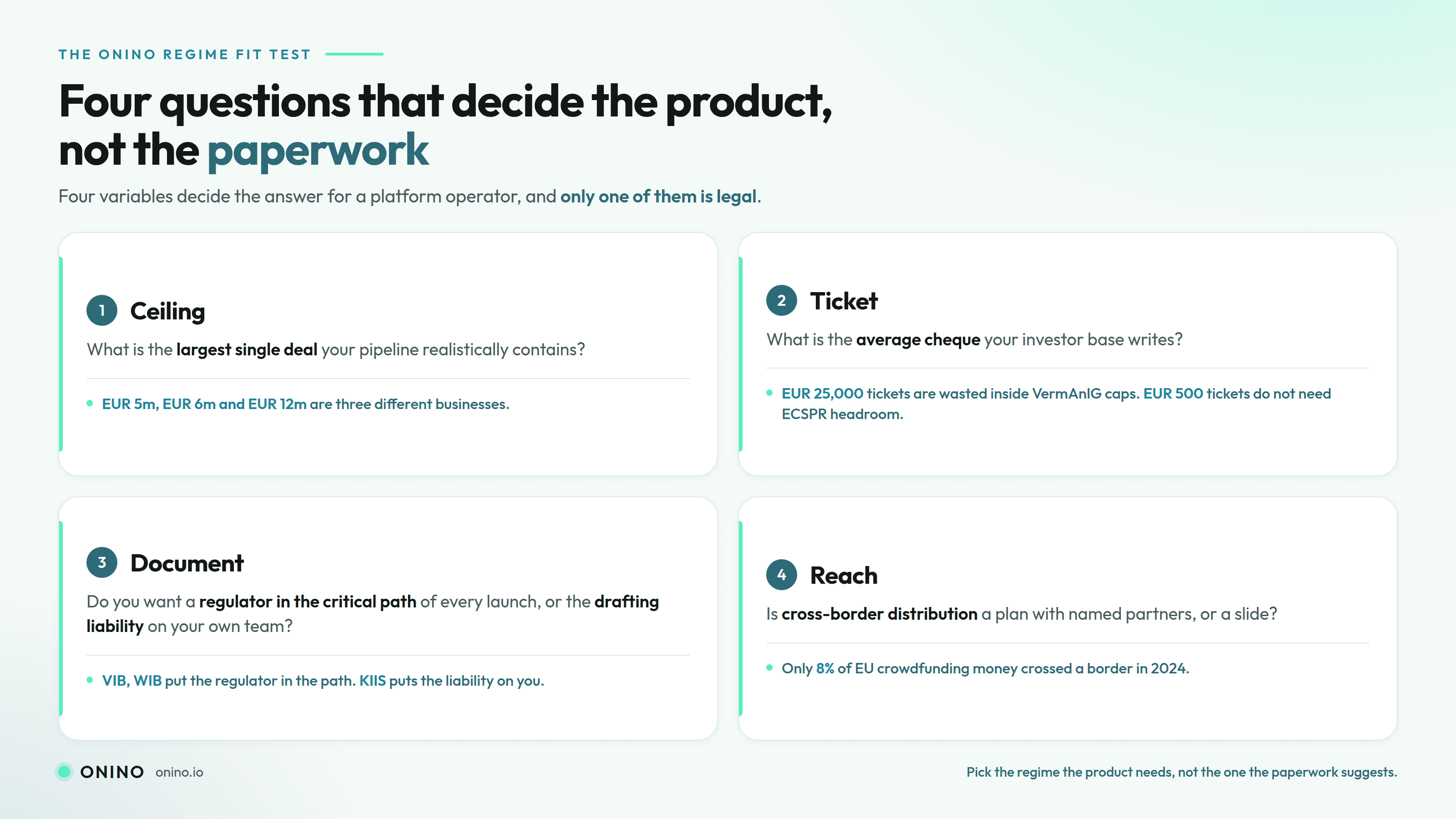
Ceiling. What is the largest single deal your pipeline realistically contains? EUR 5 million, EUR 6 million and EUR 12 million are three different businesses.
Ticket. What is the average cheque your investor base writes? A base that writes EUR 25,000 tickets is wasted inside VermAnlG's caps. A base that writes EUR 500 tickets does not need ECSPR's headroom.
Document. Do you want a regulator in the critical path of every launch (VIB, WIB) or a verification duty on your own team (KIIS)?
Reach. Is cross-border distribution a plan with named partners, or a slide? Only 8% of EU crowdfunding money crossed a border in 2024.
"Operators come to us asking which licence is cheapest, and that is the wrong first question. The regime sets your maximum deal size, your maximum ticket and your addressable market, so you are picking a business model and finding out the licence afterwards. The one thing I would tell every founder: model the investor count you need to fill your biggest deal under each regime before you talk to a lawyer."
Lukas Wipf (Co-founder and CPO)
What does each regime cost your platform, how long does it take, and can investors sell?
Cost and time separate the three regimes more sharply than the rule books do. An ECSP licence is the slow, front-loaded option: BaFin has three months to decide, but that clock only starts once your application file is complete, and BaFin has 25 working days to tell you whether it is. The legal floor is therefore about four and a half months, and six to twelve months is the range to plan against. You also need reserve capital of at least EUR 25,000, or a quarter of last year's fixed costs if that is higher, held as capital, as an insurance policy, or as both. BaFin's own fee is the small part: EUR 5,685 for the licence, then an annual supervisory levy of at least EUR 4,500, or EUR 6,500 if you hold client money or securities.
The broker permit used for the VermAnlG route comes from regional trade authorities rather than from BaFin, and is faster and much cheaper, a few hundred euros against BaFin's five figures. That is precisely why 30 German platform operators still sat there when the Federal Government last published a figure, in January 2023. A full prospectus is the expensive end: the European Commission put a standard equity prospectus at up to EUR 300,000 for large issuers and total IPO costs at 3% to 10% of the amount raised. BaFin takes 10 working days per review round, 20 for a first-ever submission from an issuer that has never listed or offered publicly before, and the clock restarts at 10 working days with every resubmission, so plan at least three months.
The honest liquidity answer is the same under all three regimes: none of them creates a market. ECSPR permits a bulletin board where investors advertise interest in buying and selling, and 29% of 227 platforms ran one as at January 2025 per the EDFA paper, but the platform may not match the two sides itself. It works more like eBay: a seller posts an offer, a buyer has to find it and accept it, and the platform never pairs them or creates the contract. Execute orders instead and you are running a trading venue, which needs a licence under MiFID II, the EU's securities-markets rulebook. Under VermAnlG and the WIB route there is no equivalent EU-level mechanism at all. Making an instrument transferable, by tokenising it or by entering it in an electronic register, makes transfer possible; it does not create demand.
Finally, size your regime against the market rather than against the ceiling. ESMA's 2025 report puts the average amount raised per project at EUR 240,000 for loan-based, EUR 640,000 for equity and EUR 770,000 for debt-based crowdfunding, with 46% of all projects raising under EUR 1 million, and average tickets of EUR 660 for retail and EUR 2,660 for sophisticated investors. Meanwhile 88% of all investors were classified as retail. For the large majority of platforms, therefore, the EUR 5 million ECSPR cap never binds, and the real constraint is the per-investor rules, not the headline threshold.
In conclusion
Ultimately the regime is a product decision, and the deciding variable is the per-investor rule rather than the ceiling. Of the four variables in the fit test, ticket size overturns a founder's first instinct most often: a platform whose investors write EUR 10,000 to EUR 25,000 cheques loses most of that capacity inside VermAnlG's hard caps, while a platform running EUR 500 retail tickets gains nothing from the cost of an ECSP licence and everything from a cheaper national permission.
Two people should act before anything gets built. The founder should model this week how many investors each regime requires to fill the largest deal in the pipeline, because that number is the business plan. German counsel should then settle the two points this article deliberately flags: whether a qualified subordination puts a subordinated loan outside ECSPR, and exactly which permission covers the brokering the platform intends to do. ONINO's platform software supports the operating models behind all three routes, with licensed functions running through pre-integrated partners and offering-level permissions sitting with the operator.
Two reads follow naturally from here: what an ECSP licence really costs in fees, capital and elapsed months, and what tokenised crowdfunding changes once the instrument sits on an electronic register rather than on paper.
Run the fit test against your own pipeline rather than in the abstract. Take your largest deal through the four variables and model the investor count each regime requires to fill it, under ECSPR, under the VermAnlG small-offer route and under the WIB route. If the answer comes back ECSPR, launching a platform under ECSPR sets out what the build and the licence actually involve.
General information only, accurate at the date shown. Not legal, tax or investment advice. Confirm your own position with qualified counsel.
Want to learn more how this can be applied to your business?
Read related Articles
Which regime should your crowdfunding platform operate under? Compare ECSPR, VermAnlG and the prospectus route on thresholds, investors, documents and reach.


