Regulation
How Much Does It Cost to Start a Crowdfunding Platform in 2026?
How much does it cost to start a crowdfunding platform in 2026? Realistic EUR ranges for software, licence, legal and compliance across three build routes.

Kristina Stark
Junior Growth Manager
last updated on

Share
90% of Clients start with a free personal strategy
On this page
Contact Us
ONINO provides infrastructure for digital & tokenized financing to make your next financing a success.
Key Takeaways
Starting a regulated crowdfunding platform in the EU costs roughly EUR 100,000 to EUR 500,000+ in the first year, and the software route is the only block that moves that range. / A custom build runs EUR 150,000 to 250,000+ and 12 to 24 months to market; white-label infrastructure lands at an indicative EUR 100,000 to 200,000 and 7 to 10 months. / Licence and legal work (EUR 30,000 to 100,000 plus official fees) and compliance operations (EUR 60,000 to 150,000+ per year) cost the same on every route, and they recur. / A development agency delivers software only; the licence, the licensed partner integrations and the ongoing compliance operation stay with the operator. / Commercial ranges are indicative and based on published vendor and market sources.
Starting a regulated crowdfunding platform in the EU costs roughly EUR 100,000 to EUR 500,000 or more in the first year, and only one of the four cost blocks actually moves that range. The budget splits into platform software, the ECSP licence (European Crowdfunding Service Provider, the authorisation a platform needs to provide crowdfunding services under the EU regulation) with its legal work, integrations for KYC and payments, and the compliance operation that recurs every year after launch. Three of those four cost broadly the same whether the platform is built from scratch, adapted from open source, or licensed as white-label infrastructure. This article prices every block across all three routes: 2026 EUR ranges, official regulator fees in four jurisdictions, the capital buffer founders misread as spend, and what a development company can and cannot deliver, showing why the useful question is what everything around the software costs.
Most guides on how to start a crowdfunding platform walk through the licence steps and leave the budget as a footnote. This article does the opposite. It prices each block in turn: the from-scratch build, the licence and legal setup, compliance operations after launch, what a development company can and cannot deliver, the white-label route, and the total an operator should put in the plan. The table below sets out realistic 2026 ranges for every block across the three sourcing routes operators actually choose between.
Cost block | Custom build | Open-source base | White-label infrastructure |
|---|---|---|---|
Platform software | EUR 150,000 to 250,000+ development before launch | EUR 0 licence; EUR 60,000 to 150,000 to adapt to ECSPR workflows | Setup fee plus subscription, typically low to mid five figures per year |
Licence and legal | EUR 30,000 to 100,000 advisory and legal, plus official fees | EUR 30,000 to 100,000 advisory and legal, plus official fees | EUR 30,000 to 100,000 advisory and legal, plus official fees |
Compliance operations (per year) | EUR 60,000 to 150,000+, every regulatory update lands on your team | EUR 60,000 to 150,000+, every regulatory update lands on your team | EUR 60,000 to 150,000+, platform-side updates sit with the vendor |
Integrations (KYC, payments) | EUR 15,000 to 40,000 engineering, plus per-check and payment fees | EUR 15,000 to 40,000 engineering, plus per-check and payment fees | Pre-integrated licensed partners; per-use fees remain |
Maintenance (per year) | 15 to 20 percent of build cost, EUR 25,000 to 50,000+ | Hosting, patches and upgrades on your team, EUR 20,000 to 60,000 | Included in the subscription |
Time to market | 12 to 24 months | 9 to 16 months | 7 to 10 months |
Indicative first-year total | EUR 250,000 to 500,000+ | EUR 150,000 to 350,000 | EUR 100,000 to 200,000 |
In the operator plans we review, the line most often misread is the capital. A licensed crowdfunding platform must hold a capital buffer (the regulation calls it prudential safeguards) at all times: at least the higher of EUR 25,000 or one quarter of the preceding year's fixed overheads, plus three months of loan-servicing cost where it also arranges lending. The requirement comes from the EU Crowdfunding Regulation (ECSPR); different rules apply only where the company already holds a banking, investment-firm, e-money or payment licence with its own capital requirements. The buffer can take the form of own funds (Common Equity Tier 1, broadly the hardest form of equity capital after regulatory deductions, not simply any equity on the books), a qualifying insurance policy, or a combination of the two.
A platform trading for less than twelve months has no preceding year and calculates the figure from forward-looking estimates instead, so EUR 25,000 is a floor rather than a default. Held as own funds it is a capital requirement rather than a line of spend: the money is raised onto the balance sheet and has to stay there as equity, and the floor rises with overheads as the platform scales. For a founder raising seed capital that distinction decides how much of the round is working budget and how much the balance sheet simply has to keep.
A useful way to plan the budget is what we call the Crowdfunding Platform Cost Stack: Software, Licence and Legal, Integrations, Compliance Operations. Software is the layer that varies most with the sourcing decision, because the other three do not disappear with it: they are driven by regulatory requirements and by the licensed partners an offering needs, so they follow the platform whichever route the operator picks. Across the operator projects ONINO has scoped to date, software is typically less than a third of the total cost over the first three years once licence, legal and compliance operations are priced in. No independent EU-wide benchmark for these costs exists, so the figure stands as ONINO's own observation. This suggests that a build-versus-buy debate fought entirely over development quotes is arguing about the smaller number.
What does it cost to build a crowdfunding platform from scratch?
A from-scratch build of an ECSPR-compliant crowdfunding platform typically costs EUR 150,000 to 250,000+ and takes 6 to 12 months before the regulator even begins its review. Published vendor and agency research brackets that figure: LenderKit's own study put custom crowdfunding platform builds at EUR 89,000 to 200,000+, with North American estimates reaching USD 300,000 (LenderKit, 2025), and 2026 agency guides price a lean MVP from about USD 70,000 at Eastern European rates (Purrweb, 2026). The spread between USD 70,000 and USD 300,000 measures the difference between an MVP and a platform a regulator will accept.
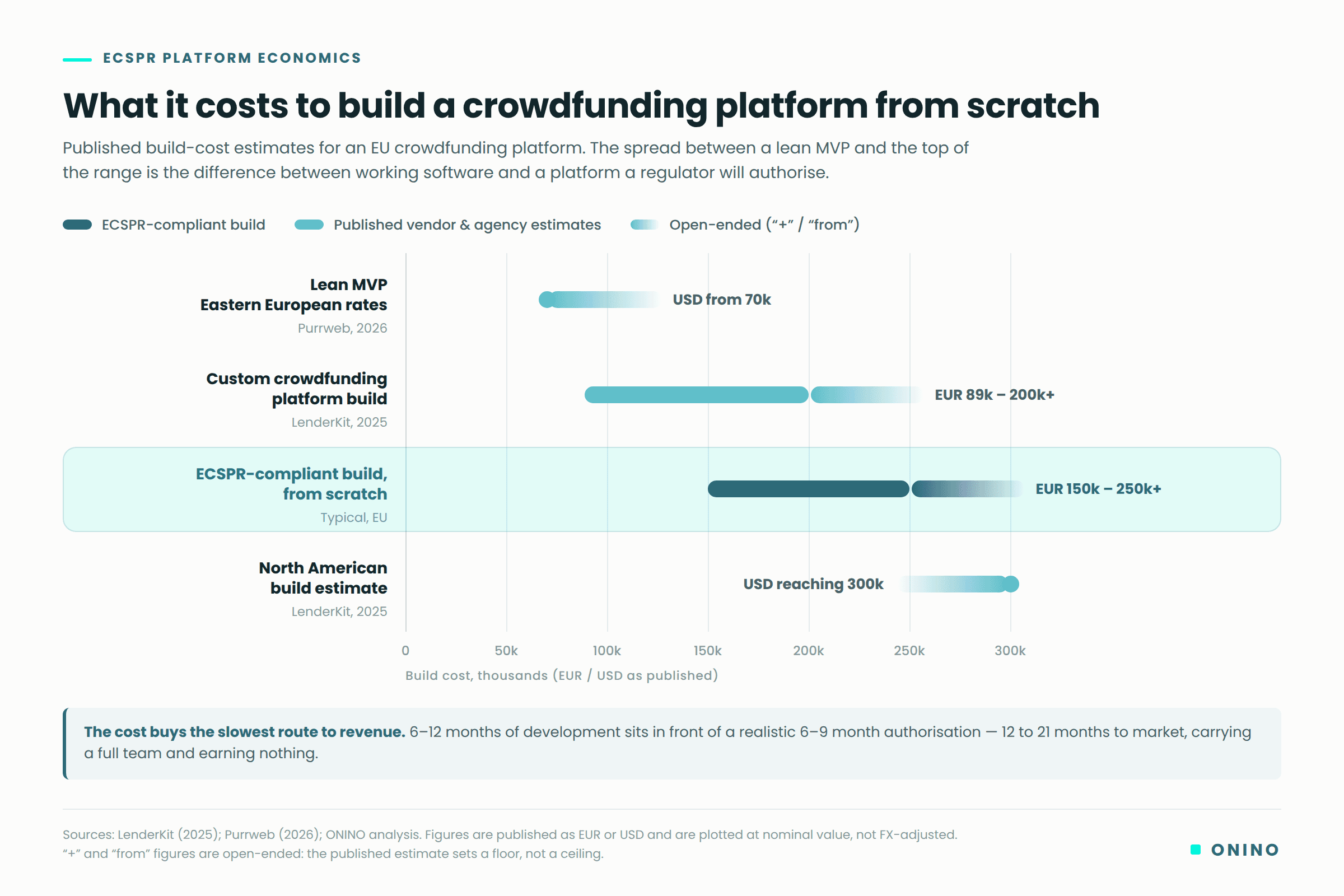
As shown in the graphic above - the number is high because an ECSPR platform is regulatory software, not a marketplace template. The licence application has to describe the procedures behind the key investment information sheet (KIIS), the standard disclosure document every offer carries, and the investment limits that protect non-sophisticated investors, meaning everyday retail investors. Regulators then probe the rest of the machinery in practice: the entry knowledge test, the loss-bearing simulation, the four calendar day reflection period in which an investor can cancel, and the KIIS workflow itself all have to exist and demonstrably function before approval. A generic e-commerce or donation codebase contains none of that logic, so most of the budget goes into compliance features a first-time founder has never had to specify before.
The build cost also buys the slowest route to revenue. With 6 to 12 months of development in front of an authorisation that realistically runs six to twelve months in Germany, France and Spain, and three to five months in Lithuania and Estonia, total time to market runs 12 to 24 months in the larger markets, during which the operator carries a full development team and earns nothing. For a founder that is a cash-burn problem long before it is a product problem, because the runway has to cover almost two years of salaries before the first raise closes.
What do the licence and legal setup cost?
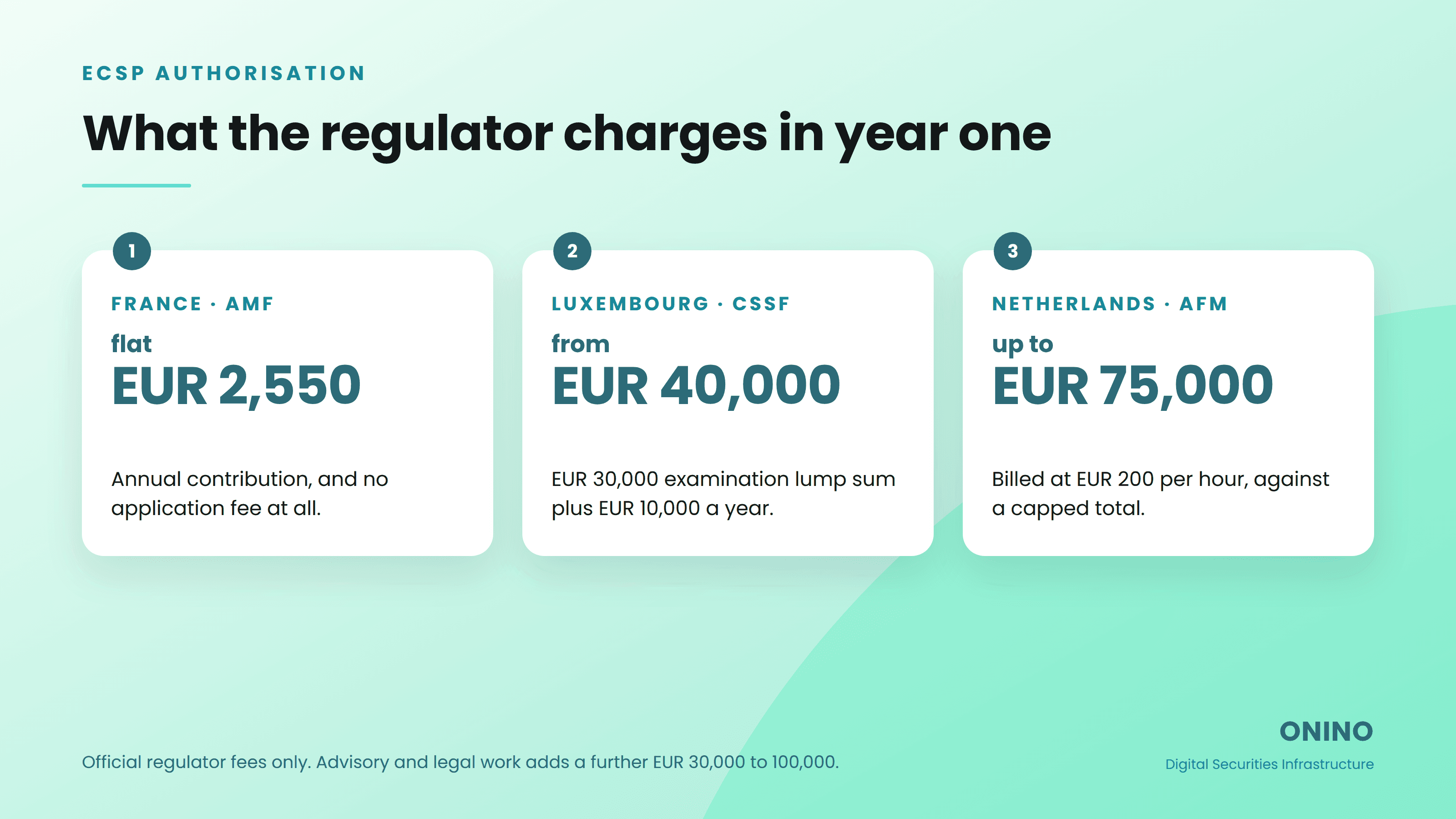
As seen in the graphic above, plan EUR 30,000 to 100,000 for advisory and legal work on the ECSP licence, depending on jurisdiction and complexity. The official fees on top of that differ sharply by country: the Dutch AFM bills EUR 200 per hour capped at EUR 75,000, plus EUR 700 and EUR 2,700 per person for vetting each manager's integrity and competence; Luxembourg's CSSF charges a EUR 30,000 examination lump sum plus an annual fee of EUR 10,000 and a volume-based component of up to EUR 30,000; France's AMF levies a EUR 2,550 annual contribution and no application fee at all; and Germany's BaFin charges EUR 5,685 for the authorisation under its fee schedule (FinDAGebV no. 28.1), plus EUR 2,256 for a later extension of services. A first year that costs EUR 2,550 in France and upwards of EUR 40,000 in Luxembourg is a gap large enough that the choice of home regulator belongs in the budget model.
This block is identical in every column of the cost table because the licence attaches to the operator and the activity, never to the software. No sourcing route removes it, no vendor can hold it for you, and the regulator's deadlines run the same whether the platform behind the application was built or bought: 25 working days to check the file is complete, then a 3 month assessment that only starts once it is. Therefore any saving an operator finds here comes from a cleaner application file.
One scope point keeps the budget honest. The ECSP licence covers crowdfunding services under the regulation, and nothing else. If the platform also wants to offer products that sit outside the regulation, such as German qualified subordinated loans, that product line needs its own national permission with its own legal budget. This essentially means every additional instrument an operator wants to offer reopens the legal line of the budget, which is why the product roadmap and the permission plan have to be written at the same time. This article prices the ECSPR platform case; consumer lending, rewards and donations sit outside ECSPR entirely and follow different rules.
What do compliance operations cost after launch?
Ongoing compliance is the block founders most often leave out of the model, and over the life of the platform it usually becomes the largest one. Plan EUR 60,000 to 150,000+ per year for a compliance owner, external audits, ICT controls and testing aligned with DORA (the EU's digital-resilience rulebook for financial firms), regulatory reporting, and the staff time that goes into vetting a key investment information sheet (KIIS) for every offer, or drafting it in-house if the platform manages loan portfolios. No published benchmark exists to check that range against: the European Digital Finance Association told the Commission in September 2025 that neither academia, nor ESMA, nor national regulators collect systematic data on the cost of ECSPR licensing or on overall operational costs. DORA has applied to crowdfunding platforms since 2025, which makes the ICT part of this budget a legal requirement. Crowdfunding platforms get no simplified regime under it: the full ICT risk-management rules apply, with lighter treatment only for the smallest companies. Compared against a one-off build of EUR 150,000 to 250,000+, a recurring EUR 60,000 to 150,000 per year overtakes the software spend inside two years at the midpoint of both ranges, so a model that stops at launch understates the real cost of the business.
The route decision changes who does the platform-side work inside that budget, and only that. On a custom or open-source platform, every regulatory clarification from ESMA, every reporting format change and every DORA finding lands on the operator's own engineering backlog, while on maintained white-label infrastructure the vendor ships the platform-side updates and the operator's compliance team consumes them. The regulatory accountability itself never moves, because supervision, audits and reporting obligations stay with the licensed operator on every route. For a small team the practical consequence is headcount: an in-house platform quietly requires a developer who understands ECSPR, and that person is harder to hire than the budget line suggests.
EUROCROWD, the European Crowdfunding Network; described the pattern in April 2025: "Platforms already stretched thin may be forced to consolidate or seek external partnerships to remain compliant. Combined with the slow uptake of DORA and limited interest in FIDA, the sector faces what could be termed 'compliance fatigue.'"
Can a crowdfunding platform development company deliver the regulatory stack?
A crowdfunding platform development company can deliver the software layer, and only the software layer. The ECSP licence, the contracts with licensed payment and KYC partners, and the year-on-year compliance operation cannot be bought as crowdfunding platform development services, because they attach to the operator: the regulator authorises you, the payment institution contracts with you, and the reporting obligations are yours. This is the single most expensive misunderstanding in a first budget, because it turns three of the four cost blocks into surprises that arrive after the software is already paid for.
That boundary matters when comparing quotes. An agency proposal typically covers discovery, design, the campaign and funding engine, payment integration work, a KYC module and an admin panel, which is exactly the scope reflected in published component pricing (Purrweb, 2026). What no development contract includes: the licence application evidence pack, the ICT documentation a regulator expects to probe, the licensed partner relationships behind payments and identity checks, and the maintenance of compliance logic after handover. Once the agency ships, every ECSPR change becomes a paid change request on the operator's timeline.
None of this makes development agencies the wrong choice for teams that want to own their codebase. It makes them a partial answer to a question that is mostly regulatory. An agency quote of EUR 150,000 answers one row of the cost table, and the other rows still arrive on schedule.
What does a white label crowdfunding platform cost?
White-label crowdfunding infrastructure typically costs a setup fee plus a subscription in the low to mid five figures per year for most providers, which published vendor pricing corroborates at roughly USD 400 to 2,000 per month, with one UK provider at GBP 2,500 to 5,500 and some charging activation fees above USD 20,000 plus a share of proceeds (LenderKit, 2025). In a white label crowdfunding cost comparison against a custom build, the first-year difference is typically six figures, and the recurring subscription replaces both the maintenance line and most of the platform-side compliance engineering. This means the saving is one of sequence as well as cash, because the operator stops paying a development team to reach the starting line and begins paying for a platform that is already there.
What the fee buys is the part of the cost stack that software can actually absorb: ECSPR workflows (investor tiering, knowledge tests, warning and consent thresholds, reflection period, KIIS handling) already built and validated, pre-integrated licensed KYC and payment partners so integration engineering shrinks to configuration, and a vendor team that ships regulatory updates as regulation moves. The fee does not buy the licence, the capital or the accountability; those stay with the operator on every route, which is exactly why the honest pitch for white-label is speed and predictability.
This is the calculation behind ONINO's white-label financing infrastructure: the licensed operation is yours, the pre-integrated platform underneath it is maintained for you, and the authorisation and platform setup run in parallel, which is what compresses the time to market.
What should operators budget in total?
A realistic first-year plan for the software stack lands at EUR 250,000 to 500,000+ for a custom build, EUR 150,000 to 350,000 on an open-source base, and EUR 100,000 to 200,000 on white-label infrastructure, in each case before the capital buffer, the higher of EUR 25,000 or a quarter of fixed overheads, which therefore scales with the cost base. From year two, the custom and open-source routes carry maintenance plus compliance engineering, while the white-label route carries the subscription plus the operator's own compliance operation. The first-year gap between the cheapest and the most expensive route is therefore around EUR 300,000, and almost all of it sits in a single block.
Ultimately the decision prices out as a trade between capital expenditure and months: the more of the software block an operator builds, the more cash and calendar sit in front of the first raise, while the regulatory stack costs the same on every path. Of the four blocks, compliance operations deserve the closest attention. At EUR 60,000 to 150,000+ every year they are the only line that keeps growing after launch, and the only one no vendor contract can carry for the operator.
Founders should therefore model year three before choosing a build route, and bring the prospective compliance owner into that conversation alongside the developers. If a number is already in your plan, the next step is to test it block by block: what the software layer costs on the route you are leaning towards, which integrations are already covered by pre-integrated licensed partners, and which lines stay with you as the licensed operator whatever platform sits underneath.
Bring your model to a walkthrough of the cost stack and we will price the software and integration blocks against it, then name the ones no software provider can carry for you.
General information only, accurate at the date shown. Not legal, tax or investment advice. Confirm your own position with qualified counsel.
Want to learn more how this can be applied to your business?
Read related Articles
How much does it cost to start a crowdfunding platform in 2026? Realistic EUR ranges for software, licence, legal and compliance across three build routes.


