Regulation
How to Start a Real Estate Crowdfunding Platform in Europe (2026)
How to start a real estate crowdfunding platform in Europe: the ECSPR licence, debt vs equity, investor onboarding, deal pipeline and software

Kristina Stark
Junior Growth Manager
last updated on

Share
90% of Clients start with a free personal strategy
On this page
Contact Us
ONINO provides infrastructure for digital & tokenized financing to make your next financing a success.
Key Takeaways
Real estate is the most popular vertical in European crowdfunding: ESMA counted 1.45 million investors in the sector in 2024, more than any other, across EUR 4.25 billion raised on 181 authorised platforms (ESMA, December 2025). Operating one under the EU regime requires an ECSPR licence from a single EU regulator, which then passports across the EEA, and it realistically takes six to twelve months in the larger markets, less in some smaller ones. Platforms in Germany that broker subordinated loans (Nachrangdarlehen) or participation rights (Genussrechte) work under the national VermAnlG instead, with a permission under § 34f GewO, § 15 WpIG or a liability umbrella (Haftungsdach). This post covers why real estate leads the market, what the licence permits, why 81% of European deals are debt rather than equity, the five layers of a platform build (deal pipeline, instrument, investor onboarding, licence, software), what the software must enforce on day one, and whether to build or buy. Ultimately the licence is the long pole, but the deal pipeline decides whether the platform earns anything in year one, and that work can start today.
A real estate crowdfunding platform is an online platform where a real-estate developer publishes a project and many private investors fund it together, each committing a few hundred or a few thousand euros. In the European Union these platforms often run under a single rulebook, the European Crowdfunding Service Providers Regulation (ECSPR), which is the EU law setting out who may operate such a platform and how investors must be protected. The platform never lends its own money and never buys the building. It matches capital with projects, produces the paperwork the regulator demands, and charges a fee for doing both. There are other ways how a platform operator can let companies raise public capital under local regimes or MiFID II in general; this article does not cover them.
Why is real estate the biggest vertical in European crowdfunding?
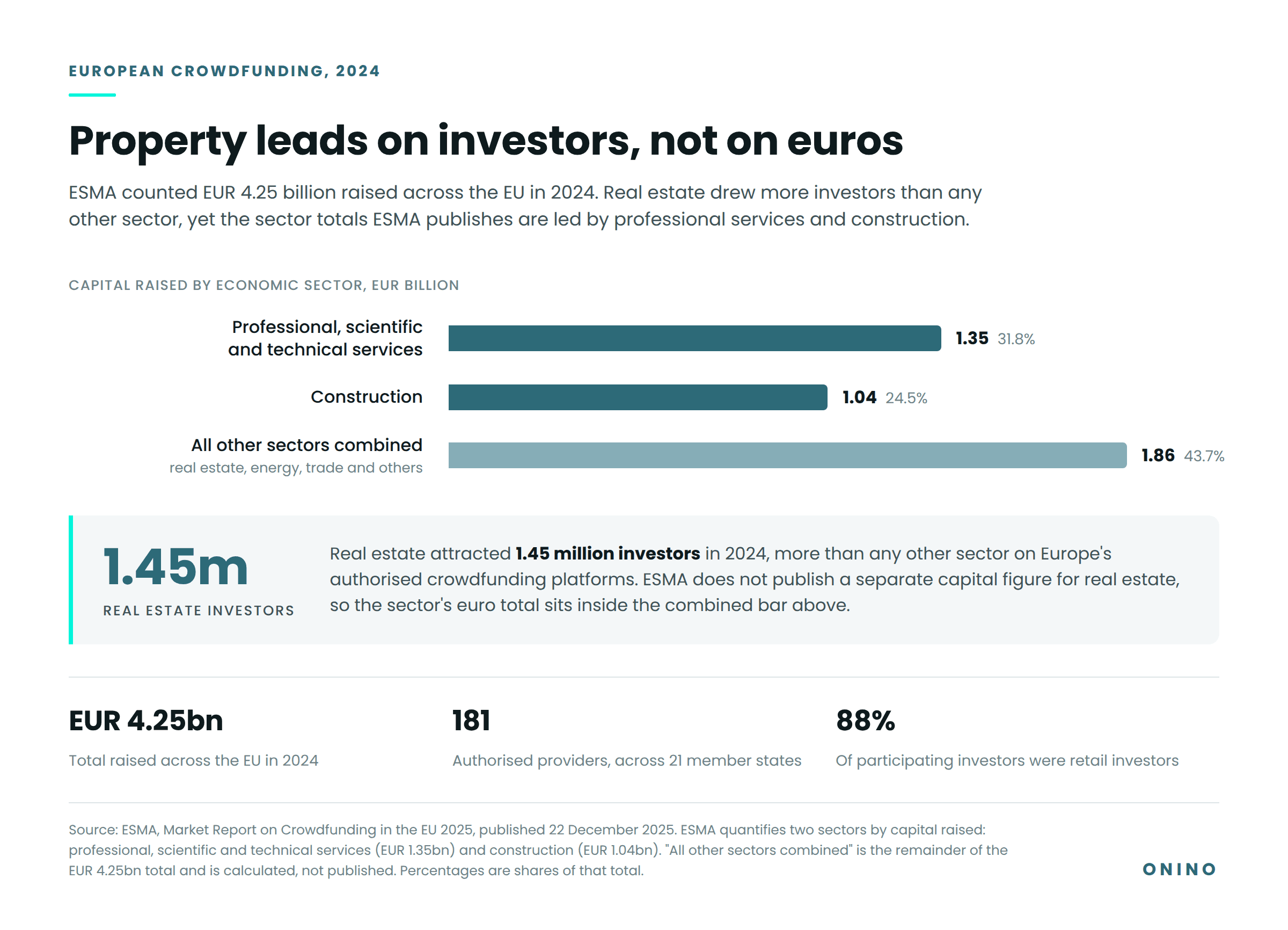
Real estate is where the European crowd actually puts its money. In its Market Report on Crowdfunding in the EU 2025, published on 22 December 2025, the European Securities and Markets Authority (ESMA, the EU's financial markets watchdog) counted roughly EUR 4.25 billion raised across the bloc in 2024 through 181 authorised platforms in 21 member states, and found that real estate attracted 1.45 million investors, more than any other sector. Construction was the second largest sector by capital raised, at about EUR 1.04 billion. Retail investors made up 88% of all participants. The bars in the graphic rank only the sectors ESMA reports separately by capital raised, professional, scientific and technical services at EUR 1.35 billion and construction at EUR 1.04 billion, so real estate has no bar of its own and its euro volume sits inside the remaining EUR 1.86 billion, which is why the sector leads on investor numbers while another sector leads on euros.
Those numbers describe an unusually friendly demand side for a new operator. Property is an asset a first-time investor understands without a finance degree, tickets start at a few hundred euros, and the return is quoted as a percentage rather than a share of an uncertain exit. More specifically, real estate crowdfunding in Europe is concentrated in a handful of markets: France alone produced EUR 1.45 billion of 2024 volume, 34.1% of the EU total, with the Netherlands at EUR 1.00 billion and Spain at EUR 0.45 billion.
However, demand is not a guarantee. France's 2024 Crowdfunding Barometer, produced by Forvis Mazars with France FinTech, recorded a 17% fall in total French crowdfunding volume that year and a fall of roughly 26% in the real-estate segment specifically, as higher rates and stalled developments worked through the loan books. Therefore an operator should read the EUR 4.25 billion as proof that the market exists, not as a promise that it grows every year, and should plan a platform that survives a slow vintage rather than one that only works in a boom.
What does an ECSPR licence let a real-estate crowdfunding platform do?
An ECSPR licence lets you match investors with businesses raising money, for the whole European Economic Area. You apply to the financial regulator of one EU country, and once authorised you can serve project owners and investors in every other member state without a second application. To passport into a new country you tell your home regulator where you intend to operate and you may begin 15 days later. The transition period for platforms operating under older national rules ended on 10 November 2023, so for a real-estate crowdfunding platform there is no unlicensed path left.
The rules the licence brings with it are easier to read than most financial regulation, because ECSPR was drafted for small operators. Five obligations shape the business models of crowdfunding platforms.
Obligation | What it means in plain terms |
|---|---|
EUR 5 million cap | One project owner may raise at most EUR 5 million across all crowdfunding platforms in any rolling 12 months. Above that, the raise leaves ECSPR entirely and needs another route: depending on instrument and country a national information sheet (in Germany a WIB for securities offers under EUR 12M), a VermAnlG exemption, or a full prospectus. |
Own funds | You must hold the higher of EUR 25,000 or a quarter of last year's fixed running costs, as a cushion so the platform can wind down without stranding investors. |
Key Investment Information Sheet (KIIS) | A standardised summary of each deal, at most six pages, written by the developer. Your platform is responsible for checking it is complete and clear. |
Entry knowledge test | Before a first-time investor can invest, you must ask questions that show they understand what they are buying and what they can lose. |
Reflection period | A non-professional investor may cancel a commitment within four days, no reason required, so your subscription flow needs a cooling-off timer built in. |
The EUR 5 million cap is the clause that decides how a real-estate platform is designed. A single mid-sized residential development in Germany or France passes EUR 5 million easily, so operators split the raise per project company, run the platform raise as the mezzanine slice sitting between the bank loan and the developer's own equity, or work alongside a licensed investment firm for the larger tickets. Above all, the cap attaches to the project owner rather than to your platform, and you are the party that has to verify it, which means the check belongs in onboarding from the first deal rather than in a spreadsheet somebody maintains by hand.
Where you apply also decides how long you wait. The statutory clock is three months from a complete file, but practice varies widely between regulators, from roughly three to five months in Lithuania and Estonia to six to twelve months in Germany, France and Spain.
One more rule arrived recently and is often missed. Since 17 January 2025, crowdfunding providers have been covered by DORA, the EU's Digital Operational Resilience Act, which is the law requiring financial firms to prove their IT can survive outages and attacks. That obligation lands on your software choice, not on your legal counsel, and regulators now ask about it during authorisation.
Which instrument fits a real-estate deal, debt or equity?
Most European real-estate platforms sell debt, not shares. ESMA's 2024 data shows loan-based crowdfunding at 58% of EU volume and debt securities at a further 23%, against 12% for equity. That split is not an accident of fashion. A developer wants money for 18 to 36 months at a known price and does not want a hundred new shareholders in the project company, while an investor wants a fixed coupon and, ideally, a claim on the land if the project fails.
Dimension | Debt (loan or bond) | Equity (shares in the project company) |
|---|---|---|
Investor return | Fixed interest, commonly 6% to 10% per year in recent European real-estate deals | A share of the profit on sale or refinancing, unknown until exit |
Security | Can be backed by a land charge, ranking behind the bank | Ranks last, after every lender |
Term | Defined at the start, matching the build programme | Open until the asset is sold |
Operational load | Interest schedules, defaults, extensions, security agent | Cap table, shareholder reporting, exit mechanics |
Typical fit | Development finance, bridge finance, the mezzanine gap | Long-hold portfolios, value-add repositioning |
In German-speaking markets the debt route usually takes the form of a subordinated loan, which is a loan that agrees to be repaid last if the project runs out of money, or a participation right, which pays a profit-linked return without granting voting rights. Both are treated as German investment products rather than shares, which is why they dominate developer raises in the DACH region. They are not ECSPR loans, so the ECSP licence does not cover them: brokering them needs a national permission under § 34f GewO, § 15 WpIG or a liability umbrella (Haftungsdach), within the EUR 6M per issuer exemption of § 2a VermAnlG. This matters commercially as well as legally: the instrument you pick determines your investor's risk, your reporting duties, and how easily the same structure can be reused on the next twelve deals instead of being redesigned each time.
What are the five layers of a real-estate crowdfunding platform?
A real-estate platform is best planned as five layers built in parallel, not as a sequence of milestones. We call this the ONINO Property Platform Stack, and it exists because the most common launch failure is a team that finishes four layers and then waits nine months for the fifth.
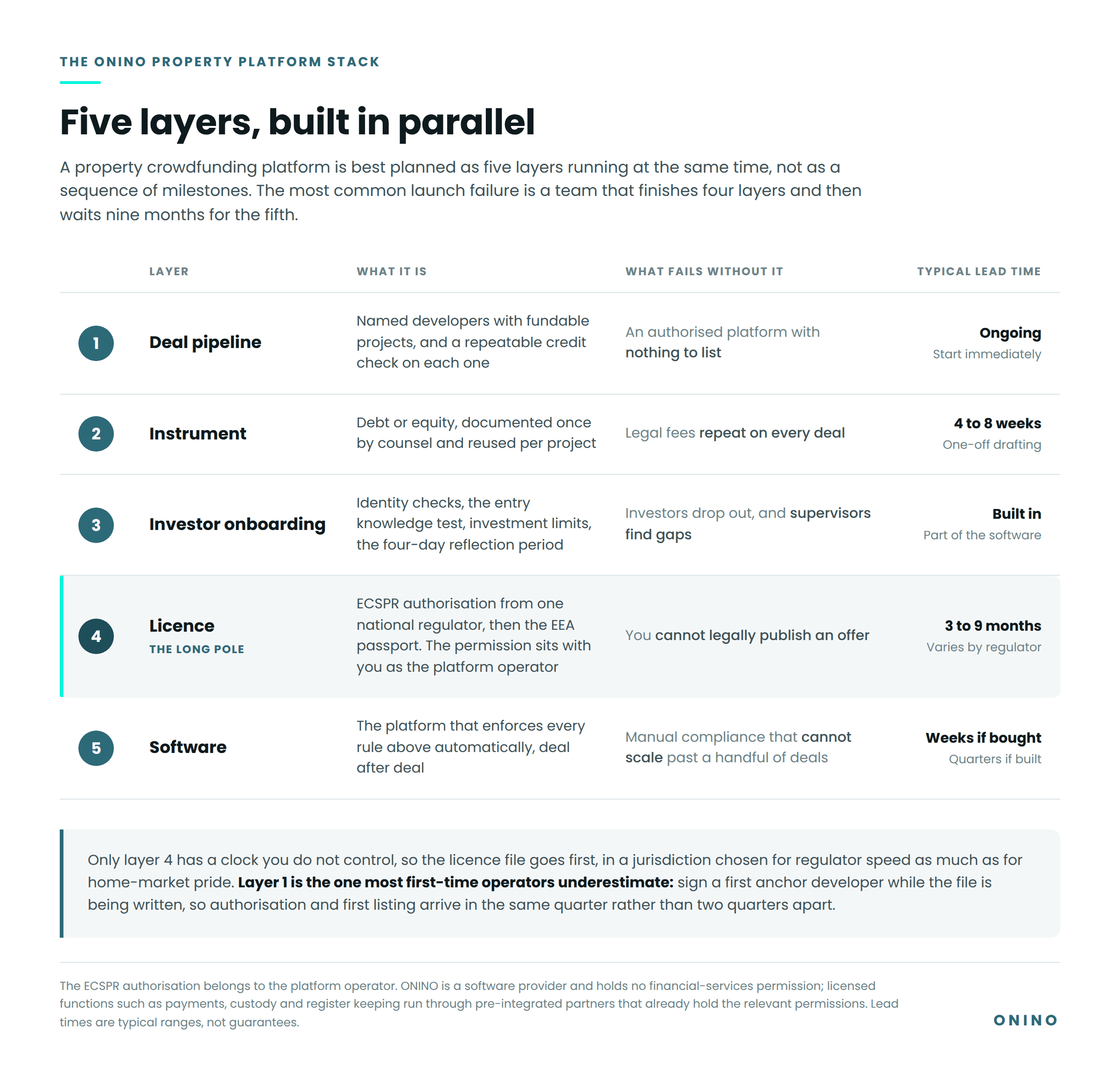
Only one of the five runs on a clock you do not control: ECSPR authorisation realistically takes 6 to 12 months from a single national regulator before the EEA passport opens the remaining member states, which is why the licence file goes first and why jurisdiction is often chosen for regulator speed rather than home market pride.
The other four are yours to schedule. Counsel documents the debt or equity instrument once in 4 to 8 weeks and it is reused per project, investor onboarding is enforced by the software itself (identity checks, the entry knowledge test, investment limits, the four-day reflection period), and the platform is a matter of weeks if bought and quarters if built.
Layer one is the one first-time operators underestimate: an authorised platform with no named developers, no fundable projects and no repeatable credit check has nothing to list on the day the permission lands. The licence takes months but follows a known process with a known checklist, whereas persuading eight developers to bring their next project to a platform that has never funded anything requires proof you do not have yet. Therefore the practical sequence is to sign a first anchor developer while the licence file is being written, so that authorisation and first listing arrive in the same quarter rather than two quarters apart.
What must real estate crowdfunding software do on day one?
Real estate crowdfunding software has one job above all others: it must enforce the regulation automatically, so that compliance is a property of the system rather than a task on somebody's list. That means:
Generating and versioning the KIIS for each project
Running the entry knowledge test and, for investors who fail it, showing the risk warning and recording their express acknowledgment
Applying investment limits and warnings
Running the four-day reflection countdown before money moves
Recording the due diligence performed on each project owner
Keeping investor money separated through a licensed payment partner
Producing the reports ESMA expects
Real-estate adds a second layer of requirements that generic crowdfunding software rarely covers. Development money is drawn in tranches against building milestones rather than paid out in one block, loan-to-value and loan-to-cost figures have to be captured per project and shown to investors, security such as a land charge has to be tracked with the agent who holds it, each project usually sits in its own project company, and repayment schedules shift when a construction programme slips. Similarly, a platform serving real estate financing needs an investor record that survives across deals, because your second and third raise are sold to the people who backed the first.
This is why white-label software for crowdfunding platforms has gained ground with new operators: the advantage sits in the developer relationships and the investor base, not in rebuilding a KIIS workflow, and every week spent on the technology is a week not spent on either. One point on where the permissions sit, since it decides your build. ONINO is a software provider, not a licensed firm: the ECSPR authorisation belongs to you as the platform operator, and the licensed functions around it, payments, custody and register keeping, run through pre-integrated partners that already hold the relevant permissions. The regulatory framework sets what has to happen; the software decides whether it happens reliably at deal number fifty.
Should you build or buy a white label real estate crowdfunding platform?
Buy, unless the software itself is the product you intend to sell.
A white-label real estate crowdfunding platform is infrastructure that runs under your brand while somebody else maintains the regulatory logic underneath it. The case for buying is two-fold: timing, because you reach the market months sooner, and focus, because the people you would have put on the build spend their time finding developers and raising investors instead.
Published fee schedules make that timing cost concrete. EstateGuru, an Estonian real-estate lender authorised under ECSPR by Finantsinspektsioon in May 2023, with EUR 952 million financed since 2014, charges developers an intermediation fee of 2.5% to 4% of the loan, an annual administration fee of up to 2%, and retains up to 2% of the interest spread. On that schedule, every EUR 1 million of originations a platform cannot yet list is at least EUR 25,000 of gross fee income it never invoices. EstateGuru originated EUR 5.4 million in July 2025, so a platform at that volume gives up roughly EUR 135,000 for every month it is not live, and a first-year operator should scale that figure down to its own pipeline. Therefore, the number a custom build has to beat is not a licence fee but the months of fee income it spends before the first deal is published.
The second argument is supervisory rather than financial. A regulator assessing your application is reviewing your operating model, and a platform whose KIIS workflow, knowledge test and reflection period already exist and can be demonstrated is a shorter conversation than a specification promising the same features later. ONINO's white-label financing infrastructure exists for exactly this reason: the regulated workflow ships ready to demonstrate on the day the application goes in, rather than becoming a dependency the authorisation has to wait for.
Conversely, buying has a real cost: you inherit somebody else's roadmap, and a feature you consider urgent may sit behind another client's request. The honest test is whether your differentiation lives in the software or in the deals. If your edge is a developer network in Bavaria or a niche in student housing, licence the plumbing. If your edge is a genuinely novel product mechanic, build it and accept the longer timeline.
Transferability is the one question worth deferring deliberately. Investors in real-estate deals are locked in until repayment, and some operators later add real estate tokenization so that holdings are recorded digitally and can be transferred more easily where the law allows. That is an optional upgrade for a platform that already has deals, investors and a licence, not a launch requirement, and treating it as one is a common way to lose a year. When you are ready, see how to tokenize real estate, step by step, in our full guide.
Where to start
Ultimately, the licence is the long pole and the pipeline is the risk. Of the five layers, only authorisation has a clock you do not control, so the file goes first, in a jurisdiction chosen for regulator speed as much as for home-market pride. Meanwhile the deal pipeline is the layer that decides whether the platform earns anything in its first year, and it is built through conversations that can start today, with no permission required.
For anyone weighing this up in 2026, one more variable is worth watching: an industry proposal published in February 2026 would raise the EUR 5 million per-project cap to EUR 12 million, which would materially change how large a single development raise can be. Nothing has been legislated, so plan around EUR 5 million and treat a higher cap as upside.
If you are scoping a launch, our guide to launching under ECSPR walks through which layers you already have and which ones are still open.
General information only, accurate at the date shown. Not legal, tax or investment advice. Confirm your own position with qualified counsel.
Want to learn more how this can be applied to your business?
Read related Articles
How to start a real estate crowdfunding platform in Europe: the ECSPR licence, debt vs equity, investor onboarding, deal pipeline and software


