Regulation
Secondary Trading Under ECSPR: What May a Bulletin Board Do?
Secondary trading under ECSPR: what the Article 25 bulletin board permits, where the MiFID venue line runs and how tokenization makes investments transferable.

Kristina Stark
Junior Growth Manager
last updated on

Share
90% of Clients start with a free personal strategy
On this page
Contact Us
ONINO provides infrastructure for digital & tokenized financing to make your next financing a success.
Key Takeaways
Under Article 25 ECSPR, a crowdfunding platform may run one facility: a bulletin board where clients advertise interest in buying and selling instruments originally offered on that platform. It may not bring those interests together in a way that results in a contract. This article maps that boundary: what the rule permits, where the MiFID II execution line runs (ESMA's opinion of 12 May 2026 puts it at interaction, so a match alert or counter-offer button already needs a venue licence), what that means for investors trying to exit, and how tokenized instruments close the gap. Transferability is solved on the instrument side. An eWpG crypto security transfers by agreement plus a register entry at a BaFin-authorised registrar, with custody and payments at licensed partners. Operators get four checks: instrument scope, feature audit, disclosure set and transfer rails. The transfer rails decide whether an investor ever gets out.
Secondary trading under the EU Crowdfunding Regulation (ECSPR) rests on one rule, and that rule permits exactly one facility. A regulated crowdfunding platform may run a bulletin board, which is a notice space where clients advertise their interest in buying and selling loans, transferable securities or admitted instruments that were originally offered on that platform. Anything that works like a marketplace is out: the board may not bring buying and selling interests together in a way that results in a contract. Those two sentences are the entire boundary, and everything a platform operator may build sits on one side of it.
This article is about the secondary side only. Which instruments a crowdfunding platform can offer in the first place, and what tokenization changes at issuance, is a separate topic with its own analysis. Here we assume the offering has already happened and ask what investors, and the platform, may do next. The article then works through the boundary in turn: what the regulation permits, where the execution line runs under MiFID II, the EU's securities-markets rulebook, what the boundary means for the secondary market in practice, how tokenized instruments close the transfer gap, and what an operator can build without a MiFID licence.
What does ECSPR Article 25 permit a crowdfunding platform to operate?
ECSPR does not allow a fully functioning secondary market. What the regulation allows is a bulletin board on which clients may "advertise interest in buying and selling loans, transferable securities or admitted instruments for crowdfunding purposes that were originally offered on their crowdfunding platforms". This essentially means no active matching of buyers and sellers: the platform cannot automatically pair the two like a stock broker would. It works more like eBay. A seller places an offer, a buyer has to find it and accept it. eBay does not match the two and does not create a contract between them; it just provides the store front where both parties can find each other. The one exception is narrow: for transferable securities, a platform that separately holds an investment-firm or regulated-market licence under MiFID II may go further.
Three limits sit inside that. First, the board is an advertisement space, so matching buying and selling interests through the platform's own systems is out unless the platform separately holds a MiFID licence as an investment firm or a regulated market. Second, it reaches only instruments originally offered on the platform's own site, so a bulletin board is not a listing service for third-party instruments. Third, it covers only the instruments the regulation itself covers: loans, transferable securities and admitted instruments for crowdfunding purposes, the last of which means shares in a private limited company carrying no restrictions that effectively prevent transfer.
Instruments sold outside the regulation fail at that definition stage. A subordinated loan structured as a German investment product (Vermögensanlage) is the clearest case, because the regulation defines a loan by an unconditional obligation to repay, and on the prevailing German reading a qualified subordinated loan is precisely not unconditionally repayable, although neither BaFin nor ESMA has confirmed this in writing. It therefore cannot go on the board, and its resale is governed by national law. This means the board is a closed shelf in practice, and the risk is sharpest where the excluded instrument is a transferable security: matching interests in it runs into the MiFID trading venue rules with no crowdfunding carve-out available, because the crowdfunding rule never applied in the first place.
Operating a board also carries four duties, which exist to stop an investor mistaking a notice space for an exchange. The platform must explain to clients what the board is, require a selling client to make the key investment information sheet (KIIS, the standard disclosure document every offer carries) from the original offer available, give intending loan buyers information on the performance of the loans it has arranged, and make sure non-sophisticated buyers receive the standard information on deposit guarantee and investor compensation schemes plus the standard risk warning. On the first duty, a platform without a MiFID licence is expected to say plainly that it does not accept orders and does not operate a trading venue. ESMA adds that the seller should indicate the month and year the KIIS was provided, so buyers can see how old the disclosure is. Two further duties sit alongside those: a platform that also safekeeps assets for investors must have them notify changes of ownership, and any suggested reference price has to be identified as non-binding, substantiated, and accompanied by the key elements of the methodology behind it.
One premise beneath all of this deserves its own sentence: the regulation governs the platform's service, not the transfer itself. Whether an instrument can change hands remains a question of the law governing that instrument, and the regulation allows ownership to move through the platform's own information system only "where so permitted by national law". The licence application checklist says nothing about bulletin boards. So the board can be built and switched on inside a crowdfunding licence (formally a European Crowdfunding Service Provider, or ECSP, authorisation), while completing a transfer has to be solved on the instrument side, which is where the second half of this article goes.
Bulletin board vs trading venue: where does the MiFID line run?
The MiFID trading venue line runs at interaction, not at display. A bulletin board may collect and broadcast buying and selling interests. It may not let those parties negotiate inside the system. The moment several third-party buying and selling interests are able to interact in a system, that system is a multilateral system, and multilateral systems have to be run as a regulated market, a multilateral trading facility (MTF) or an organised trading facility (OTF), each of which needs its own licence. Note what the test does not require: ESMA has confirmed that a contract need not be concluded in the system at all, and that arranging trades where the essential terms are negotiated inside still needs a licence even where the paperwork is finished elsewhere. The question a product team has to answer is therefore not whether a contract forms inside the system, but whether two clients can move toward price and size inside it.
The regulation states the test once, then draws the consequence. The board may not be used to bring buying and selling interests together "by means of the crowdfunding service provider's protocols or internal operating procedures in a way that results in a contract", and so may not be an internal matching system that executes client orders. What is forbidden is not that a contract results, but that it results through the platform's own machinery. There is one narrow exit: internal matching is allowed for transferable securities where the platform separately holds a MiFID licence as an investment firm or as a regulated market. Loans get no carve-out at all. Austria's regulator states the consequence plainly: crowdfunding platforms are "not allowed to operate multilateral trading platforms".
A good deal of useful product fits inside the rule. An operator may let clients advertise buying and selling interests in instruments originally offered on its own platform, and may show a reference price, provided it calls the price non-binding, substantiates it, and discloses the methodology. The disclosure duties come with it: explain the board, make the key investment information sheet available, and warn non-sophisticated buyers.
The line is interaction, not bindingness. ESMA's opinion of 12 May 2026 keeps a board outside the trading venue rules only if it merely collects and broadcasts, allows no negotiation between advertising parties and no notification of a potential match, and offers no route to execution. A contract is not required, so even purely indicative adverts cross the line once the interests can interact.
Ultimately, a crowdfunding licence covers crowdfunding services only. Matching, match alerts, execution, an order book, or the platform standing as counterparty all demand a MiFID licence plus a regulated market or MTF, since an OTF is closed to equity. The EU's separate regime for market infrastructure built on distributed ledgers layers exemptions on top of that licence but never replaces it, and for crowdfunding loans and admitted instruments there is no path at all, because they are not financial instruments. Build the discovery feature, and stop short of letting two clients find each other in the system.
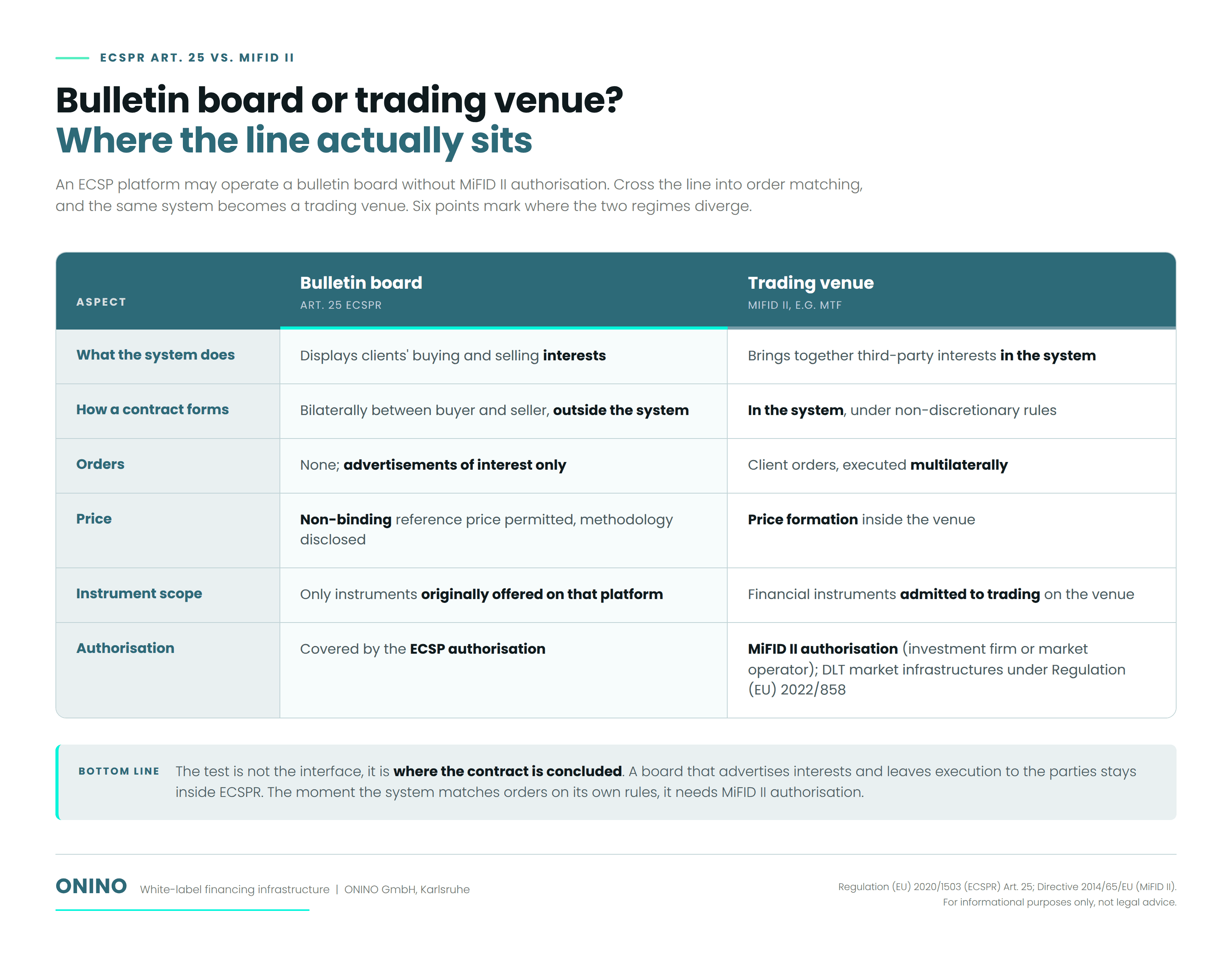
Aspect | Bulletin board (Art. 25 ECSPR) | Trading venue (MiFID II, e.g. MTF) |
|---|---|---|
What the system does | Displays clients' buying and selling interests | Brings together third-party interests in the system |
How a contract forms | Bilaterally between buyer and seller, outside the system | In the system, under non-discretionary rules |
Orders | None; advertisements of interest only | Client orders, executed multilaterally |
Price | Non-binding reference price permitted, methodology disclosed | Price formation inside the venue |
Instrument scope | Only instruments originally offered on that platform | Financial instruments admitted to trading on the venue |
Authorisation | Covered by the ECSP authorisation | MiFID II authorisation (investment firm or market operator); DLT market infrastructures under Regulation (EU) 2022/858 |
What does the bulletin-board boundary mean for the crowdfunding secondary market?
The boundary produces one clear outcome: the crowdfunding secondary market under ECSPR is, by design, a market without execution. Investors can find each other on the platform, and everything after that happens bilaterally, between buyer and seller, off the system.
Walk through what a selling investor actually experiences. They advertise their position with the original KIIS attached, an interested buyer appears, and the two negotiate a price with at most a non-binding reference point from the platform. Then comes the part the bulletin board cannot help with: completing the transfer.
Completion is a matter of national law, and it differs by instrument. In Germany a loan claim moves by assignment, with no particular form required: the friction sits in the loan agreement, which may exclude assignment altogether or require the borrower's consent, and in platform terms that add consent steps and lock-ups. Telling the borrower decides who gets paid rather than whether the assignment is valid. A security held in a custody chain moves by book entry. A claim recorded only in the platform's own ledger needs a contractual assignment plus a ledger correction that carries no effect on legal ownership by itself.
The honest consequence, and platforms should say it this plainly to their investors, is that most crowdfunding investments today change hands rarely, bilaterally, or not at all, and an investor should expect to hold to maturity. The duty to explain the nature of the bulletin board points the same way: a platform that markets its board as an exchange is misdescribing a notice space, and the description itself can become a supervisory problem. Therefore the operator's first job in this section of the product is expectation management, in the marketing copy as much as in the terms.
“Operators regularly come to us asking for a secondary market button. I usually tell them the button is the easy part, and it is also the part Article 25 already lets them build. What their investors are missing is not a place to advertise; it is an instrument that can actually change hands without a paper chase. From a technical perspective, all this can easily be implemented; the demand on the bulletin boards we see has remained quite limited. Often due to the nature of the crowd-funded asset. These often do not entice active secondary markets, as they are most often buy and hold type assets.”
Lukas Wipf (Co-Founder & CPO)
How do tokenized instruments improve the transferability of crowdfunding investments?
Tokenized instruments close the transfer gap from the instrument side. A crypto security under Germany's Electronic Securities Act (eWpG), which is the statute that lets a security exist as a register entry instead of a certificate, transfers by agreement and registration: the buyer becomes the holder when the crypto-securities register is updated, and the register entry is the authoritative record of ownership. The transfer that two investors agree on the bulletin board can therefore actually be completed, digitally and verifiably, without the platform executing anything.
The division of labour is what keeps the platform inside the rule. The bulletin board does what the regulation permits and surfaces interest, the contract is concluded bilaterally between the two clients, and the transfer is then completed in the register. That register is not the platform's to run: the crypto securities register is maintained by a BaFin-authorised registrar, and the permission sits with that partner.
Custody and cash sit with licensed partners in the same way, and one boundary is worth stating plainly because the vocabulary invites confusion. Custody of the instrument sits with a licensed crypto custodian under German banking law, because crypto securities count as financial instruments and the EU's crypto rulebook (MiCAR) leaves them out. A firm holding a MiCAR licence alone cannot take custody of such an instrument. The cash leg runs through a licensed payment institution. That leaves a three-layer licence stack which reads cleanly for the operator: the crowdfunding licence covers the bulletin board, the licensed functions around the register sit with partners, and the software connecting them needs no permission of its own.
One condition carries the whole construction and belongs in every structuring conversation: a German crypto security can be offered on a crowdfunding platform only where it counts as a transferable security under MiFID II, since the only other securities route the regulation offers, admitted instruments for crowdfunding purposes, is reserved for shares in private limited companies. A standardised electronic bearer bond ordinarily qualifies. What defeats it is not the usual transfer machinery, because whitelisting, lock-ups and consent requirements leave the instrument tradeable in the eyes of both ESMA and BaFin, but terms cut so closely to a single investor that the instrument no longer forms a class with comparable paper. Lose that qualification and you lose more than the crowdfunding route: the instrument also stops being excluded from MiCAR.
Precision also demands the negative list. Tokenization does not create demand for the instrument, does not turn the bulletin board into a venue, and does not move the line by a millimetre; a register entry makes an instrument cleanly and verifiably transferable, and it does not create a market. What changes is that when a buyer exists, the transfer completes in a register update, and the platform's asset tokenization rail plus its partner set is what makes that completion routine. On infrastructure built by ONINO, issuers have tokenized EUR 55M+ in instrument volume across live platforms in 7+ jurisdictions (ONINO platform data, August 2026), which means register-based transfers are operating practice, and what is left for the operator to solve is demand.
Can a platform offer secondary trading under ECSPR without a MiFID authorisation?
Yes, within the limits the regulation sets: a bulletin board for advertising interest, a contract concluded directly between the two clients, and completion of the transfer through the instrument's own register. What a platform cannot do without a MiFID licence is execute trades, in any packaging.
For an operator planning this, four checks cover most of the ground.
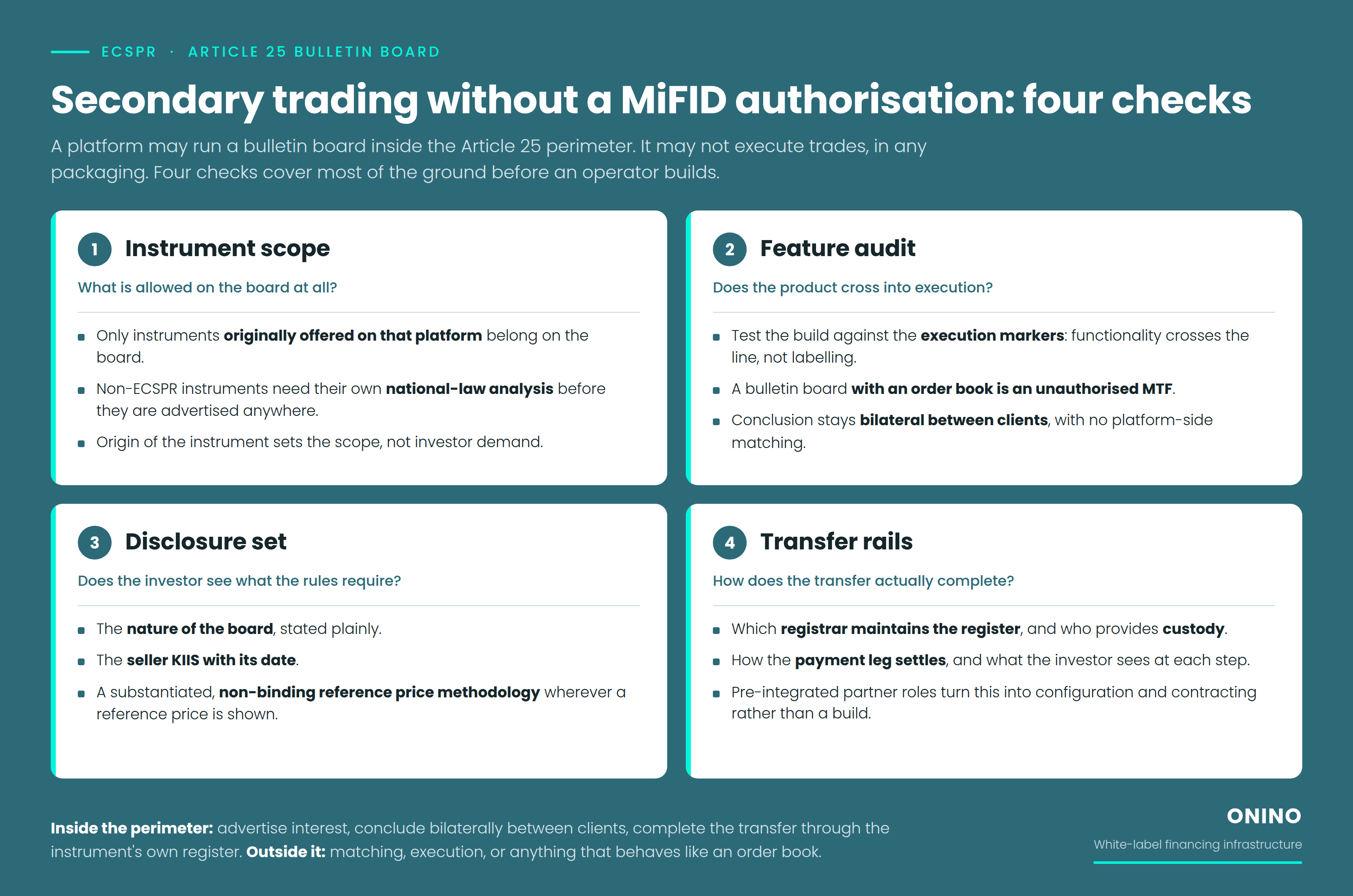
First, instrument scope: only instruments originally offered on the platform belong on the board. Anything else sits outside the crowdfunding licence, which puts it under MiFID first if it is a financial instrument, and under national law only for what MiFID does not reach.
Second, feature audit: review the product against the execution markers above, because the line sits far earlier than an order book. ESMA's opinion permits an interface that only collects and broadcasts interests. A match notification, an in-product chat, a counter-offer button: each lets one user react to another's interest, and that is already a multilateral system. The order book is the obvious failure, not the marginal one. For a platform that wants matching, the answer is a licence, since a platform also licensed as an investment firm may run a venue for its own transferable securities.
Third, the disclosure set: what the board is; the seller's original disclosure sheet carrying the month and year it was issued, which comes from ESMA guidance rather than the regulation itself; loan performance data for prospective loan buyers; the standard investor-protection information and risk warning for non-sophisticated buyers; ownership-change notification where you hold the assets; and a substantiated, non-binding reference price methodology if a price is shown. No EU rule prescribes that methodology, so the substantiation is yours to defend.
Fourth, the transfer rails: which registrar maintains the register, who provides custody, how the payment leg settles, and what the investor sees at each step. The regulation lets a platform move ownership by updating its own systems where national law permits, and in Germany that means transfer by agreement plus a register entry, which makes the registrar a structural dependency rather than a vendor choice. Settling an agreed trade is permitted; only matching before the trade is not. Where those partner roles are pre-integrated into the platform infrastructure, switching on register-based transfers is a configuration and contracting exercise measured in weeks rather than the months it takes to assemble registrar, custodian and payment partner from scratch. That gap is the difference between a feature this quarter and a project next year, which is why the partner question belongs in the build decision.
Ultimately the strategic point for platform operators is quiet but real: nobody has built the definitive ECSPR secondary market, because the regulation does not allow one inside a crowdfunding licence. Of the four checks, the transfer rails deserve the most attention. Advertising interest is permitted and comparatively cheap to build, whereas completion is the step that decides whether an investor ever gets out, and completion depends entirely on the instrument and the licensed partners behind it. What the regulation does allow, advertising of interest plus instruments that transfer cleanly through licensed register infrastructure, is available today on white-label platform infrastructure with the partner roles already connected.
The next move therefore sits with the operator and its registrar, custody and payment partners. If you operate a crowdfunding platform and want to see how a compliant bulletin board and register-based transfers fit your instrument set, the full build sequence is set out in our guide to launching a crowdfunding platform under ECSPR.
This article is for general information only and does not constitute legal or investment advice.
General information only, accurate at the date shown. Not legal, tax or investment advice. Confirm your own position with qualified counsel.
Want to learn more how this can be applied to your business?
Read related Articles
Secondary trading under ECSPR: what the Article 25 bulletin board permits, where the MiFID venue line runs and how tokenization makes investments transferable.


