Regulation
White-Label Crowdfunding Software Under ECSPR: The Fastest Route to Market (2026)
ECSP authorisation requires a working platform, not a plan. Build vs buy costs, ECSPR platform requirements, and how white-label software speeds up launch.

Kristina Stark
Growth Manager
last updated on
Share
90% of Clients start with a free personal strategy
On this page
Contact Us
ONINO provides infrastructure for digital & tokenized financing to make your next financing a success.
Key Takeaways
The regulator grades your platform, not your plan. An ECSP licence application is assessed against software that already works, so building it in-house means spending 6 to 12 months and EUR 150,000 to 250,000+ in development, plus a further EUR 30,000 to 100,000 in licence and legal work, before the review even begins. Proven white-label crowdfunding software turns that phase into configuration measured in weeks rather than quarters. Build versus buy is therefore a question about revenue: how many months of it are you willing to give up? Figures in this article are indicative industry ranges, and no vendor can guarantee an authorisation outcome.
Most guides to ECSPR walk through the licence: the capital floor, the EUR 5 million cap per project owner over 12 months, the single-licence passport across the EU. All of it is true, and none of it answers the question a founder actually asks, which is how soon they can be live. The answer sits in a dependency hidden inside the application itself.
The application has to describe the platform the business will run on, so the choice of white-label crowdfunding software sets the timeline before the regulator reads a single page.
Under Article 12, a national competent authority does not authorise a business plan. Your own financial regulator assesses systems, procedures, and controls that must already exist and already work. So the platform is not something you build after getting licensed. It is evidence in the application.
That evidence problem is the single biggest driver of time to market for new crowdfunding service providers, and it is the problem white-label investment infrastructure was designed to remove. This article answers the question in three steps, each one more technical than the last: what ECSPR actually requires your technology to prove, what the build and buy routes cost in money and months in 2026, and how to evaluate a white-label provider if speed is what you are buying.
The ECSPR Licensing Catch: No Platform, No Licence
Article 12 of Regulation (EU) 2020/1503 sets out what a complete application file has to contain, and the list reads more like a product specification than a form:
A programme of operations.
Governance arrangements.
A description of the systems.
Resources, and procedures for controlling and safeguarding data processing.
Business continuity arrangements.
Internal procedures covering due diligence, complaints, conflicts of interest, and record-keeping.
Since 17 January 2025, the ICT components of that file must also align with DORA, the EU's digital operational resilience regime for financial entities.
Read that list again from the supervisor's side of the desk. Almost every item describes something your platform must demonstrably do, not something you intend it to do. Appropriateness testing, investment-limit enforcement, KIIS workflows, and payment segregation are all inspected as working arrangements. An applicant who cannot show them collects rounds of follow-up questions instead, and every round resets the clock.
That clock is where the regulation and reality part company. The statutory assessment period is three months from a complete file, but practice varies widely between regulators: roughly three to five months in Lithuania and Estonia, against six to nine months in Germany, France and Spain, once the completeness check and the regulator's back-and-forth are priced in. The time to market for a crowdfunding platform is therefore decided before the statutory clock starts, by how long it takes you to put a demonstrable platform in front of the regulator.
Route | Time to demonstrable platform | Time to authorisation (realistic) | Total time to market |
|---|---|---|---|
Build in-house | 6 to 12 months | 6 to 9 months | 12 to 21 months |
Battle-tested white-label | 2 to 6 weeks of configuration | 6 to 9 months | 7 to 10 months |
Read that table by column rather than by row. The authorisation column barely moves, because the regulator's clock runs the same whoever wrote your software. It uses the six-to-nine-month case of the larger markets, so a Lithuanian or Estonian application shortens both totals by the same few months. The build column is where a year disappears, and it is a year in which you carry a full development team, pay legal advisers to re-review each iteration, and generate no revenue. Timeline and cost ranges in this article are indicative, drawn from published vendor and market guides, and vary with scope and jurisdiction.
Above all, a licence needs a platform to run on: advisory work, legal work and the build itself, whether in house or on white-label financing infrastructure, are all larger and far more variable lines than the official fee.
ECSPR Platform Requirements: What Your Technology Must Prove
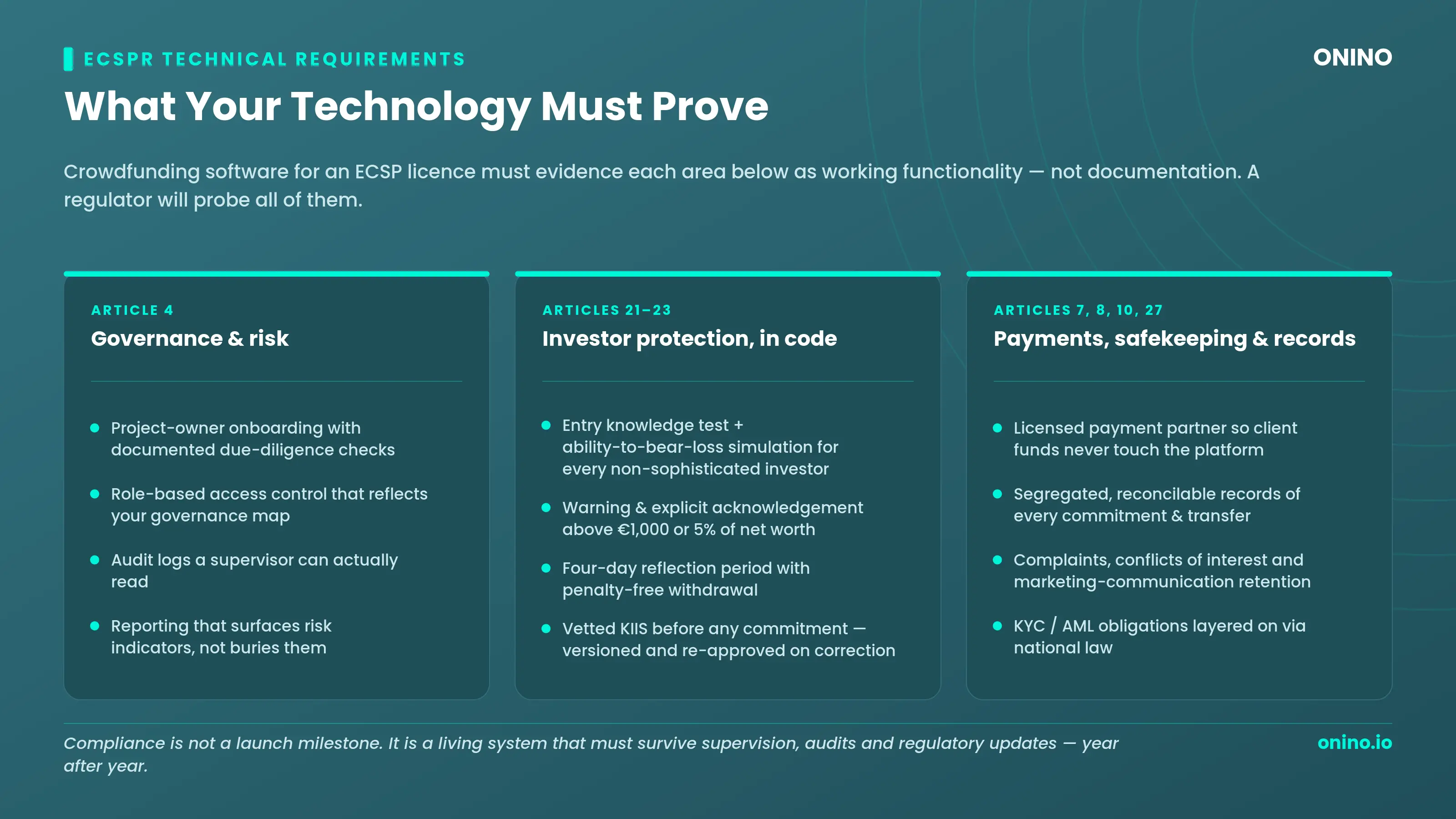
The year disappears because the ECSPR licence technical requirements are wider than most founders expect. Crowdfunding software for an ECSP licence has to evidence each of the three areas below, and a regulator will probe all of them as working functionality rather than documentation.
Article 4 Governance and Risk Management
Article 4 asks for effective and prudent management, which comes down to three things: defined responsibilities, due diligence on the project owners whose offers you host, and a risk framework proportionate to the complexity of your business. Translated into platform terms, that is a project-owner onboarding workflow with documented checks, role-based access control that reflects your governance map, audit logs a supervisor can actually read, and reporting that surfaces risk indicators rather than burying them in a database. Generic marketplace software ships with none of it, so all four become build items sitting on your critical path.
Investor Protection Written in Code
ECSPR's investor-protection provisions are not policies, they are product features. A compliant platform must run an entry knowledge test and a simulation of the ability to bear loss for every non-sophisticated investor, warn and require explicit acknowledgement when an investment exceeds the greater of EUR 1,000 or 5 percent of the investor's net worth, enforce a four-day pre-contractual reflection period during which the investor can withdraw without penalty, and display a vetted Key Investment Information Sheet before any commitment.
Each of those four carries edge cases, and the edge cases are what regulators actually check: what happens when an investor retakes the test, how a withdrawal during the reflection period unwinds a payment, and how a KIIS correction is versioned and re-approved. Those are the questions a supervisor asks, which is why a feature list is not evidence.
Payments, Safekeeping, and Records
Crowdfunding providers either hold a payment-services authorisation or, far more commonly, integrate a licensed payment partner so that client funds never touch the platform's own accounts. The platform must keep segregated, reconcilable records of every commitment and transfer, handle complaints through a documented workflow under Article 7, manage conflicts of interest under Article 8, keep every service and transaction record on a durable medium for at least five years under Article 26, and hold marketing communications to the fair, clear and not misleading standard of Article 27. Layer the KYC/AML obligations that apply through national law on top, and the record-keeping surface alone becomes a significant engineering project.
That surface is where platforms are already coming unstuck. Compliance reviews by EUROCROWD, the European crowdfunding industry association, have repeatedly found platforms struggling to meet core ECSPR requirements in practice, which is a qualitative finding rather than a measured rate, and enough to make the point. Compliance is not a launch milestone for a new entrant. It is a living system that has to survive supervision, audits, and regulatory updates year after year, which is a strong argument for infrastructure maintained by a team whose only job is keeping it current.
Build vs Buy Crowdfunding Platform: The 2026 Numbers
Dimension | In-house build | Battle-tested white-label |
|---|---|---|
Upfront cost | EUR 150,000 to 250,000+ development before launch, plus EUR 30,000 to 100,000 advisory and legal work | Setup fee plus subscription, typically low-to-mid five figures per year |
Time to demonstrable platform | 6 to 12 months | 2 to 6 weeks |
Compliance logic | Designed, coded, and proven from scratch | Pre-built by the vendor for ECSPR workflows, with maturity to be evidenced case by case |
Regulator's view of the system | Unknown quantity, more follow-up rounds | An established system type, provided the vendor can evidence comparable cases |
Team required | Product, engineering, and compliance hires | Vendor team plus your compliance owner |
First revenue | After build and authorisation complete | Months earlier, application runs in parallel |
The cost gap in the top row is real, and it is not the decisive number. The decisive number is the revenue delay: a platform that launches nine months earlier starts building deal flow, investor base, and track record nine months earlier, which is the same spread as the 12-to-21 months against 7-to-10 months in the first table. In a market where angel networks and investor clubs are formalising deal flow at pace, being second into a niche is expensive.
The Honest Risks of White-Label, and How to De-Risk Them
A fair comparison lists the failure modes on both sides. White-label buyers face three: vendor lock-in if the contract offers no exit path, fee stacking when payment, KYC, and e-signature providers are fixed by the vendor, and roadmap dependency if the vendor pivots away from your segment. None of these is hypothetical.
However, all three are addressable in procurement rather than in hope. Insist on data-export and source-code or escrow provisions, agree exit and transition-support terms in the contract itself rather than trusting a roadmap, review which third-party integrations can be swapped, and weigh the vendor's track record and client concentration before signing. A vendor that has supported multiple ECSP authorisations and serves your segment, whether that is real estate developers running a project pipeline or private markets operators managing parallel raises, has structural reasons to keep the compliance layer current.
What a Battle-Tested Platform Changes for Your Application
The practical difference shows up in the application file itself. A mature white-label platform arrives with the systems descriptions, security documentation, and process diagrams that Article 12 asks for, already written and refined across earlier client applications, so your advisers adapt documents instead of drafting them. Every NCA assesses every application independently and no vendor can promise an outcome. What a familiar system type buys you is fewer follow-up rounds than one built from scratch, and follow-up rounds are what reset the clock.
Those rounds also decide your critical path. With infrastructure that configures in weeks, licence preparation and platform setup run in parallel: your legal team assembles the Article 12 file while the platform is branded, connected to your payment partner, and loaded with your investment products. Build first and apply second, and every development delay becomes a licensing delay instead. That parallel track is exactly how ONINO's white-label infrastructure is deployed, from investor onboarding and appropriateness testing through subscription flows to a central, auditable investor record, for operators ranging from banks entering digital distribution to first-time platform founders.
How to Choose the Best White-Label Crowdfunding Platform
The best white label crowdfunding platform for an ECSP applicant is not the one with the longest feature list, it is the one that survives regulatory scrutiny. So evaluate providers against the requirements the regulator will test rather than the ones a sales deck volunteers. Six questions separate battle-tested infrastructure from a rebranded marketplace template:
Which ECSPR mechanics are native: investor tiering, entry test, loss simulation, investment-limit warnings, four-day reflection period, KIIS creation and approval workflow?
What is the vendor's track record with ECSP applicants, and in which jurisdictions?
Is the documentation pack (systems description, security architecture, DORA-aligned ICT policies) available to drop into an Article 12 file?
Which payment and KYC partners are integrated, and can they be exchanged?
What are the exit terms: data export, source-code escrow, transition support?
Who maintains regulatory updates, and how fast did the provider ship DORA alignment?
A provider that answers all six in writing, with references, is selling infrastructure. A provider that answers with a feature tour is selling software, and the difference becomes visible the day your regulator asks its first hard question.
Launch in Weeks, Not Quarters
Ultimately, one number on this page decides the outcome, and it is not the cost. It is the time to a demonstrable platform, because that is the only figure in either table your build-versus-buy decision actually moves. Six to nine months of authorisation is fixed whichever route you take. Two to six weeks against 6 to 12 months is not, and that gap is the whole argument.
So the next decision belongs to the founder reading this, and it is not which vendor to sign. It is where to incorporate, which regulator to apply to, and which licensed partners to connect before you file. Those are the next six steps, with a month-by-month timeline and a downloadable ECSPR licence checklist, in our ECSPR playbook for starting a crowdfunding platform in Europe. Read it alongside the six vendor questions above and you have both halves of the launch: the licence path, and the platform that has to survive it.
General information only, accurate at the date shown. Not legal, tax or investment advice. Confirm your own position with qualified counsel.
Want to learn more how this can be applied to your business?
Read related Articles
ECSP authorisation requires a working platform, not a plan. Build vs buy costs, ECSPR platform requirements, and how white-label software speeds up launch.


